

Metrics explained
Power-to-weight ratio (W/kg): why it decides climbs and Zwift races
Watts per kilogram divides your power by your body weight. On climbs and in virtual racing it predicts performance better than raw watts.
Written by MoveVitals Editorial Collective
Community-authored educational content. Individual clinical review is identified only when a named review is actually recorded.
Editorial standards & corrections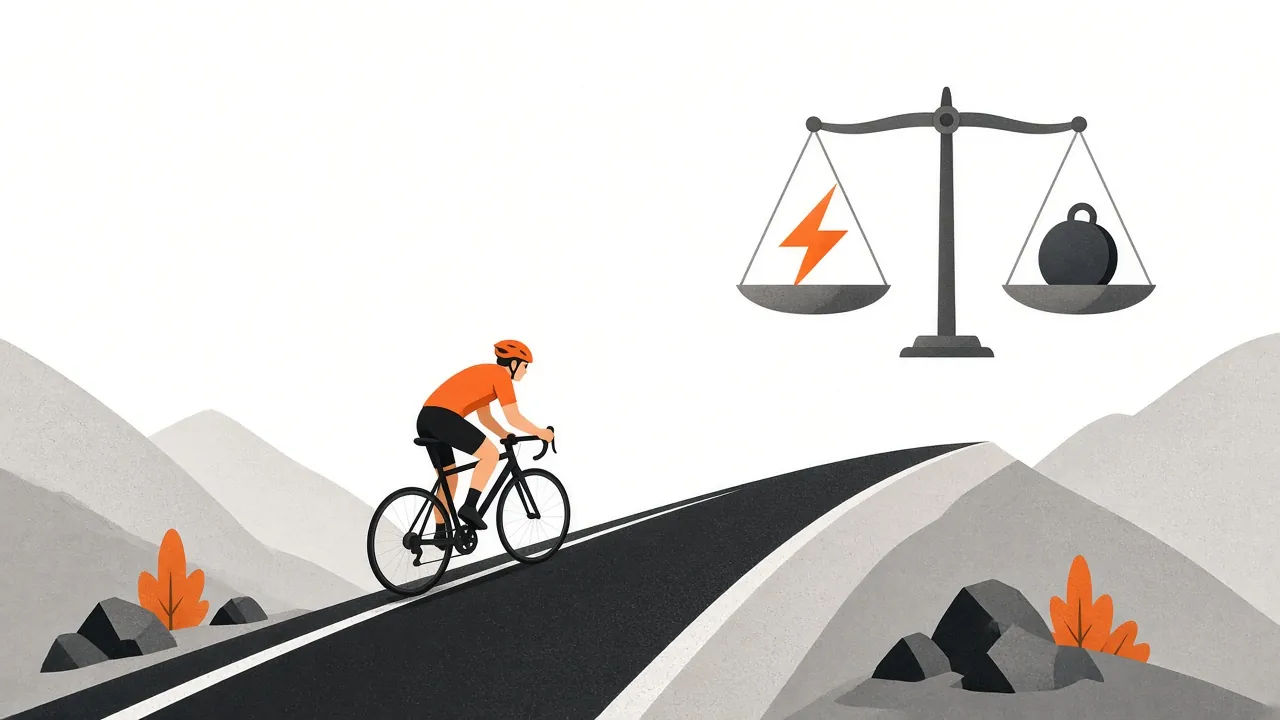
Key takeaways
- A rider with a 260 W FTP weighing 70 kg has 3.7 W/kg at threshold.
- Zwift-style categories put A at 4.0 W/kg or more, B at 3.2–4.0, C at 2.5–3.2 and D below 2.5, and many recreational riders sit around 2–3.5 W/kg at FTP.
- Structured training improves FTP by 5–20 % in a season for many riders, so raise power first and use absolute watts for flats and time trials.
- If losing weight, aim for under about 0.5 kg a week and keep fuelling training, because chronically low energy availability harms hormones, bones and performance.
Power-to-weight (W/kg) = power (W) ÷ body weight (kg). A rider with a 260 W FTP weighing 70 kg has 3.7 W/kg at threshold.
Why it matters
- Climbing: on steep gradients gravity dominates, so speed is roughly proportional to W/kg.
- Flat roads: aerodynamics dominate; absolute watts and a low drag position matter more.
- Zwift: race categories are based on W/kg (and, in newer systems, on a combination of power durations), and the game uses your entered weight. An accurate weight is a matter of fair play.
Category guide (FTP W/kg, Zwift-style)
| Category | W/kg |
|---|---|
| A | ≥ 4.0 |
| B | 3.2–4.0 |
| C | 2.5–3.2 |
| D | < 2.5 |
Improving W/kg sensibly
- Raise power first. Structured training improves FTP by 5–20 % in a season for many riders.
- Lose fat, not muscle, if you have excess body fat: a slow deficit with adequate protein.
- Avoid under-fuelling. Chronically low energy availability harms hormones, bones and performance (RED-S). Fuel your training — see carbohydrate fuelling.
- Measure consistently: same scale, same time of day.
In MoveVitals
MoveVitals combines your latest prioritised weight from a Withings or Garmin scale with ride power from Zwift, Magene or a power meter, so W/kg stays accurate as your weight changes.
Worked example
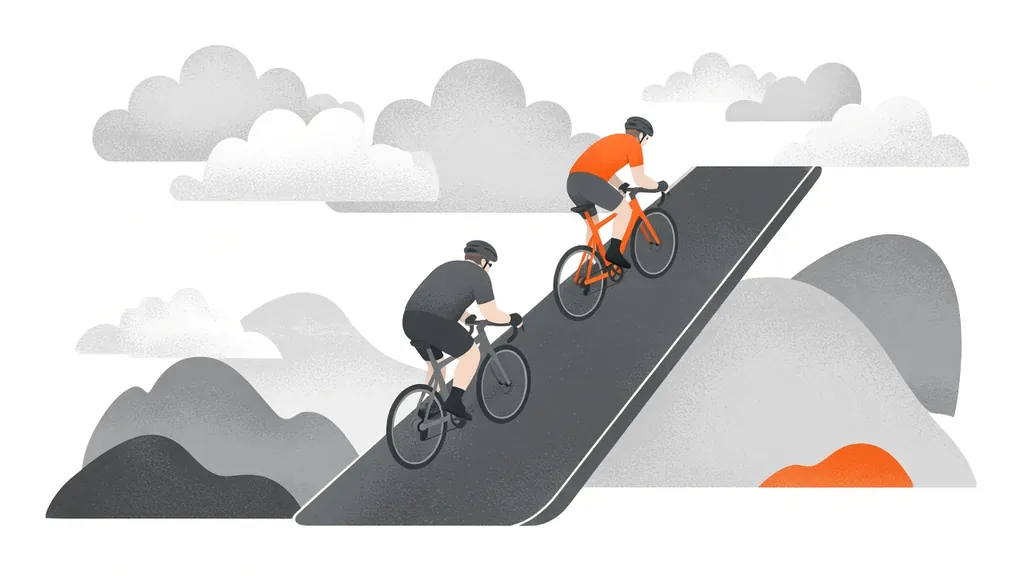
Worked calculation. Rider A has an FTP of 260 W and weighs 80 kg: 260 ÷ 80 = 3.25 W/kg. Rider B has 230 W at 65 kg: about 3.54 W/kg. On a flat road Rider A's higher absolute power and aerodynamics matter more, but on a long 7% climb Rider B will usually be faster. If Rider A raises FTP to 275 W (+6%) while staying at 80 kg he reaches 3.44 W/kg. In this illustration, gaining power through training is safer and more sustainable than aggressive weight loss, which risks low energy availability and lost power.
Action steps
- Test FTP (e.g., a 20-min test × 0.95) and weigh in the morning on the same day.
- Calculate W/kg = FTP (W) ÷ body mass (kg).
- Prioritise raising power with threshold and VO2max work.
- If losing weight, aim for a slow rate (under ~0.5 kg/week) and keep fuelling training.
- Use W/kg for climbs and Zwift categories; use absolute watts for flats and time trials.
Related guides
- FTP (functional threshold power): what it is and how to test it
- Zwift with MoveVitals: indoor rides and runs via Strava
- Body weight: why daily numbers jump and how to read the trend
- Sweet spot and threshold training: raising your FTP
- Road cycling training plan: an 8–12 week structure, from your first 100 km to a gran fondo
FAQ
Should I diet to raise W/kg? Only if you have meaningful excess fat, and slowly. Power gains are safer and usually larger.
Does bike weight count? Not in W/kg, but on real climbs total system weight (rider + bike) matters.
What is a good W/kg for an amateur? Ranges vary widely; many recreational riders sit around 2–3.5 W/kg at FTP, and racing amateurs often 3.5–4.5.
Should I include bike weight? For climbing speed total system mass matters, but W/kg conventions use body mass only.
Does Zwift use W/kg? Yes, its race categories are based mainly on W/kg, which is why accurate weight entry matters.
References
- Jobson et al. (2009). The Analysis and Utilization of Cycling Training Data. Sports Medicine. https://doi.org/10.2165/11317840-000000000-00000
- Thomas et al. (2016). Position of the Academy of Nutrition and Dietetics, Dietitians of Canada, and the American College of Sports Medicine: Nutrition and Athletic Performance. Journal of the Academy of Nutrition and Dietetics. https://doi.org/10.1016/j.jand.2015.12.006
For general information only. This is not medical advice — talk to a qualified professional about your health.
Keep reading
Devices & setup
Strava and MoveVitals: workouts, streams and devices that arrive via Strava
3 min read
Training science
Zone 2 training: the science and how to do it right
4 min read
Training science
Sweet spot and threshold training: raising your FTP
3 min read
Devices & setup
How MoveVitals handles multiple devices: provenance, duplicates and conflicts
5 min read
Training science
Interval training and HIIT: designing sessions that work
4 min read
Devices & setup
Withings and MoveVitals: scales, blood pressure and sleep
3 min read