

Training science
Faster 5K: a training plan to break 25, 22 or 20 minutes
A faster 5K comes from a simple weekly template (one interval session, one threshold run, easy running with strides and a long run) built over 8–10 weeks around a 5K race pace you can actually hold. This plan gives the paces for 25, 22 and 20 minutes.
Written by MoveVitals Editorial Collective
Community-authored educational content. Individual clinical review is identified only when a named review is actually recorded.
Editorial standards & corrections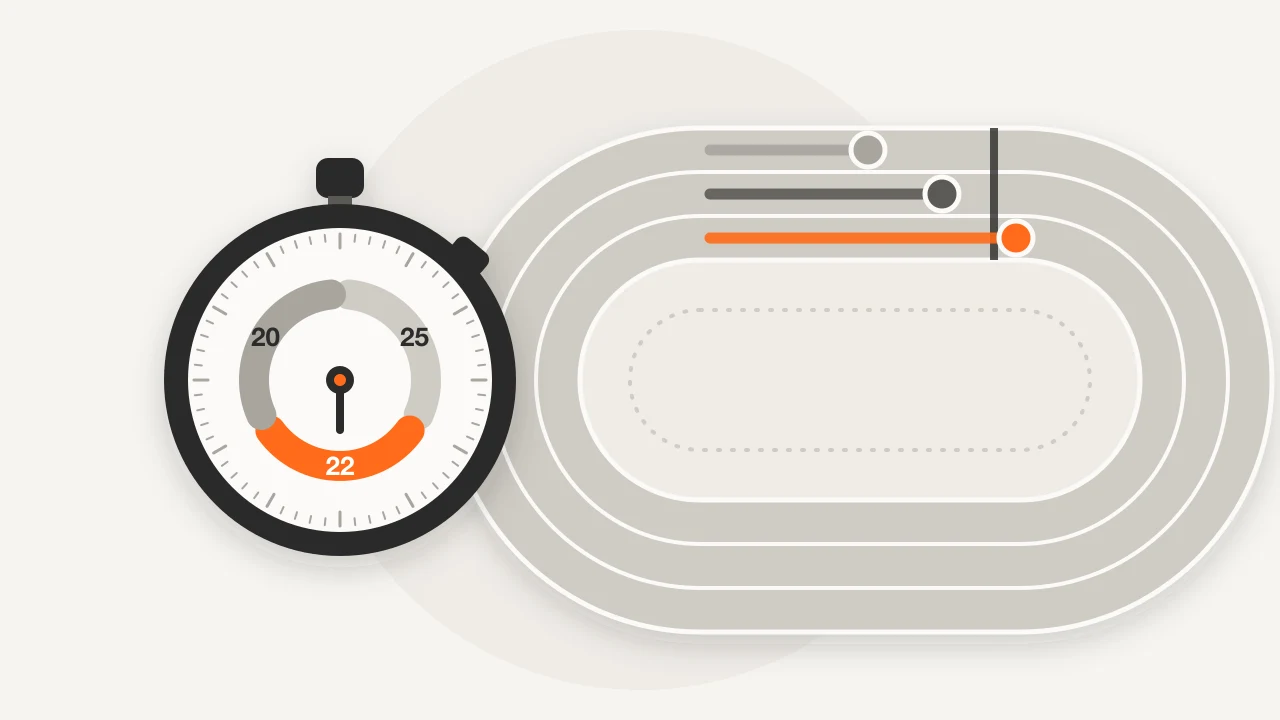
Key takeaways
- One 8–10 week block usually takes a few percent off a 5K, so choose a goal about 3–6 % faster than a recent result, not an old or best-ever time.
- Target 5K race paces are 5:00/km for 25:00, 4:24/km for 22:00 and 4:00/km for 20:00; aiming at 4:58/km gives 24:50 and finishes under the mark.
- Two hard days a week are the limit: intervals such as 6 × 800 m and 20–30 minutes at threshold, with every other run easy.
- A 5K taper lasts 7–10 days, cuts volume by roughly 30–50 % and puts the last hard session 4–6 days before the race.
This 5K training plan for intermediate runners assumes you can already run 30 minutes without stopping. If you are still getting there, start with the from zero to 5K plan; if you want more distance later, see the 10K training plan.
How fast is realistic? Your 5K race pace and target paces
Improvement in a single 8–10 week block is usually a few percent, not a leap. A goal about 3–6 % faster than your current 5K is realistic; 26:15 to 25:00 is roughly 5 %, while 30:00 to 20:00 is a multi-year project. No recent 5K? A 10K time divided by about 2.1 is a rough equivalent.
| Goal | Current 5K that makes it realistic | Runs per week | Weekly distance | Longest run |
|---|---|---|---|---|
| Under 25:00 | about 26:00–26:30 | 4 | 30–40 km | 60–75 min |
| Under 22:00 | about 22:45–23:15 | 4–5 | 40–55 km | 70–80 min |
| Under 20:00 | about 20:40–21:00 | 5–6 | 50–70 km | 75–90 min |
To finish under the mark, aim a little faster than the round number: 4:58/km gives 24:50, 4:22/km gives 21:50 and 3:58/km gives 19:50.
| Goal | 5K race pace per km (per mile) | 400 m at race pace | Interval pace | Threshold pace | Easy pace |
|---|---|---|---|---|---|
| 25:00 | 5:00 (8:03) | 2:00 | 4:55–5:00 | 5:15–5:25 | 6:10–6:50 |
| 22:00 | 4:24 (7:05) | 1:46 | 4:18–4:24 | 4:40–4:50 | 5:35–6:15 |
| 20:00 | 4:00 (6:26) | 1:36 | 3:55–4:00 | 4:15–4:25 | 5:10–5:50 |
Treat these as starting points per km. Easy running should stay conversational (RPE 3–4, zone 2) even when that is slower than the table.
The weekly template: intervals, threshold, easy runs and a long run
| Session | What it looks like | Effort |
|---|---|---|
| Intervals | 6 × 800 m or 5 × 1,000 m at interval pace, 90 s to 2 min jog; 15 min warm-up first | RPE 8, hard but even (interval training) |
| Threshold | 20–30 min in total, such as 3 × 8 min with 2 min jog or 20 min continuous | RPE 6–7, comfortably hard (tempo runs) |
| Easy runs plus strides | 30–60 min easy, then 4–6 × 15–20 s relaxed fast strides | RPE 3–4 |
| Long run | 60–80 min easy (the long run) | RPE 3–4 |
| Strength | 1–2 sessions of 20–30 min (strength for endurance) | Moderate |
A four-run week: Tuesday intervals, Thursday threshold, Saturday easy with strides, Sunday long. A fifth run is an easy day on Monday or Wednesday. Leave at least 48 hours between hard sessions and keep about 80 % of your running easy (polarized training); a rise of roughly 10 % a week is a common guard-rail, not a proven limit.
An 8–10 week 5K training plan
| Weeks | Phase | Interval session | Threshold session | Long run |
|---|---|---|---|---|
| 1–3 | Base and speed | 8 × 400 m at interval pace, 60–75 s jog | 3 × 6 min | 60 min |
| 4–6 | Build | 6 × 800 m, then 5 × 1,000 m, 90 s jog | 3 × 8 min | 65–75 min |
| 7–8 | Race-specific | 4 × 1,200 m or 3 × 1,600 m at goal pace, 2 min jog | 20 min continuous | 70–80 min |
| 9–10 | Sharpen and taper | One short session, such as 4 × 400 m at goal pace | 2 × 6 min | 50–60 min, then rest |
Make week 4 a little lighter (about 20 % less distance) if you feel flat. Every rep should be close to the same time; if the last one is much slower than the first, the pace was too fast.
What your watch can and cannot tell you
- GPS on a track. Distance wobbles on a 400 m oval, and each lane further out adds roughly 7–8 m a lap. Use a track mode if your watch has one, or press lap at the markers (running pace).
- Wrist heart rate in intervals. Optical sensors tend to lag in short, hard efforts and are generally less accurate than chest straps during vigorous movement (Bent 2020). Run reps by pace and RPE, and read the lap-average heart rate afterwards; use a chest strap if you want it live.
- Easy days. Keep heart rate in zone 2 and watch pace at the same heart rate improve over weeks. In the race itself, heart rate climbing close to your maximum in the last kilometre is normal.
- VO₂ max and race predictions. These are estimates; follow their trend, not a single number (VO2 max).
- Recovery. If HRV is well below your usual range for several days and resting heart rate is up a few beats, swap the hard session for an easy run (HRV, resting heart rate).
Taper, warm-up and pacing
Taper for 7–10 days: cut volume by roughly 30–50 %, keep some fast running and do the last hard session 4–6 days out (see tapering). Warm up with 10–15 minutes easy, a few drills and 3–4 strides, finishing 5–10 minutes before the start (warm-up routine). Run the first kilometre at goal pace or 2–3 s slower, hold it through kilometres 2–4 and push in the last one (race pacing).
Common mistakes
- Running easy days too fast, which leaves no energy for the two sessions that matter.
- Starting intervals faster than goal pace so the last reps fall apart.
- Setting the goal from an old or best-ever 5K.
- Adding a third hard session or stacking hard days back to back.
- Skipping the warm-up and strides, or going out 10 s/km too fast in the race.
Add intervals gradually and run them on flat ground; persistent sharp pain, especially in the shin or Achilles, means stop and see a clinician (injury prevention for runners).
In MoveVitals
Runs from Strava, Garmin, COROS, Polar and Suunto, plus Apple Watch workouts you share to Strava, merge into one weekly view without duplicates. Lap splits from Strava and Suunto let you compare every rep in a session, and the pace and heart rate streams show easy pace at the same heart rate over weeks. HRV and resting heart rate from WHOOP, Oura, Garmin, Polar or COROS sit beside the week so you can check recovery before a hard day.
Worked example
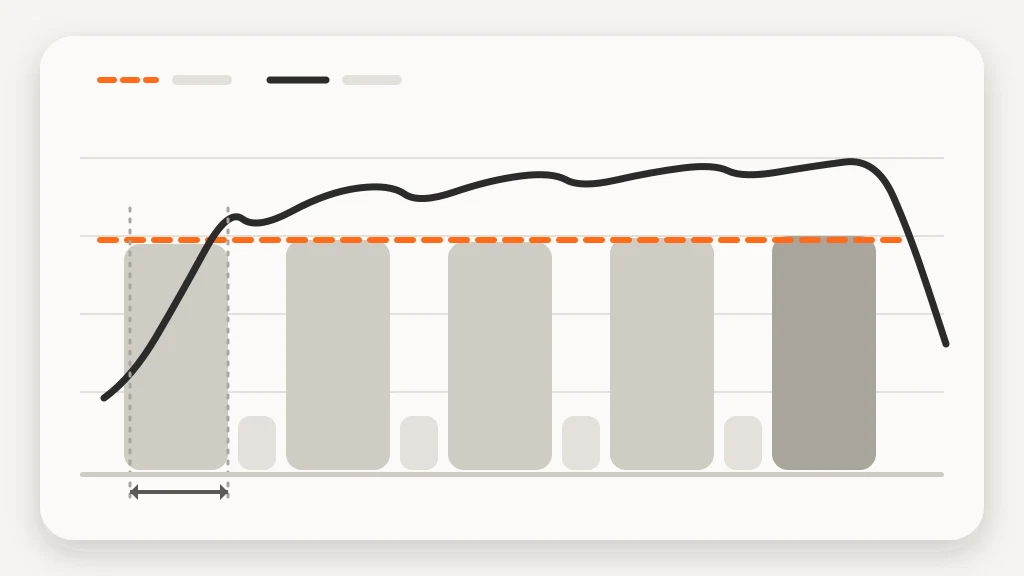
Illustrative scenario. Nina, 34, ran a parkrun in 23:10 (4:38/km) and wants to break 22:00 (4:24/km), about 5 % faster, in 10 weeks. She runs four times a week, building from 38 to 46 km, with easy runs at 5:45–6:15/km and heart rate around 143–150 bpm. In weeks 4–5 her Tuesday session is 6 × 800 m in 3:28 (4:20/km); in week 6 it is 5 × 1,000 m at 4:22, and in weeks 7–8 it becomes 3 × 1,600 m at 4:24 (7:02). On Thursdays she does 3 × 8 min at 4:50/km. On the 800s her wrist reads 158 bpm in the first rep and 176 at the end, so she paces by RPE 8 and reads the lap averages afterwards. In week 6 her resting heart rate is 6 bpm up and HRV is low for three days, so she runs easy and does the session later. She tapers for eight days, cutting distance by about 40 %, with 4 × 400 m at 1:44 five days out. On race day her splits are 4:25, 4:24, 4:23, 4:24 and 4:20: 21:56. Figures are illustrative.
Action steps
- Take a recent 5K (or a 10K ÷ 2.1), choose a goal about 3–6 % faster and pick easy, threshold and interval paces from the table.
- Run four times a week (five if you already do): one interval session, one threshold run, easy runs with strides and one long run, never more than two hard days.
- Follow the 8–10 week block, moving from base to build to race-specific work, with a lighter week 4.
- Pace reps by effort and lap average heart rate, and check HRV and resting heart rate before hard days.
- Taper for 7–10 days, warm up properly and start the first kilometre at goal pace.
Related guides
- From zero to 5K: a beginner's running plan
- Interval training and HIIT: designing sessions that work
- Tempo runs: how fast, how long and why they work
- Race pacing: why even splits usually win
- 10K training plan: pace, key sessions and how to get faster
FAQ
How long does it take to run a faster 5K? An 8–10 week block typically takes a few percent off a recent time. Bigger drops, such as 30:00 to 25:00, usually take several blocks.
How do I run a 5K in under 25 minutes? Hold 4:58/km (24:50). Train with one interval session, one threshold run, easy runs and a weekly long run for 8–10 weeks, starting from about 26:00–26:30.
How many days a week should I run to get faster? Four is a good number for most runners; five suits a sub-22 or sub-20 goal. Only two of those runs should be hard.
Is a sub-20 5K realistic? It means 4:00/km. It usually needs 50 km or more a week and a history of regular training, so treat it as a multi-block goal unless you are already near 21:00.
What is the best 5K race pace strategy? Start at goal pace or a touch slower, hold it through the middle and finish hard. Even or slightly negative splits are the norm.
References
- Seiler (2010). What is Best Practice for Training Intensity and Duration Distribution in Endurance Athletes?. International Journal of Sports Physiology and Performance. https://doi.org/10.1123/ijspp.5.3.276
- Esteve-Lanao et al. (2007). Impact of Training Intensity Distribution on Performance in Endurance Athletes. The Journal of Strength and Conditioning Research. https://doi.org/10.1519/R-19725.1
- Billat (2001). Interval Training for Performance: A Scientific and Empirical Practice. Sports Medicine. https://doi.org/10.2165/00007256-200131010-00002
- Laursen and Jenkins (2002). The Scientific Basis for High-Intensity Interval Training. Sports Medicine. https://doi.org/10.2165/00007256-200232010-00003
- Bosquet et al. (2007). Effects of Tapering on Performance. Medicine & Science in Sports & Exercise. https://doi.org/10.1249/mss.0b013e31806010e0
- Bent et al. (2020). Investigating sources of inaccuracy in wearable optical heart rate sensors. npj Digital Medicine. https://doi.org/10.1038/s41746-020-0226-6
For general information only. This is not medical advice — talk to a qualified professional about your health.
Keep reading
Training science
Zone 2 training: the science and how to do it right
4 min read
Training science
Polarized training (80/20): easy most of the time, hard some of the time
4 min read
Training science
Interval training and HIIT: designing sessions that work
4 min read
Sports
Trail running with a watch: heart rate, climbs and pacing by effort
7 min read
Mobility & stretching
Mobility vs flexibility: what's the difference and what do you need?
3 min read
Devices & setup
Strava and MoveVitals: workouts, streams and devices that arrive via Strava
3 min read