

Training science
Ultramarathon training: 50K to 100 miles, volume, back-to-backs and fuelling
Ultramarathon training builds on a marathon base with more time on feet rather than more speed: weekly volume of roughly 50–110 km, back-to-back long runs, a walking plan, rehearsed fuelling and a watch set up to last the whole race.
Written by MoveVitals Editorial Collective
Community-authored educational content. Individual clinical review is identified only when a named review is actually recorded.
Editorial standards & corrections
Key takeaways
- From a marathon base, plan about 14–18 weeks and a 7–10 hour peak week for a 50K, 18–24 weeks and 10–14 hours for 100 km, and 20–30 weeks and 12–16 hours for 100 miles.
- Power-hike steeper climbs from the start, since many runners switch above roughly 10–15 % grade, and plan by hours and ascent rather than distance.
- Start at 40–60 g of carbohydrate an hour, move towards 60–90 g only if rehearsals show your gut copes, and drink to thirst.
- Full-GPS mode on many sports watches lasts roughly 20–40 hours, less in the cold, so test the battery before race day.
- Dark urine with severe muscle pain or swelling, a fever, or pain that keeps worsening are reasons to see a doctor after the race.
If you have never raced a marathon, start with marathon training. This is general guidance, not medical advice; see a doctor before a first ultra if you have heart, joint or other health concerns.
Ultra marathon training plan: how weeks and volume change from 50K to 100 miles
| Race | Plan length from a marathon base | Typical weekly volume | Peak long run / back-to-back | Time on feet in the peak week |
|---|---|---|---|---|
| 50K | 14–18 weeks | 50–80 km | 3–4 h; 2 × 2–3 h | 7–10 h |
| 80 km (50 miles) | 16–20 weeks | 60–100 km | 4–5 h; 3 h + 2–3 h | 9–12 h |
| 100 km | 18–24 weeks | 70–110 km | 4–6 h; 3–4 h + 2–3 h | 10–14 h |
| 100 miles (160 km) | 20–30 weeks | 80–130 km | 5–6 h; 4 h + 3 h | 12–16 h |
These are common coaching ranges, not proven prescriptions: many finishers train less and walk more, and a mountain course takes far longer per kilometre. A 50K ultra training plan is mostly a marathon plan with a longer long run and more hills; 100 mile ultra training adds time on feet and night practice. Coaches commonly suggest a marathon (or a year of regular running) before a first 50K, and a 50K–50 miler before a 100-miler.
Build in four phases: base (6–8 weeks of easy running, hills and strength), build (8–10 weeks as volume and back-to-backs grow), peak (2–3 weeks with the biggest back-to-backs and one or two full dress rehearsals) and taper (2–3 weeks, volume down about 40–60 %, see tapering). Raising volume by roughly 10 % a week is a guard-rail, not a proven limit, and a lighter week every 3–4 weeks keeps you healthy (deload weeks).
Back-to-back long runs and a sample peak week
A back-to-back means two long runs on consecutive days, usually Saturday and Sunday. The second starts on tired legs, so you practise pacing, fuelling and walking while fatigued with less damage than one 6–7 hour run. Keep both at conversational effort, use race-day food, and do the biggest pair only two or three times before the taper (the long run).
| Day | Sample peak week for a 100 km race (about 11 h) |
|---|---|
| Mon | Rest, or 30 min of mobility and strength |
| Tue | 60 min easy plus 30 min strength |
| Wed | 75 min easy with 20–30 min of hill hiking or hill repeats |
| Thu | 60 min easy |
| Fri | Rest or 30 min shake-out |
| Sat | 4 h easy with climbing, race fuelling |
| Sun | 2.5–3 h easy |
Time on feet, climbs and a walking plan
- Plan by time. Five hours in the mountains may be 30 km, so progress hours and ascent, not distance (trail running).
- Walk early, on purpose. Power-hike steeper climbs from the start (many runners switch above roughly 10–15 % grade) or use run and walk blocks such as 25–30 minutes running, 3–5 minutes walking. Walking in hour two saves the legs for hour twelve; see hiking and heart rate.
- Train descents and strength. Add gradual downhill practice in the last 8–10 weeks and 1–2 strength sessions a week (strength for endurance).
- Plan for conditions. If the race is hot or high, practise heat acclimatisation or arrive early for altitude.
- Rehearse the night. Do a night run with your headlamp, a spare light and your clothing layers.
Ultramarathon fuelling strategy: carbohydrate, fluids and the night
- Carbohydrate. Start at 40–60 g an hour and move towards 60–90 g only if rehearsals show your gut copes (carbohydrate fuelling). Stomach trouble is common in 100-milers (Stuempfle 2015), so mix gels and drink with real food such as potatoes, rice, sandwiches or soup once sweet things stop appealing, and eat small amounts every 20–30 minutes.
- Fluids. Drink to thirst and add sodium in heat or heavy sweating (hydration and electrolytes). Overdrinking can cause hyponatraemia (Hew-Butler 2015); confusion, severe headache, vomiting or marked swelling mean stop and get help.
- Caffeine and sleep. Save caffeine for the second half and the night (caffeine and timing). Expect poor sleep before the start, so aim for full nights in the week before and especially two nights out; in a 24-hour race plan company and, if the rules and conditions allow, a short nap.
What your watch should track over 8+ hours
- Battery. Full-GPS mode on many sports watches lasts roughly 20–40 hours, less in the cold. Plan for your slowest finish plus a margin. Long-battery GPS modes (named differently by each brand) stretch this by recording fewer points, so distance and pace get rougher, and some also reduce sensor use. Test your mode on a long run, check it records while charging, and carry a small power bank and short cable.
- Heart rate. Use it as a ceiling in the first third, such as the top of your easy range on climbs (zone 2, heart rate zones). Over hours it drifts upward at the same effort (cardiac drift), and late in a long race it often stops tracking effort in the usual way, so lean on RPE and breathing. Wrist sensors can lose contact with sweat and cold, and a strap may chafe over many hours, so test both (Bent 2020).
- Elevation. Set the altimeter at the start; ascent totals differ between devices and apps.
- Afterwards. Compare resting heart rate and HRV with your personal baseline.
After the finish: when is recovery really over?
Many coaches suggest at least one to two weeks without structured running after a 100-miler and several weeks of easy running before speed work, and less after a 50K; individual variation is large. Recovery is over when several things agree for a few days in a row:
- Resting heart rate and HRV are back inside your usual range (resting heart rate, HRV).
- Sleep is back to normal.
- An easy run at your usual easy heart rate gives your usual pace.
- Soreness and any local pain have gone.
Dark urine with severe muscle pain or swelling, a fever, or pain that keeps worsening are reasons to see a doctor, not to wait for the numbers.
Common mistakes
- Chasing distance instead of time on feet, or jumping to 100 miles too soon.
- Running the first third at marathon effort and never walking.
- Training fuelling only with gels and never rehearsing real food or the night.
- Skipping tests of shoes, pack, lights and watch battery before race day.
- Making every long run hard, skipping lighter weeks and ignoring niggles.
- Drinking more than thirst asks for.
In MoveVitals
Garmin delivers full FIT activities with sleep, HRV and resting heart rate; COROS connects directly for workouts and daily health data, with second-by-second streams and GPS via Strava; Suunto brings workouts with ascent and streams; Strava adds elevation. If a run arrives from your watch and Strava, one record is kept. You can compare the first and last third of a long run and, in the days after the race, watch HRV and resting heart rate return towards your baseline.
Worked example
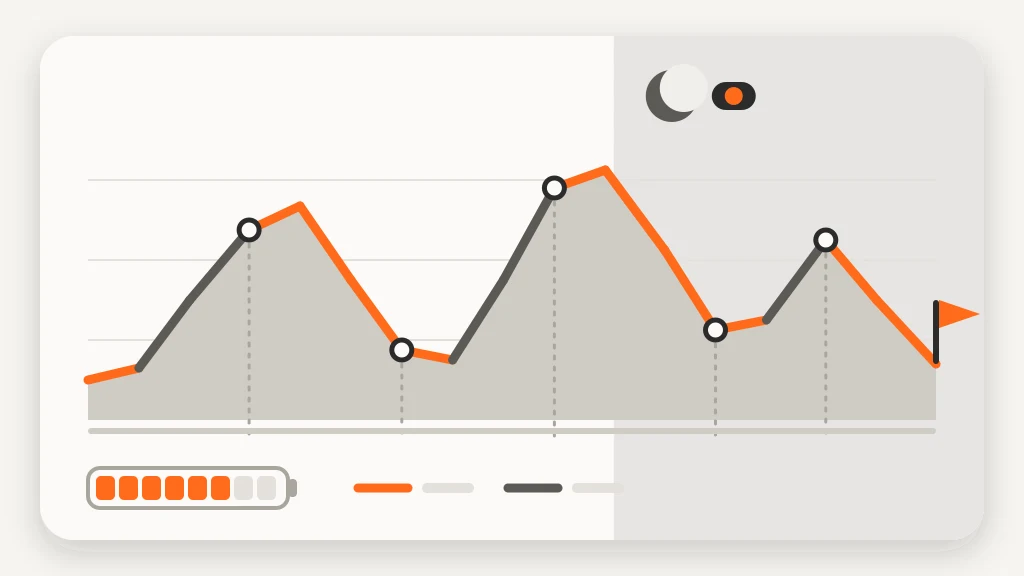
Illustrative scenario. Inés, 41, a 3:50 marathoner, trains 20 weeks for a 100 km trail race with 4,500 m of ascent and a 17-hour goal. Weekly volume grows from 55 to 95 km with a lighter week every fourth week; her peak weeks have about 11–12 hours on feet. Her back-to-backs rise from 3 h + 2 h to 4 h + 3 h, with 1,200 m of ascent on the Saturday. She hikes any climb steeper than about 10 % and walks 3 minutes every 30 minutes after hour four. On a Sunday rehearsal, 60 g an hour of gels alone brings on nausea after five hours, so she plans 50 g an hour from gels, drink, boiled potatoes and broth. In a six-hour test her watch drops from 100 % to 78 % in full-GPS mode, about 27 hours in all, so she keeps that mode and packs a power bank. On a 6-hour rehearsal her heart rate drifts up about 7 % at the same effort, so she caps climbs at 150 bpm for the first six hours and uses RPE afterwards. She finishes in 17:42. The morning after, resting heart rate is 9 bpm above her baseline and HRV about 40 % below. Resting heart rate is back within 2 bpm by day 8 and HRV is normal by day 12. She jogs 30 easy minutes on day 13 and adds speed work in week 4. Figures are illustrative.
Action steps
- Count back from race day: 14–18 weeks for 50K, 18–24 for 100 km, 20–30 for 100 miles, from a marathon-level base.
- Plan in hours and ascent, add back-to-back long runs in the last 8–10 weeks and take a lighter week every 3–4 weeks.
- Rehearse race gear: shoes, pack, lights, poles if allowed, real food and a night run.
- Write a plan for walking, fuelling and fluids: easy effort at the start, eat every 20–30 minutes, drink to thirst.
- Test the watch's long-battery mode on a long run and carry a backup power source.
- Rest after the race and return to training when HRV, resting heart rate, sleep and easy-run pace are back to normal.
Related guides
- Marathon training: building a plan that gets you to the finish
- Trail running with a watch: heart rate, climbs and pacing by effort
- The long run: building endurance safely
- Carbohydrate fuelling for training and racing
- Hydration and electrolytes: drinking smart for training and racing
FAQ
How long does it take to train for an ultramarathon? From a marathon base, about 14–18 weeks for a 50K, 18–24 for a 100 km and 20–30 for 100 miles. A first-timer also benefits from a year or more of regular running beforehand.
How many kilometres a week do I need? Roughly 50–80 for a 50K and 70–130 for 100 km to 100 miles, but time on feet and ascent matter more than distance, and many finishers train less.
Do I need back-to-back long runs? They are a common tool, not a rule. They practise running tired with less damage than one very long run; do the biggest pair only two or three times.
How do I make my watch last a 100-miler? Use a long-battery GPS mode, check it records while charging, carry a small power bank and cable, and test everything on a long run first.
When can I run again after an ultra? Many coaches suggest one to two weeks without structured running after 100 miles. Resume when HRV, resting heart rate, sleep and easy-run pace are back at baseline.
References
- Hoffman and Krishnan (2014). Health and Exercise-Related Medical Issues among 1,212 Ultramarathon Runners: Baseline Findings from the Ultrarunners Longitudinal TRAcking (ULTRA) Study. PLoS ONE. https://doi.org/10.1371/journal.pone.0083867
- Stuempfle and Hoffman (2015). Gastrointestinal distress is common during a 161-km ultramarathon. Journal of Sports Sciences. https://doi.org/10.1080/02640414.2015.1012104
- Hew-Butler et al. (2015). Statement of the Third International Exercise-Associated Hyponatremia Consensus Development Conference, Carlsbad, California, 2015. Clinical Journal of Sport Medicine. https://doi.org/10.1097/JSM.0000000000000221
- Jeukendrup (2014). A Step Towards Personalized Sports Nutrition: Carbohydrate Intake During Exercise. Sports Medicine. https://doi.org/10.1007/s40279-014-0148-z
- Bent et al. (2020). Investigating sources of inaccuracy in wearable optical heart rate sensors. npj Digital Medicine. https://doi.org/10.1038/s41746-020-0226-6
For general information only. This is not medical advice — talk to a qualified professional about your health.
Keep reading
Sports
Trail running with a watch: heart rate, climbs and pacing by effort
7 min read
Metrics explained
VO2 max: what it means and how to improve it
4 min read
Training science
Zone 2 training: the science and how to do it right
4 min read
Training science
Polarized training (80/20): easy most of the time, hard some of the time
4 min read
Devices & setup
Strava and MoveVitals: workouts, streams and devices that arrive via Strava
3 min read
Sports
Hiking and trekking: heart rate on climbs, pacing and how to train for it
8 min read