

Training science
Running in the heat: how much to slow down and what your watch will show
Running in the heat costs more at every pace. A dew point rule of thumb for pace adjustment, a higher heart rate at the same speed and 10–14 days of acclimatisation help you slow down sensibly instead of blowing up.
Written by MoveVitals Editorial Collective
Community-authored educational content. Individual clinical review is identified only when a named review is actually recorded.
Editorial standards & corrections
Key takeaways
- Adding air temperature and dew point in °C gives a pace rule: up to about 20 needs no slowdown, 32–42 costs about 1–3 %, 43–53 about 3–6 % and 54–64 about 6–10 %, while above 64 you should skip hard running.
- Dew point is a better guide than relative humidity: under about 10 °C feels dry and above about 16 °C feels muggy.
- Most heat adaptation happens within about two weeks of regular exposure, starting with 20–40 minutes easy in the warm part of the day.
- Aim to finish with less than about 2 % of body weight lost, but never gain weight, because overdrinking plain water in long events can be dangerous.
- Call emergency services for confusion, odd behaviour, slurred speech, stumbling, collapse or a seizure.
Heat and humidity make the same pace harder because your body has to carry heat from the working muscles to the skin and lose it by evaporating sweat. A muggy 25 °C can be harder than a dry 32 °C, because sweat that cannot evaporate does not cool you. That is the short answer to how to run in the summer: slow down by a predictable amount, read your watch differently and give your body two weeks to adapt.
Why heat slows you down
- Blood is shared. The skin needs extra blood flow to shed heat, and sweating shrinks plasma volume. Stroke volume falls, so heart rate climbs to keep cardiac output up. It is the same mechanism as cardiac drift, only larger and earlier.
- Humidity matters as much as air temperature. Dew point is a better guide than relative humidity: under about 10 °C feels dry, above about 16 °C feels muggy and above about 21 °C is oppressive. Sun, still air and hot tarmac add to it; race organisers combine them in the wet-bulb globe temperature (WBGT).
- Core temperature rises faster. The same pace feels harder and fatigue arrives sooner, so a marathon suffers more than a 5 km. Marathon results slow as WBGT rises, and more for slower finishers, who spend longer in the heat (Ely et al. 2007).
Pace adjustment for running in the heat: the dew point rule
A widely used coaching rule of thumb works as a simple heat and humidity pace calculator: it adds the air temperature and the dew point and reads off an approximate slowdown for hard or race-pace running. It is a guide, not a laboratory formula.
| Air temperature + dew point (°C) | (°F) | Typical slowdown at hard or race effort |
|---|---|---|
| Up to about 20 | Up to 100 | None |
| 21–31 | 101–120 | Up to ~1 % |
| 32–42 | 121–140 | ~1–3 % |
| 43–53 | 141–160 | ~3–6 % |
| 54–64 | 161–180 | ~6–10 % |
| Above 64 | Above 180 | Skip hard running or move indoors |
Examples: 12 °C with a 6 °C dew point (sum 18) needs no adjustment; 29 °C with 21 °C (sum 50) costs roughly 3–6 %. Acclimatised runners lose a little less, unacclimatised runners more, and shade, wind, hills and sun shift the number. On easy and long runs hold an effort (RPE 3–4 out of 10) or a heart rate ceiling, not a pace. For race plans, see race pacing.
What your watch will show
- Slower pace, higher heart rate. Expect heart rate several beats per minute higher at the same pace, sometimes 10 or more, and a steeper upward drift over a long run. Maximum heart rate does not change with the weather, so keep your heart rate zones and let pace drop to stay inside them. That is the practical answer when your heart rate looks too high running in hot weather.
- Wrist sensors can wobble. Optical sensors are generally less accurate than chest straps during hard, sweaty running, and a wet or loose band adds error (Bent et al. 2020). For key hot sessions use a strap and moisten its electrodes.
- Recovery numbers move after hot days. The following night, resting heart rate is often higher, HRV lower and skin temperature deviation up, partly from the run and partly from a warm bedroom and lighter sleep. Compare with your own baseline (resting heart rate, HRV, skin temperature) before concluding you are overtrained.
Acclimatising in 10–14 days
Most heat adaptation happens within about two weeks of regular exposure (Racinais et al. 2015; Périard et al. 2015): plasma volume rises, sweating starts earlier and is more dilute, and heart rate and core temperature at a given pace fall.
- Days 1–5: 20–40 minutes easy in the warm part of the day, by effort; cut short or walk if you feel dizzy. Days 6–14: build to 40–60 minutes, adding one moderate effort once the earlier days feel controlled.
- Repeat daily or at least every second day. Hot baths or sauna after easy runs are a back-up (heat training and sauna).
- Gains fade over a few weeks without heat, and the first hot spell of the year is always the hardest. For a hot race, arrive early or start this routine at home.
Fluids, sodium and cooling
- Know your sweat rate. Weigh yourself before and after an hour's run: litres lost per hour ≈ weight lost in kg + fluid drunk in litres. It commonly lies between 0.5 and 2.5 L/h.
- Limit the loss. Aim to finish with less than about 2 % of body weight lost (Sawka et al. 2007), but never gain weight: overdrinking plain water in long events can cause dangerously low blood sodium.
- Sodium on long runs. Beyond 60–90 minutes, or for heavy and salty sweaters, add sodium (see hydration and electrolytes), plus carbohydrate on long runs. This is the core of summer running hydration.
- Cool the body, not only the bottle. Cold drinks, water over the head and neck, ice in a cap, shade and loops that pass taps all help. Early morning is usually coolest, but check the dew point: dawn can be muggy.
Warning signs and when to stop
This is general information, not medical advice.
- Stop, find shade and cool down if you feel dizzy, nauseated, headachy, clammy, chilled with goosebumps in the heat or you cramp badly. Walk, drink, wet your head and neck, and do not restart that day.
- Call emergency services for confusion, odd behaviour, slurred speech, stumbling, collapse or a seizure. Exertional heat stroke is life-threatening; while waiting, move the person into shade and cool them fast, ideally by cold-water immersion, or with cold wet towels and ice on the neck, armpits and groin (Casa et al. 2015).
- Skip hard running when you are ill, feverish, short of sleep or dehydrated (training when sick), and tell someone your route. If you have a heart condition or take medication, ask a doctor before exercising in the heat.
In MoveVitals
Runs from Garmin, Strava, COROS, Polar or Suunto arrive with heart rate and pace streams (Apple Watch workouts via Strava), so you can compare the same easy route on a cool and a hot day at the same heart rate. Overnight resting heart rate and HRV from Garmin, COROS, Polar, WHOOP or Oura, and skin temperature deviation from WHOOP or Oura, sit on the same timeline, showing whether heat, a stuffy bedroom or the run moved them. A run that arrives from both your watch and Strava is kept once, labelled with the original device (how conflicts are resolved). Weather is not part of the data MoveVitals compares, and a wrist temperature reading is skewed by body heat, so note the air temperature and dew point yourself.
Worked example
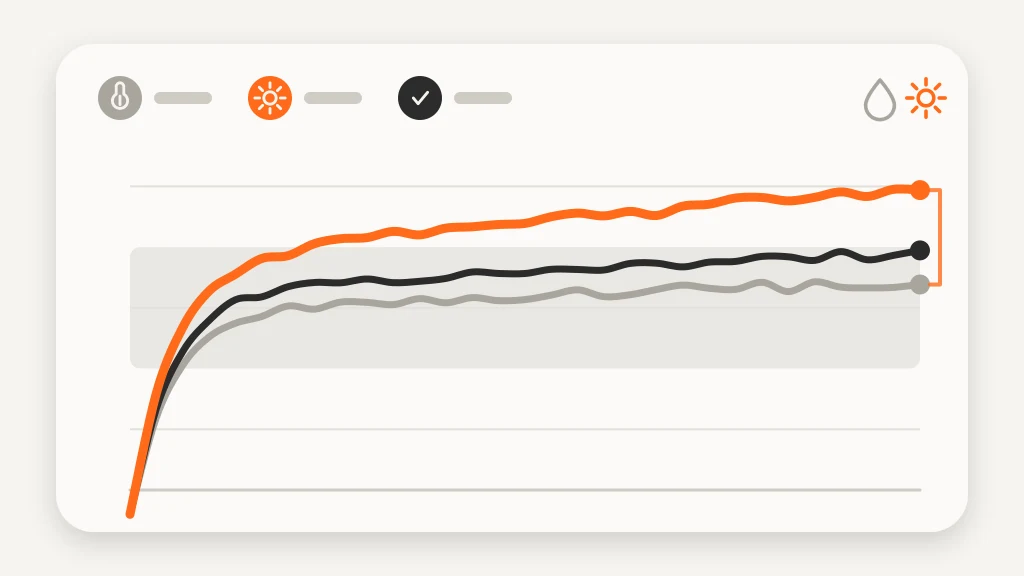
Illustrative scenario. Mia's easy pace is 5:40/km (9:07/mile) at about 142 bpm on a 10 °C morning with a 5 °C dew point (sum 15, no adjustment). On a 29 °C afternoon with a 21 °C dew point (sum 50) the same pace sends her heart rate to about 152 bpm after 20 minutes. The table suggests 3–6 % slower, so she runs 6:00/km (9:39/mile) and settles near 148 bpm. A 10 km goal of 50:00 would become roughly 51:30–53:00 in those conditions. After 12 days of 40–50 minute easy runs in the warm part of the day, the same 5:40/km on a hot afternoon costs about 145 bpm. The night after her first hot run her resting heart rate was 56 versus a usual 52 and her HRV was lower; both were back to baseline within two days. Figures are illustrative.
Action steps
- Before you go, check air temperature and dew point, add them (in °C) and read the slowdown from the table, or simply run by effort.
- Control easy runs with a heart rate ceiling or RPE; do not reset your zones, and accept a slower pace.
- Acclimatise over 10–14 days: easy runs in the warm part of the day, building gradually to 40–60 minutes.
- Weigh yourself before and after a run to learn your sweat rate, and plan fluid and sodium for long runs.
- Move sessions to early morning or evening, pick shaded loops with water, and cool your head and neck.
- Learn the stop signs and do not run alone in extreme heat.
Related guides
- Heat training and sauna: acclimatisation, recovery and safety
- Hydration and electrolytes: drinking smart for training and racing
- Cardiac drift (decoupling): why heart rate rises at the same pace
- Race pacing: why even splits usually win
- Resting heart rate: normal ranges and what changes it
FAQ
How much does heat slow you down? It depends on temperature and humidity together: negligible with a low dew point, often roughly 3–6 % for hard or race-pace running when air temperature plus dew point reaches 43–53 °C. Treat the table as a rough guide.
Why is my heart rate so high when I run in the heat? More blood goes to the skin and sweat shrinks plasma volume, so each beat moves less blood and the heart beats faster. Several to 10+ bpm at the same pace is common and usually narrows with acclimatisation.
How hot is too hot to run? There is no single number; dew point, fitness, acclimatisation and sun all matter. As a rough rule, avoid hard running when air temperature plus dew point is above about 64 °C, and stop whenever you feel dizzy, nauseated or confused.
References
- Ely et al. (2007). Impact of weather on marathon-running performance. Medicine & Science in Sports & Exercise. https://doi.org/10.1249/mss.0b013e31802d3aba
- Racinais et al. (2015). Consensus recommendations on training and competing in the heat. British Journal of Sports Medicine. https://doi.org/10.1136/bjsports-2015-094915
- Périard et al. (2015). Adaptations and mechanisms of human heat acclimation: applications for competitive athletes and sports. Scandinavian Journal of Medicine & Science in Sports. https://doi.org/10.1111/sms.12408
- Casa et al. (2015). National Athletic Trainers' Association Position Statement: Exertional Heat Illnesses. Journal of Athletic Training. https://doi.org/10.4085/1062-6050-50.9.07
- Sawka et al. (2007). American College of Sports Medicine position stand. Exercise and fluid replacement. Medicine & Science in Sports & Exercise. https://doi.org/10.1249/mss.0b013e31802ca597
- Bent et al. (2020). Investigating sources of inaccuracy in wearable optical heart rate sensors. npj Digital Medicine. https://doi.org/10.1038/s41746-020-0226-6
For general information only. This is not medical advice — talk to a qualified professional about your health.
Keep reading
Training science
Zone 2 training: the science and how to do it right
4 min read
Training science
Polarized training (80/20): easy most of the time, hard some of the time
4 min read
Devices & setup
Strava and MoveVitals: workouts, streams and devices that arrive via Strava
3 min read
Metrics explained
VO2 max: what it means and how to improve it
4 min read
Training science
Interval training and HIIT: designing sessions that work
4 min read
Sports
Trail running with a watch: heart rate, climbs and pacing by effort
7 min read