

Sports
CrossFit and functional fitness: heart rate, WODs and wearable accuracy
CrossFit heart rate climbs fast in a WOD, and wrist sensors often misread it when you grip a bar or flex your wrists, so a chest strap and effort-based pacing give a more reliable picture. This guide covers how heart rate behaves in AMRAPs, EMOMs and chippers, which sensors to trust and how to read recovery with HRV and resting heart rate.
Written by MoveVitals Editorial Collective
Community-authored educational content. Individual clinical review is identified only when a named review is actually recorded.
Editorial standards & corrections
Key takeaways
- In an AMRAP of 10–20 minutes heart rate climbs in the first 2–3 minutes and stays high, an EMOM draws a saw-tooth, and a heavy strength block often sits at 100–140 bpm.
- In metcons many people spend most of the time at roughly 80–95 % of maximum, so pace by round time and RPE 8–9 rather than by a heart rate target.
- Break sets before failure, such as 21 reps as 7-7-7, and treat a last round 20 % or more slower than the first as a sign you started too hard.
- A chest strap is generally the most accurate option, while wrist watches are least reliable during grip, handstand and burpee work.
- Get medical advice for chest pain, fainting or very dark urine with severe muscle pain.
How heart rate behaves in a WOD
Heart rate follows effort with a delay of tens of seconds, so a 30-second burst can be over before your watch shows it. Over a hard metcon, many people spend most of the time in zones 4–5, roughly 80–95 % of maximum (see heart rate zones). Heavy lifts and gymnastics tax muscles and grip more than the heart, so heart rate alone says little about how hard they were.
| Format | Typical heart rate pattern | What to read from it |
|---|---|---|
| AMRAP (10–20 min) | Climbs in the first 2–3 minutes, then stays high with small dips between movements | Round times: a steady pace beats a fast start and a fade |
| EMOM | Saw-tooth: peaks in the work, falls in the rest | Does it fall before the next minute? If you have no rest left, the work is too hard |
| For time / chipper (15–30 min) | Drifts up through the workout | RPE and planned breaks, not a heart rate target |
| Heavy strength block | Moderate between sets, often 100–140 bpm | Ignore it; use load and RPE |
Why wrist sensors struggle, and what to wear
Gripping a barbell or pull-up bar tightens the forearm tendons under the sensor, wrist flexion and impacts shake it, and the optical sensor can lock onto the rhythm of your movement instead of your pulse. Studies of consumer devices show variable accuracy during exercise, and chest straps that read the heart's electrical signal are generally more accurate (Gillinov et al., 2017).
| Option | Strengths | Watch-outs |
|---|---|---|
| Chest strap (e.g. Polar H10) | Generally the most accurate; steady during grip-heavy work | Can slip during burpees; wet the electrodes and fit it snugly; some find it uncomfortable under a bar |
| Optical armband (forearm or upper arm) | Away from wrist flexion; no chest contact | Muscle flexing can still add noise; needs a snug fit |
| Wrist watch | Convenient; good for timers | Least reliable during grip, handstand and burpee work; wear it snug and higher on the forearm |
For the best watch for CrossFit, features matter more than brand: interval timers (AMRAP and EMOM), strap pairing, a screen lock, large readable numbers and battery life for a class. Some brands offer a CrossFit or HIIT profile; check your model. Compare the wrist trace with a strap once, and see how accurate is wrist heart rate?.
Pacing AMRAPs, EMOMs and chippers
- Start slower than feels necessary. The first round should feel too easy; the last should be hard, not a collapse.
- Break before failure. Planned small sets, such as 21 reps as 7-7-7, usually beat one big set followed by a long rest.
- Hold your round times. If your last round is much slower than your first (a rough rule is 20 % or more), you started too hard.
- Use RPE. A metcon is often 8–9 out of 10 (see RPE), with a kick in the final round.
- Scale. Choose loads and reps that keep good movement quality; scaling is normal at every level.
Heart rate is a check after the fact: time in zones 4–5 and how fast it drops afterwards (see heart rate recovery). Stop and seek medical advice for chest pain, fainting or palpitations with dizziness.
Recovery after high-intensity days: HRV, resting heart rate and sleep
A hard WOD often lifts overnight resting heart rate by a few bpm and lowers HRV, which is a normal reaction. A single day is noisy, so compare it with your own 7-day baseline (see heart rate variability). If HRV stays below your usual range and resting heart rate stays up for several days, together with poor sleep, soreness or low mood, ease the volume for a few days; the overtraining guide covers the signs.
Many people do well with three or four hard days a week, alternating heavy and high-impact days. Surveys report injuries most often in the shoulders and lower back, so technique, scaling and sleep matter. Very dark urine with severe muscle pain, swelling or weakness after an unusually hard session needs urgent medical attention.
In MoveVitals
CrossFit sessions that arrive from Garmin, WHOOP, Polar, COROS or Strava (including Apple Watch workouts uploaded to Strava) are stored as activities with the duration, heart rate and calories the source supplies. Next to them you see the next morning's HRV, resting heart rate and sleep from the devices you wear overnight. If a strap and a watch record the same class, MoveVitals can group them and pick fields by your priorities, so a chest-strap heart rate can outrank a wrist reading (how MoveVitals resolves conflicts). Heart-rate load underestimates heavy lifting, so add session RPE (see training load) and keep sets, reps and loads in your own log.
Worked example
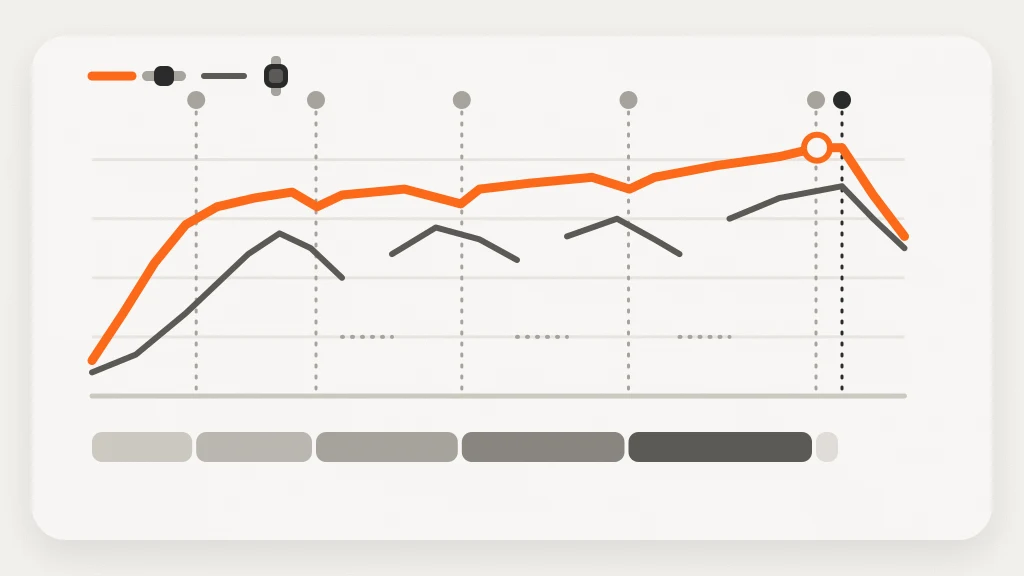
Illustrative scenario. Dana, 31, has a measured maximum heart rate of 190 bpm. After a warm-up and heavy squats (heart rate 110–140 bpm between sets), she does a 12-minute AMRAP. Her round times fade: 1:40, 1:55, 2:20, 2:40 and 3:00, five rounds in 11:35. Her chest strap averages 168 bpm (88 % of maximum) and peaks at 184 (97 %); her wrist watch averages 154 and drops out on the pull-ups. One minute after the finish her chest-strap heart rate has fallen 30 bpm. The next morning her HRV is 54 ms against a usual 62–68 and her resting heart rate is 56 against 52; both are back to baseline two days later. Next time she holds about 2:00 per round and completes six rounds, averaging 171 bpm (90 %). Figures are illustrative.
Action steps
- Find your maximum heart rate by a proper test or from a hard session, not only a formula, and use a chest strap or armband for key sessions.
- Ignore heart rate on heavy strength sets; use load and RPE instead.
- Pace metcons by round time and RPE 8–9, start slower and break sets early.
- Record round times and scaled loads so you can repeat the same workout weeks later.
- Check 7-day trends of HRV, resting heart rate and sleep; ease off if they stay off for several days.
- Scale to protect technique, and get medical advice for chest pain, fainting or very dark urine with severe muscle pain.
Related guides
- HYROX training: stations, run splits and how to use your watch on race day
- Strength training heart rate: what your wearable shows — and what it can’t
- How accurate is wrist heart rate? Optical sensors vs chest straps, by sport
- Normal heart rate variability (HRV) by age: RMSSD vs SDNN
- Interval training and HIIT: designing sessions that work
FAQ
What heart rate should I have in CrossFit? In metcons many people spend most of the time at roughly 80–95 % of maximum, with lower values on heavy lifting. There is no single target: base zones on a measured maximum and use RPE as the main guide.
Why is my watch heart rate wrong in CrossFit? Grip, wrist flexion, impacts and sweat disturb optical sensors, and they can lock onto movement rhythm. A chest strap is generally more reliable.
Is a chest strap or a watch better for CrossFit? A strap is generally more accurate for the heart rate, and a watch is handier for timers, so many people wear both.
Can beginners do CrossFit, and how often? Yes, with scaled loads and coaching on technique. Two or three classes a week is a common starting point, and recovery signals can tell you whether to add more.
References
- Gillinov et al. (2017). Variable Accuracy of Wearable Heart Rate Monitors during Aerobic Exercise. Medicine & Science in Sports & Exercise. https://doi.org/10.1249/MSS.0000000000001284
- Plews et al. (2013). Training Adaptation and Heart Rate Variability in Elite Endurance Athletes: Opening the Door to Effective Monitoring. Sports Medicine. https://doi.org/10.1007/s40279-013-0071-8
- Buchheit (2014). Monitoring training status with HR measures: do all roads lead to Rome? Frontiers in Physiology. https://doi.org/10.3389/fphys.2014.00073
- Hak et al. (2013). The nature and prevalence of injury during CrossFit training. Journal of Strength and Conditioning Research. https://doi.org/10.1519/JSC.0000000000000318
For general information only. This is not medical advice — talk to a qualified professional about your health.
Keep reading
Training science
Zone 2 training: the science and how to do it right
4 min read
Training science
Polarized training (80/20): easy most of the time, hard some of the time
4 min read
Sports
Japanese interval walking: the 3-minute fast / 3-minute slow method, step by step
8 min read
Training science
Interval training and HIIT: designing sessions that work
4 min read
Metrics explained
Heart rate zones explained: how to set and use them
4 min read
Sports
Trail running with a watch: heart rate, climbs and pacing by effort
7 min read