

Sports
Rucking: weighted walking for fitness — load, pace, heart rate and injury risk
Rucking is walking with a weighted backpack, a low-impact way to add strength and cardio demand to an ordinary walk. This guide covers how much weight to carry, a safe progression, how load changes heart rate and calories, and how to avoid foot, back and shoulder problems.
Written by MoveVitals Editorial Collective
Community-authored educational content. Individual clinical review is identified only when a named review is actually recorded.
Editorial standards & corrections
Key takeaways
- For a 70 kg person, a beginner pack is 5–10 % of body weight, 3.5–7 kg, on 2–4 km routes at 4–5 km/h, and experienced ruckers carry 15–20 %, 10.5–14 kg.
- Add 1–2 kg or about 10 % more distance every week or two, one change at a time, and hold if something is sore.
- A watch does not know your pack weight, so calories are often undercounted; log the load yourself and treat the figure as a minimum.
- Running usually burns more per hour, but rucking is gentler on joints, so many people can do it more often.
- Studies of military load carriage link heavier loads and rapid increases to overuse injuries, so stop for sharp pain, numbness or tingling.
What is rucking, and how does it differ from walking and running?
The word comes from "rucksack" and the military ruck march: walking at a steady pace with a load on your back. As a fitness activity it sits between walking and strength training. The main rucking benefits are more work from a low-impact activity, stronger legs, trunk and upper back, and time outdoors.
| Brisk walking | Rucking | Running | |
|---|---|---|---|
| Joint impact | Low | Low to moderate; rises with load and downhill | High |
| Muscles worked | Mainly legs | Legs, trunk, upper back, shoulders | Mainly legs |
| How you scale it | Speed, hills | Load, speed, hills, distance | Speed, distance |
Rucking vs running: running usually burns more per hour and builds a higher cardio ceiling, but rucking is gentler on joints, so many people can do it more often or on days they cannot run. It also complements running as cross-training. For plain walking, see walking for fitness.
How much weight for rucking?
Pack weight means everything on your back: the bag, water and ballast. A common starting point is 5–10 % of body weight. Military loads of 20–30 kg or more are not a fitness target.
| Level | Pack weight (70 kg / 154 lb person) | Typical session | Pace |
|---|---|---|---|
| Beginner | 5–10 % (3.5–7 kg, 8–15 lb) | 2–4 km, 30–45 min | 4–5 km/h |
| Intermediate | 10–15 % (7–10.5 kg, 15–23 lb) | 5–8 km, 60–90 min | 4.5–5.5 km/h |
| Experienced | 15–20 % (10.5–14 kg, 23–31 lb) | 8–12 km | 5–6 km/h |
- Change one thing at a time. Add 1–2 kg, or about 10 % more distance, every week or two, and hold if something is sore.
- Do the form check. If you lean forward, your stride shortens or your shoulders ache, the load is too heavy for today.
- Start with one or two rucks a week, with a day between heavy ones.
- Fit the pack high and close to the back, with the hip belt snug so the hips share the load. Pad dense ballast (plates, sandbags) so it does not press on the spine. A weighted vest is an alternative that keeps the load close to the torso.
Heart rate and calories under load
At the same speed a heavier pack means a higher heart rate, and hills add more. A flat ruck at a brisk pace often sits in zone 2 to zone 3; steep climbs can push you higher, so cap effort with the talk test or the zones in heart rate zones and hiking heart rate.
Energy cost rises roughly in proportion to the total weight you move, plus extra for speed and incline (the Pandolf equation models this). Brisk walking at 5.6 km/h is about 4.3 METs per kg of body weight, so a first estimate is MET × (body weight + pack weight) × hours. Rucking calories for 80 kg plus a 10 kg pack for one hour: 4.3 × 90 ≈ 390 kcal, against about 345 without the pack. See calories burned by activity.
| Metric | What your watch does under load |
|---|---|
| Steps and distance | Counted normally; the pack does not change them |
| Heart rate | Rises with load. Wrist optical is generally fine for steady walking; use a chest strap if you need accuracy |
| Calories | Often undercounted, because the watch does not know the pack weight |
| Elevation | Needs a barometric altimeter, and hills drive much of the effort |
| Pack weight | Not recorded; log it yourself |
Use a hike or walk profile (some watches also offer a rucking mode) and keep your own note of load.
Injury risk and recovery
- Feet. Friction causes hot spots and blisters. Wear broken-in shoes, well-fitting socks and stop to treat a hot spot early.
- Knees, shins and Achilles. Downhill with load is hard on the knees; shorten your steps or use poles, and build slowly.
- Back and shoulders. A pack that is low, loose or too heavy pulls you forward. Tingling, numbness or weakness in the arms or hands means reduce the load or take the pack off.
- Overuse. Studies of military load carriage link heavier loads, longer distances and rapid increases to overuse injuries; jumps in weight are riskier than adding distance.
- Heat. A pack traps heat, so drink and shorten rucks in hot weather (see running in the heat).
Expect sore calves and back for a day or two after heavy rucks, and see runner injury prevention for load management. Ask a clinician first if you have heart, lung, back, joint or balance problems. Stop and seek care for chest pain, fainting or palpitations with dizziness.
In MoveVitals
Rucks recorded as hikes or walks on Garmin, COROS, Polar, Suunto and Strava arrive as workouts with duration, distance and heart rate, plus elevation where the source supplies it (Apple Watch sessions come via Strava). The same session from two sources is merged, and time in zone is calculated from the heart-rate stream. None of these sources records pack weight, so keep your own note and compare rucks on the same route by heart rate and pace.
Worked example
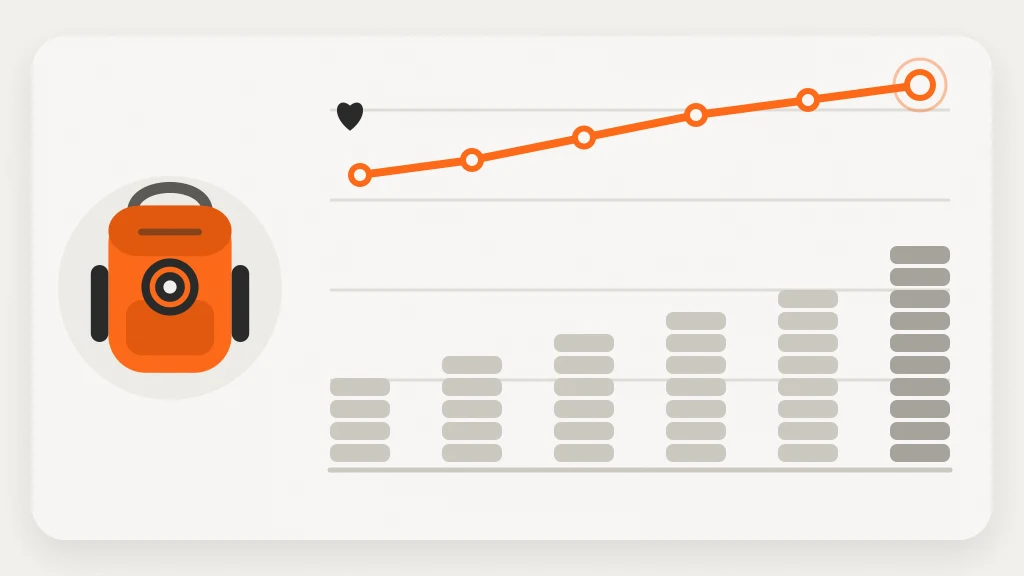
Illustrative scenario. Marcus, 41, weighs 80 kg and has a measured maximum heart rate of 182 bpm. He walks a flat 5 km loop at about 5.5 km/h (55 minutes). In week 1 he carries 4 kg (5 % of body weight) and averages 112 bpm, about 62 % of maximum. He adds 1 kg every second walk, and by week 6 carries 10 kg (12.5 %) at the same pace, averaging 124 bpm (68 %). The loaded walk costs about 4.3 METs × 90 kg × 0.92 h ≈ 355 kcal, against roughly 315 kcal without the pack; his watch reports about 330 because it only knows his body weight. He treats the watch figure as a floor, logs the pack weight in his notes and holds 10 kg for two more weeks when his calves are still sore.
Action steps
- Weigh your loaded pack, water included, and start at 5–10 % of body weight on a flat 2–4 km route.
- Fit the pack high and snug with the hip belt, and wear broken-in shoes and good socks.
- Change only load, distance or pace each week or two, and hold when anything is sore.
- Cap effort with the talk test or heart rate, especially uphill, and record your pack weight yourself.
- Treat watch calories as a minimum, not a precise figure.
- Ruck once or twice a week, and keep strength and mobility work in the rest of your week.
Related guides
- Walking for fitness and weight loss: pace, heart rate zones and how much is enough
- Hiking and trekking: heart rate on climbs, pacing and how to train for it
- Heart rate zones explained: how to set and use them
- Calories burned by activity: MET values, per-hour tables and how wearables estimate them
- Injury prevention for runners: load, strength and listening early
FAQ
Is rucking better than walking? It is harder for the same speed and distance, because you carry extra weight, and it works the trunk and upper back more. For most people the best option is the one they will do regularly, and a plain brisk walk is a good base.
How much weight should a beginner carry for rucking? About 5–10 % of body weight, including water, on flat routes. Add weight slowly, and only when the previous load feels easy.
Does rucking burn more calories than walking? Yes, roughly in proportion to the extra weight you carry, and more on hills. Weight loss still depends on your overall energy balance, and watch calories usually undercount load.
Is rucking bad for your back or knees? Not by itself, but poor pack fit, loads that are too heavy and fast increases can cause problems. If you have back or joint conditions, ask a clinician first.
Can I use a weighted vest instead of a backpack? Yes. A vest keeps the load close to your torso, which many find comfortable for lighter loads; the same progression rules apply.
References
- Knapik et al. (2004). Soldier Load Carriage: Historical, Physiological, Biomechanical, and Medical Aspects. Military Medicine. https://doi.org/10.7205/MILMED.169.1.45
- Pandolf et al. (1977). Predicting energy expenditure with loads while standing or walking very slowly. Journal of Applied Physiology. https://doi.org/10.1152/jappl.1977.43.4.577
- Ainsworth et al. (2011). 2011 Compendium of Physical Activities: A Second Update of Codes and MET Values. Medicine & Science in Sports & Exercise. https://doi.org/10.1249/MSS.0b013e31821ece12
For general information only. This is not medical advice — talk to a qualified professional about your health.
Keep reading
Sports
Walking for fitness and weight loss: pace, heart rate zones and how much is enough
9 min read
Sports
Hiking and trekking: heart rate on climbs, pacing and how to train for it
8 min read
Sports
Japanese interval walking: the 3-minute fast / 3-minute slow method, step by step
8 min read
Sports
Pickleball and your health data: heart rate zones, calories and joint load
6 min read
Sports
Padel with a wearable: heart rate, calories and recovery between matches
7 min read
Training science
Zone 2 training: the science and how to do it right
4 min read