

Training science
Cross-training: building fitness while sparing your joints
Cross-training uses other sports — cycling, rowing, swimming, elliptical — to add aerobic volume, recover from injury and reduce repetitive strain.
Written by MoveVitals Editorial Collective
Community-authored educational content. Individual clinical review is identified only when a named review is actually recorded.
Editorial standards & corrections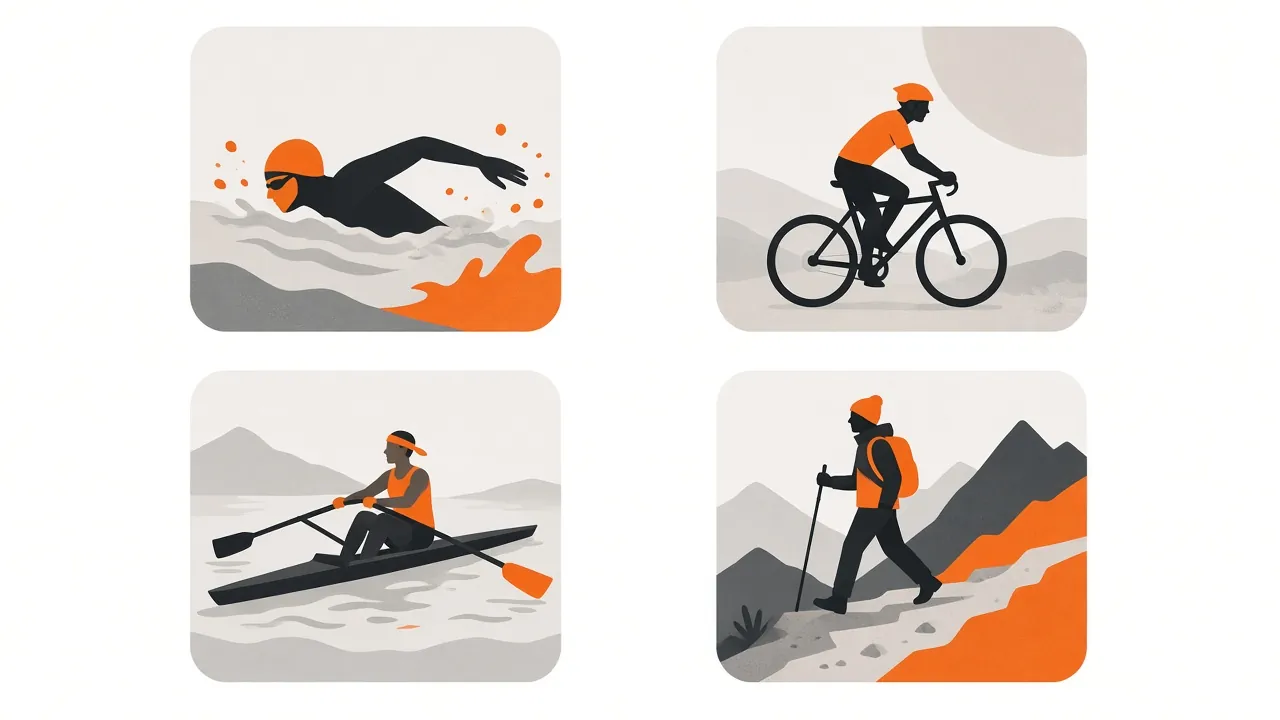
Key takeaways
- Deep-water running and the elliptical transfer best to running, cycling and rowing transfer moderately, and swimming transfers low to moderately.
- Cycling heart rate is often 5–10 bpm lower than running at the same effort, so use RPE or cycling-specific zones when replacing a run.
- Healthy athletes can swap 1–2 easy runs a week for cross-training; injured athletes can replace running time roughly minute-for-minute, sometimes 1.5× on the bike, with a clinician's approval.
- Keep some running unless injured, because cycling replaces aerobic stress but not running-specific impact tolerance.

Why cross-train
- More aerobic volume with less impact than extra running.
- Injury management: keep fitness while a running injury heals.
- Balance: works muscles your main sport neglects.
- Mental freshness during long seasons.
How well does fitness transfer?
| Activity | Transfer to running | Notes |
|---|---|---|
| Deep-water running | High | Mimics running motion with no impact |
| Elliptical / cross-trainer | High | Similar movement, low impact |
| Cycling | Moderate | Great aerobic stimulus, different muscles |
| Rowing (Concept2) | Moderate | Whole body; good for heart and posterior chain — see indoor rowing |
| Swimming | Low–moderate | Aerobic benefit, upper-body dominant |
| Hiking / incline walking | Moderate | Great for trail runners |
For cyclists, running and rowing add weight-bearing or upper-body work that cycling lacks.
Training for a triathlon has a different goal: bike-to-run brick workouts practise the transition between sports, rather than simply replacing an easy run.
Matching intensity
Heart rate is a good common currency, but zones differ by sport: cycling heart rate is often 5–10 bpm lower than running at the same effort, and swimming lower still. Use sport-specific zones, or RPE — see RPE.
How much?
- Healthy athletes: 1–2 cross-training sessions per week in place of easy runs.
- Injured athletes: replace running time roughly minute-for-minute (sometimes 1.5× for cycling) at similar effort, with your clinician's approval.
In MoveVitals
Every sport from every connected platform contributes to one training load timeline, so a Zwift ride, a Concept2 row and a Garmin run are counted together without duplicates.
Worked example
Illustrative scenario. Daniel normally runs 50 km a week and develops shin pain. His physiotherapist suggests cutting running to 25 km for three weeks. To keep his aerobic fitness, he replaces two easy runs with 60-minute easy rides at a similar heart rate (Zone 2) and turns one interval session into deep-water running intervals of matching effort and duration. Using session RPE × minutes, his weekly training load stays close to normal even though running volume halves. When he returns to running he increases volume by no more than about 10% a week and keeps one ride as a recovery session.
Action steps
- Choose low-impact options that suit your goal: cycling, swimming, elliptical, rowing or aqua jogging.
- Match heart rate or RPE, not distance, when replacing a run.
- Count cross-training in your weekly training load.
- Keep at least some sport-specific training unless injured, because impact tolerance is specific.
- Return to your main sport gradually after an injury break.
Related guides
- Training load explained: TRIMP, TSS, strain and relative effort
- Injury prevention for runners: load, strength and listening early
- Zone 2 training: the science and how to do it right
- Strength training for endurance athletes
- Swimming for fitness and weight loss: how often, how long and what to track
- Elliptical and stair climber: heart rate, calories and why machine readouts overestimate
FAQ
Does cycling count as easy running? It replaces aerobic stress well, but not running-specific impact tolerance.
Can I cross-train on rest days? Light activity is fine; keep true rest days when fatigue is high.
Is heart rate lower when cycling than running at the same effort? Often by about 5–10 bpm, because less muscle mass is working, so use RPE or cycling-specific zones.
Does strength training count as cross-training? It is complementary training rather than an aerobic replacement, but it is valuable for injury resilience.
References
- Seiler (2010). What is Best Practice for Training Intensity and Duration Distribution in Endurance Athletes?. International Journal of Sports Physiology and Performance. https://doi.org/10.1123/ijspp.5.3.276
- Foster et al. (2001). A New Approach to Monitoring Exercise Training. The Journal of Strength and Conditioning Research. https://doi.org/10.1519/1533-4287%282001%29015%3C0109:anatme%3E2.0.co;2
- Soligard et al. (2016). How much is too much? (Part 1) International Olympic Committee consensus statement on load in sport and risk of injury. British Journal of Sports Medicine. https://doi.org/10.1136/bjsports-2016-096581
For general information only. This is not medical advice — talk to a qualified professional about your health.
Keep reading
Mobility & stretching
Mobility vs flexibility: what's the difference and what do you need?
3 min read
Training science
Zone 2 training: the science and how to do it right
4 min read
Training science
Polarized training (80/20): easy most of the time, hard some of the time
4 min read
Training science
Interval training and HIIT: designing sessions that work
4 min read
Mobility & stretching
Thoracic spine mobility: for cyclists, rowers and desk workers
3 min read
Mobility & stretching
The ideal warm-up: raise, activate, mobilise, potentiate
3 min read