

Sports
Elliptical and stair climber: heart rate, calories and why machine readouts overestimate
The calorie figure on an elliptical or stair climber is one of the least reliable numbers in the gym: consoles commonly read high, and even your watch only estimates. Here is how to read elliptical heart rate, set up a machine so the readout is less wrong, and choose between the elliptical, the stair climber and the treadmill.
Written by MoveVitals Editorial Collective
Community-authored educational content. Individual clinical review is identified only when a named review is actually recorded.
Editorial standards & corrections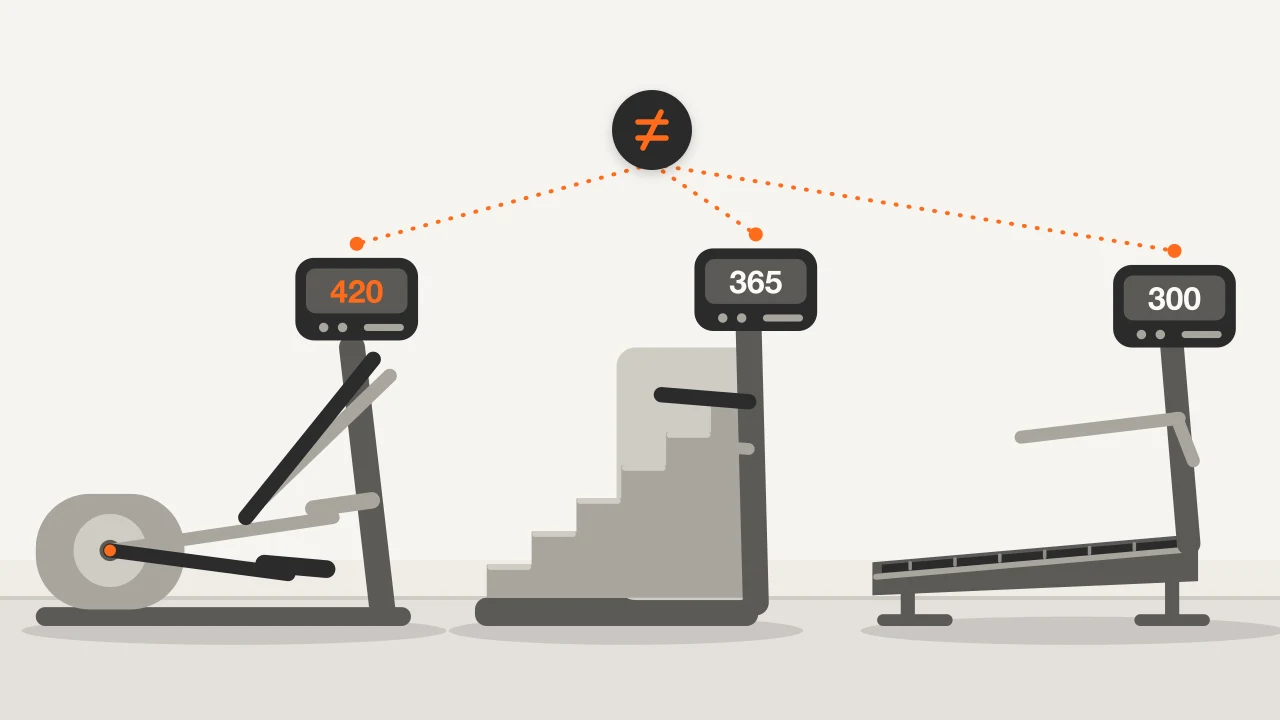
Key takeaways
- The Compendium of Physical Activities rates a stair-treadmill ergometer at about 9 METs, close to running at 9.7 km/h, while a moderate elliptical is about 5 METs.
- At the same perceived effort, the elliptical costs similar energy to a treadmill or a little less, with far less impact, but it does not condition you for running's impact.
- Consoles usually show total energy with resting energy included, while a watch often shows only active energy, so the two rarely match.
- Enter your real weight on every machine and use the console only to repeat a session and compare with last week, not to decide how much to eat.
Cardio machines look precise: a screen counts calories, level and strides to the second. But those numbers come from equations that know your weight only if you enter it, and have no idea how you are really moving.
Why the machine's calorie number reads high
- Weight. Calories scale with body weight. Many consoles fall back on a default weight, or one left by the previous user, unless you enter yours.
- Gross, not net. Consoles usually show total energy, resting energy included, while a watch often shows only active energy. The two are not comparable (calories burned).
- Assumed workload. A console estimates from resistance and stride or step rate using equations built for set conditions. It cannot see that you are leaning on the rails, which lowers the real energy cost on a stair climber, or how efficiently you move.
Use the console to repeat the same session and compare it with last week, not to decide how much to eat. A watch is a second opinion, not the truth: a large review of wrist-worn devices found that energy accuracy depends on the activity and improves when heart rate is added to motion sensing (calories burned by activity). To make any readout less wrong, enter your actual weight and age, make sure the machine is not still set to someone else, and keep your hands off the rails.
Elliptical vs treadmill
At the same perceived effort, laboratory studies find similar energy cost. In one study of untrained young adults at RPE 12–13, oxygen use and energy expenditure were similar on both machines, yet heart rate averaged about 20 bpm higher on the elliptical (164 against 145). In a study of trained runners working at the same percentage of each machine's peak workload, heart rate and oxygen use did not differ between treadmill, elliptical and stepper, and the authors called the elliptical and stepper suitable substitutes when running load must be reduced. In a third study of active middle-aged men at a hard effort (RPE 17), the treadmill had the highest energy cost, then the stair climber, then the elliptical.
So the elliptical is a legitimate way to build aerobic fitness with little impact, but it is not a perfect stand-in for running: running's impact is part of what conditions bones and tendons for running (treadmill vs outdoor running, injury prevention for runners). Use it for easy aerobic days, or when a clinician has told you to cut impact (cross-training).
Stair climber workout: Stairmaster vs treadmill
The Compendium of Physical Activities rates a stair-treadmill ergometer at about 9 METs, close to running at 9.7 km/h (6 mph). That makes a stair climber a time-efficient way to lift heart rate and a good match for hills, hiking and short intervals (hiking heart rate, interval training). It is weight-bearing without running's impact and works the glutes and quadriceps hard, but it punishes posture: leaning forward on the rails lowers the effort, hides the real work and loads wrists and back. Start with 5–10 minute blocks at a level where you can stand upright and let go of the rails.
| Machine | Typical MET | Impact | Best use |
|---|---|---|---|
| Elliptical, moderate effort | about 5 (about 9 vigorous) | very low | Easy aerobic days, returning from impact injuries |
| Stair climber | about 9 | low, weight-bearing | Hill and hiking prep, short intervals, glutes |
| Treadmill | walking about 3.5 to running about 10 | highest | Run-specific work and pace practice |
Elliptical heart rate: set zones per machine
Because machines differ, copy zones from a running test only as a starting point. Anchor easy effort to the talk test (full sentences, as in zone 2), note the heart rate you see and reuse that number for that machine. Console target zones usually rest on "220 − age", which can be off by 10 bpm or more (maximum heart rate, heart rate zones).
Sensors matter too. Hand-grip sensors are often unreliable. A wrist optical sensor can lock onto your stride rate while you grip moving handles, and chest straps are generally more accurate in this kind of rhythmic arm-and-leg work (wrist vs chest strap accuracy). Beta-blockers and some other heart medicines lower heart rate, so ask your clinician how to gauge effort, and stop for chest pain or pressure, fainting, unusual breathlessness or palpitations with dizziness.
In MoveVitals
Elliptical and stair-climber sessions arrive as ordinary workouts from whichever source recorded them: Garmin, Polar, COROS, Suunto or WHOOP through their direct connections, or Apple Watch sessions that reach your Strava account. MoveVitals has no dedicated sport type for these machines, so a session can appear under a general workout label. Duration, heart rate and calories are what the device supplied, and time in heart rate zones is calculated from the heart rate stream when the source provides one. The console's own calorie figure stays on the machine unless it syncs to a connected service, so compare it by eye with the watch value. If a watch and a chest strap both recorded the session, MoveVitals groups them as one (how MoveVitals handles multiple devices). Direct Apple Health sync is planned, not available.
Worked example
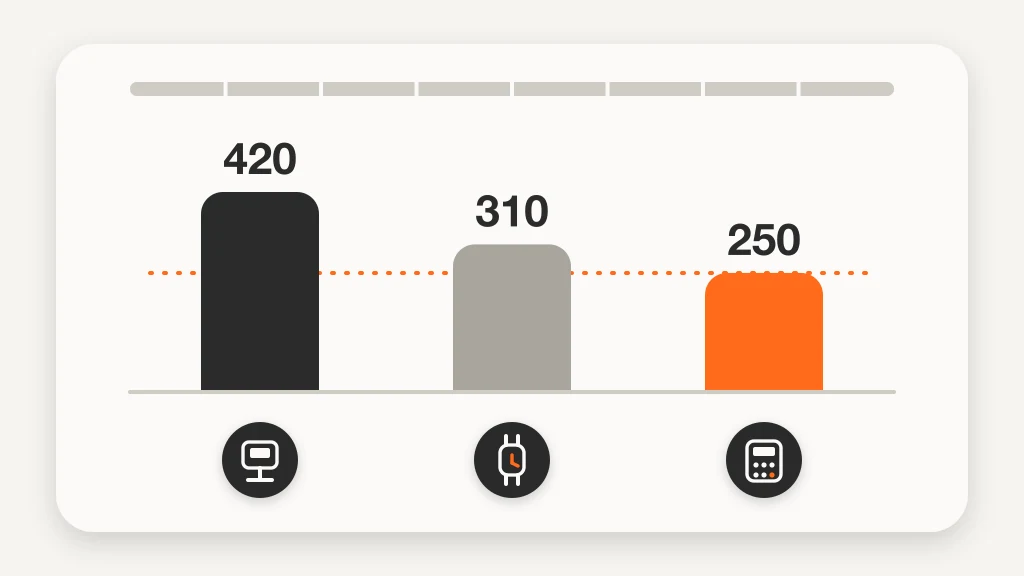
Illustrative scenario. Sam, 75 kg, does 40 minutes on an elliptical at moderate effort (RPE 6–7), with an average heart rate of 138 bpm on a chest strap. The console, still set to the previous user's 90 kg, shows 420 kcal. His watch reports 310 kcal of active energy. A MET estimate (5.0 × 75 kg × 40/60 h) gives about 250 kcal in total, roughly 200 above rest. Correcting the weight to 75 kg brings the console to about 350 for the same effort, closer but still the highest of the three. He treats 250–310 as his working range and uses the console only to repeat the same session. Numbers are illustrative.
Action steps
- Enter your real weight, and age if asked, on every machine, and check that it has not kept someone else's profile.
- Choose the elliptical or stair-stepper profile if your watch offers one, wear it snug or use a chest strap, and ignore hand-grip heart rate.
- Set intensity by the talk test and RPE, not the machine's level or target zone, and note the heart rate that matches each effort on each machine.
- Treat console and watch calories as estimates: compare them with the MET table, use them to repeat sessions, and let your weight trend over 2–4 weeks settle the question.
- Keep your hands off the rails and your posture upright. Use the elliptical for easy or low-impact days, the stair climber for short climbing intervals, and the treadmill when you need run-specific work.
Related guides
- Cross-training: building fitness while sparing your joints
- Calories burned: active, resting and total energy expenditure
- Heart rate zones explained: how to set and use them
- Injury prevention for runners: load, strength and listening early
- Zone 2 training: the science and how to do it right
FAQ
Are elliptical calories accurate? Not very. Console figures commonly read high and depend on the weight you enter; watches are closer but still estimates, often 10–30 % off. Use a MET estimate as a check and your weight trend as the final word.
Is a stair climber harder than a treadmill? Per minute it can be: the Compendium rates it around 9 METs, close to running at 9.7 km/h, and one study ranked it between the treadmill and the elliptical. Effort depends on level and on whether you lean on the rails.
What heart rate should I aim for on the elliptical? Whatever matches your effort: full sentences for easy work, a few words for hard. Heart rate can differ from running, so build zones for the machine instead of copying them.
Is the elliptical good for fat loss? It helps through the total energy you use over weeks, like any exercise. The best machine is the one you will keep using; check your weight trend rather than the console.
References
- Herrmann et al. (2024). 2024 Adult Compendium of Physical Activities: A third update of the energy costs of human activities. Journal of Sport and Health Science. https://doi.org/10.1016/j.jshs.2023.10.010
- Brown et al. (2010). Comparison of energy expenditure on a treadmill vs. an elliptical device at a self-selected exercise intensity. Journal of Strength and Conditioning Research. https://doi.org/10.1519/JSC.0b013e3181cb2854
- Bosch et al. (2021). Physiological and Metabolic Responses to Exercise on Treadmill, Elliptical Trainer, and Stepper: Practical Implications for Training. International Journal of Sport Nutrition and Exercise Metabolism. https://doi.org/10.1123/ijsnem.2020-0155
- Prieto-González and Yagin (2024). Energy expenditure, oxygen consumption, and heart rate while exercising on seven different indoor cardio machines at maximum and self-selected submaximal intensity. Frontiers in Sports and Active Living. https://doi.org/10.3389/fspor.2024.1313886
- O'Driscoll et al. (2020). How well do activity monitors estimate energy expenditure? A systematic review and meta-analysis of the validity of current technologies. British Journal of Sports Medicine. https://doi.org/10.1136/bjsports-2018-099643
For general information only. This is not medical advice — talk to a qualified professional about your health.
Keep reading
Sports
Walking for fitness and weight loss: pace, heart rate zones and how much is enough
9 min read
Sports
Pickleball and your health data: heart rate zones, calories and joint load
6 min read
Sports
Padel with a wearable: heart rate, calories and recovery between matches
7 min read
Training science
Zone 2 training: the science and how to do it right
4 min read
Sports
Japanese interval walking: the 3-minute fast / 3-minute slow method, step by step
8 min read
Devices & setup
Strava and MoveVitals: workouts, streams and devices that arrive via Strava
3 min read