

Sports
Skiing and snowboarding with a wearable: runs, vertical, heart rate and cold-weather battery
A watch in ski or snowboard mode logs runs, vertical and speed, but cold and altitude change how skiing heart rate and battery life behave. Here is what the numbers mean, what to look for in a ski watch and a six-to-eight-week pre-season plan.
Written by MoveVitals Editorial Collective
Community-authored educational content. Individual clinical review is identified only when a named review is actually recorded.
Editorial standards & corrections
Key takeaways
- Skiing heart rate swings with terrain: roughly 50–65% of max on lifts, 60–75% on groomed runs and 75–90% on steep terrain, moguls or deep snow.
- Lithium batteries lose capacity in the cold, so a watch that lasts all day indoors can go flat before the last lift; carry a power bank.
- A barometric altimeter reads air pressure, so a weather front can shift altitude by tens of metres; calibrate at the lift base and compare vertical only on the same device.
- A week of pre-season ski fitness is two easy aerobic sessions, one interval session of 6–8 × 90 seconds hard and two strength sessions.
- Stop and get medical help for chest pain or pressure, fainting, palpitations with dizziness, or breathlessness that does not settle with rest.
What a ski or snowboard mode records
Most sports watches have ski and snowboard profiles, and the Apple Watch Workout app has downhill skiing and snowboarding types, so snowboarding with an Apple Watch works much like on any other brand. GPS, a barometric altimeter and motion sensors tell descending from riding the lift and turn the day into a list of runs; which metrics show up depends on the model and software version.
| Metric | What it is | How far to trust it |
|---|---|---|
| Runs | Descents detected from altitude loss and speed | Good; a long stop can split one run in two |
| Vertical (descent) | Total height lost on runs | A few percent of difference from other devices and resort apps is normal |
| Speed and distance | From GPS | Fine for comparing days; short spikes inflate the maximum and tight turns shorten distance |
| Heart rate | Wrist optical sensor or chest strap | Steadier with a strap; see below |
| Calories | Estimate from heart rate, motion and profile | Rough; lifts and breaks may count as activity |
A barometric altimeter reads air pressure, so a weather front can shift the altitude by tens of metres. Calibrate it at a known elevation (lift bases are usually signed) and compare vertical on the same device from day to day, not against the resort's gate count. For energy costs, see calories burned by activity: moderate downhill skiing is about 5 METs for the time you are actually skiing, so a day spent mostly on lifts burns less than the clock suggests.
Skiing heart rate: what to expect
Skiing is stop-and-go: heart rate drops on the lift and jumps during a run, so the whole-day average sits far below the run peaks.
| Situation | Typical share of max HR | Notes |
|---|---|---|
| Lift ride, breaks | 50–65% | Shivering can keep it higher |
| Cruising groomed runs | 60–75% | Roughly zones 2–3 |
| Steep terrain, moguls, deep snow | 75–90% | A low stance and held legs push it up fast |
| Racing, long hard pitches | 90% and above | Brief for most recreational skiers |
These ranges are illustrative and vary with fitness, snow and terrain. Altitude raises heart rate at the same effort and may lower your maximum slightly (altitude). Cold, gloves, tight cuffs and vibration make wrist optical sensors less reliable, and chest straps are generally steadier (wrist vs strap accuracy). Judge effort by breathing and leg fatigue as well as the number (RPE), and stop when your technique falls apart: injuries tend to come late in the day.
Stop and get medical help for chest pain or pressure, fainting, palpitations with dizziness, or breathlessness that does not settle with rest. If you have a heart condition or high blood pressure, or have been inactive, check with your doctor before a strenuous ski trip. A watch shows a number; it cannot tell you why.
Cold, altitude and battery
- Battery. Lithium batteries lose capacity in the cold, so a watch that lasts all day indoors can go flat before the last lift. Start fully charged, wear it under your cuff, choose a lower-power GPS mode, turn off the always-on display and music, and keep a power bank in an inner pocket.
- Controls. Lock the touchscreen or use buttons with gloves, so a sleeve does not end the activity mid-run.
- SpO2. Readings are lower at altitude and noisier with cold hands. Treat wrist SpO2 as a rough indicator, not a diagnosis. Headache, nausea or unusual breathlessness mean rest and no higher; severe symptoms call for descent and medical help (Luks et al., 2019).
Choosing the best watch for skiing
Look for a barometric altimeter, automatic run and lift detection, battery life well beyond your longest day (cold cuts it), controls that work with gloves and chest strap support. Garmin, COROS, Suunto, Polar and Apple Watch all offer ski or snowboard modes, so compare battery life and controls instead of logos.
Ski season preparation: a 6–8 week workout plan
Skiing needs aerobic fitness for long days, legs that absorb and control force, and balance and trunk control. Start six to eight weeks before the trip and train three to four times a week, moving from base (weeks 1–2: easy aerobic work, strength basics) through build (3–5: heavier legs, slow lowering, intervals) to sharpening (6–7: single-leg strength, lateral power, balance), then keep the last few days light.
A sample week of ski fitness training:
- Two easy aerobic sessions of 30–60 minutes at about 60–70% of max HR: cycling, hill walking or jogging (zone 2).
- One interval session: 6–8 × 90 seconds hard with 90 seconds easy, much like runs separated by lift rides.
- Two strength sessions: squats, lunges, step-downs lowered over 3–4 seconds, single-leg hip hinges, calf raises, side planks and wall sits (strength training).
- Five minutes of balance work (single-leg stands; lateral hops from week 5 if your knees are healthy) plus hip and ankle drills (hip mobility, ankle mobility).
Knee injuries are among the most common in alpine skiing and wrist injuries in snowboarding; strength and balance work may help but cannot prevent them. Helmets are widely recommended, and wrist guards for beginner snowboarders. Common mistakes: only steady cardio, skipping single-leg work, hard sessions in the last week and skiing until exhausted because the pass is paid for.
In MoveVitals
Ski and snowboard are MoveVitals sport types, and overlapping recordings of the same session are merged into one workout. Garmin activities arrive with heart rate and GPS data, Suunto adds ascent, Polar sends duration, distance, heart rate and training load, and COROS sends the summary, with second-by-second streams via Strava if you connect it too. Apple Watch workouts reach MoveVitals through Strava only for now. Fields such as runs or vertical depend on what each service shares, so compare one workout with your watch. Time in heart rate zone is calculated from the heart rate stream.
Worked example
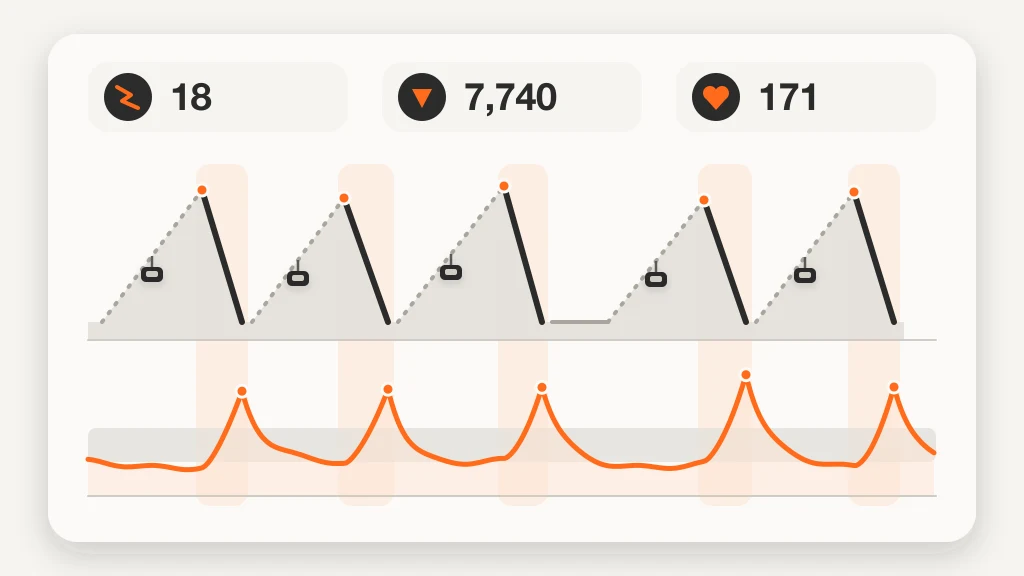
Illustrative scenario. Lena, 38, skis one week a year and starts eight weeks ahead: two easy 45–60 minute sessions at about 110–129 bpm (60–70% of an estimated maximum of 184), one session of 6 × 90 seconds hard, and two strength sessions with slow step-downs. On day two her watch logs 6 hours 30 minutes, 18 runs and about 7,700 m of vertical (18 × roughly 430 m), with 1 hour 50 minutes of actual skiing. Her average heart rate on runs is 128 bpm, peaking at 171 bpm on a steep black run, and near resting on lifts. Cold takes the battery from 100% to 62% by 3 pm, so she keeps the screen dim and a power bank in her pocket. Her vertical is about 6% above the resort's count, which is normal, so she compares only with her own earlier days. She stops at 3:30 pm when her legs tire. Figures are illustrative.
Action steps
- Start six to eight weeks before the trip: two easy aerobic sessions, one interval session and two strength sessions a week.
- Update the watch, charge it fully, pick a ski or snowboard mode with lower-power GPS and lock the screen.
- Calibrate the altimeter at the lift base and compare vertical only on the same device.
- Use a chest strap if wrist readings jump, and pace by breathing and leg fatigue as well as heart rate.
- Carry a power bank, take breaks and stop before you are exhausted; treat chest pain or altitude symptoms as reasons to stop and get help.
Related guides
- Altitude: acclimatisation, training camps and your wearable data
- Blood oxygen (SpO2): what wearables measure and when to worry
- Strength training for endurance athletes
- Hip mobility for runners and cyclists: a 10-minute routine
- Calories burned by activity: MET values, per-hour tables and how wearables estimate them
FAQ
What is a normal heart rate for skiing? It swings: roughly 50–65% of max on lifts, 60–75% on easy runs and 75–90% on steep or bumpy terrain. Judge it against your own maximum and how you feel.
Is the Apple Watch good for snowboarding? It has snowboarding and skiing workout types and handles heart rate and run summaries, but battery is the limit on long cold days. Its workouts reach MoveVitals through Strava.
Why does my watch show a different vertical from the resort? Watches estimate from air pressure, resorts count at lift gates, and weather shifts pressure. Calibrate the altimeter and compare days on the same device.
Can a watch tell me I have altitude sickness? No. Wrist SpO2 is a rough indicator; headache, nausea, dizziness or unusual breathlessness mean rest and no higher, and severe symptoms mean descend and seek medical help.
References
- Bent et al. (2020). Investigating sources of inaccuracy in wearable optical heart rate sensors. npj Digital Medicine. https://doi.org/10.1038/s41746-020-0226-6
- Luks et al. (2019). Wilderness Medical Society clinical practice guidelines for the prevention and treatment of acute altitude illness: 2019 update. Wilderness & Environmental Medicine. https://doi.org/10.1016/j.wem.2019.04.006
For general information only. This is not medical advice — talk to a qualified professional about your health.
Keep reading
Metrics explained
Resting heart rate: normal ranges and what changes it
4 min read
Metrics explained
VO2 max: what it means and how to improve it
4 min read
Metrics explained
Heart rate zones explained: how to set and use them
4 min read
Devices & setup
How MoveVitals handles multiple devices: provenance, duplicates and conflicts
5 min read
Sports
Walking for fitness and weight loss: pace, heart rate zones and how much is enough
9 min read
Metrics explained
Normal heart rate variability (HRV) by age: RMSSD vs SDNN
6 min read