

Sports
E-bikes and bike commuting: calories, heart rate and whether it counts as exercise
An e-bike does burn calories: pedal-assist riding is generally still moderate-intensity exercise, a little easier than a conventional bike, and a daily commute adds up to weekly activity minutes. Heart rate, not speed, shows how hard you are really working.
Written by MoveVitals Editorial Collective
Community-authored educational content. Individual clinical review is identified only when a named review is actually recorded.
Editorial standards & corrections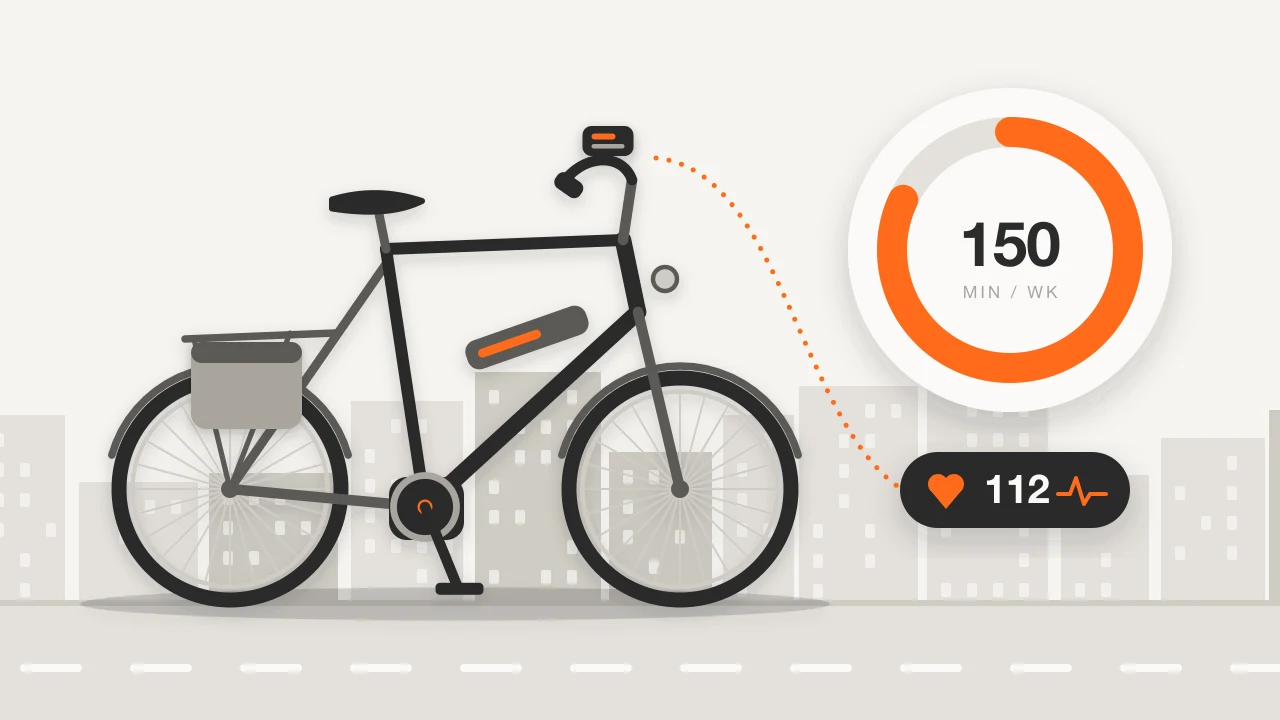
Key takeaways
- Moderate intensity is roughly 3–6 METs, so a 75 kg e-bike rider burns roughly 225–450 kcal an hour, against about 600 kcal on a conventional bike at 19–22 km/h.
- The WHO recommends 150–300 minutes of moderate activity a week, and a 15-minute commute each way, five days a week, makes 150 minutes.
- Only minutes at moderate effort count: waiting at lights, coasting and very high assist on flat roads may fall below it.
- Aim for roughly 50–70% of your maximum heart rate for moderate effort, and choose less assist on the flat and more on steep hills or tired days.
- Treat chest pain, fainting or palpitations with dizziness as reasons to stop and get help.
Do you burn calories on an electric bike?
Yes, with pedal assist. The motor adds power in proportion to what you put in, so you still pedal; only a throttle that drives the bike on its own removes most of the effort. Reviews of the research find that e-bike riding is generally at least moderate intensity: lower than on a conventional bike, higher than walking (Bourne et al., 2018).
Moderate intensity is roughly 3–6 METs, so e-bike calories burned come to about MET × body weight in kg × hours. For a 75 kg rider that is roughly 225–450 kcal an hour. A conventional ride at 19–22 km/h (12–14 mph) is about 8 METs, or around 600 kcal an hour for the same rider; see calories burned by activity.
| Assist level | How it feels | Heart rate vs a conventional bike |
|---|---|---|
| Off or eco | Like a conventional bike, slightly lighter | A little lower |
| Medium (tour) | Brisk walk to easy ride; talking is easy | Clearly lower, often zones 1–2 |
| High (turbo) | Hills flattened, light pedalling | Lowest; may fall below moderate on easy terrain |
Assist names and strengths differ by brand, and wind, hills, cargo and your weight change the picture. On a watch, speed-based calorie estimates can mislead because the motor adds speed; choose a cycling or e-bike profile and treat figures as estimates. A power meter on the pedals or cranks measures only your own contribution, not the motor's (power meter types).
E-bike heart rate: the honest metric
The motor cuts out at a legal speed limit (25 km/h in the EU), so speed and distance reflect the assist as much as your legs. Heart rate shows what the ride costs you. For fitness, aim for moderate effort: roughly 50–70% of maximum heart rate, or the talk test, where you can talk but not sing (heart rate zones). A maximum estimated from age can be off by 10–20 bpm (maximum heart rate), so use the talk test to check.
- Pick assist by effort. Less assist on flats for more work; more on hills, headwinds or tired days.
- Mind the sensor. A wrist optical sensor is usually fine at steady effort, but grip and handlebar vibration can disturb it; a chest strap is generally steadier (wrist vs strap accuracy).
- Compare like with like. Heat, hills, a heavy bag and poor sleep all move heart rate, so compare rides on the same route.
Is bike commuting enough exercise?
The WHO recommends 150–300 minutes of moderate activity a week for adults, plus muscle-strengthening on two or more days (Bull et al., 2020). A commute counts when the effort is moderate:
| One-way ride | Round trip | Five days a week | Share of 150 min |
|---|---|---|---|
| 10 min | 20 min | 100 min | Two-thirds |
| 15 min | 30 min | 150 min | All of it |
| 25 min | 50 min | 250 min | Within the 150–300 range |
Only minutes at moderate effort count: waiting at lights, coasting and very high assist on flat roads may fall below it. The wider bike commuting health benefits show up in cohort data: in a large UK cohort, cycling to work was associated with lower risks of cardiovascular disease, cancer and death from any cause than non-active commuting (Celis-Morales et al., 2017). That is observational and cannot prove cause, but it fits the activity guidelines.
Commuting suits older adults and people returning to exercise: assist helps with hills, heat and the first weeks, and a steady habit beats an occasional hard ride. If you have heart disease, symptoms or a long period of inactivity, check with your doctor first, and stop and get medical help for chest pain, fainting or palpitations with dizziness. If you track blood pressure, measure at rest on a regular schedule, not straight after a ride. Cycling registers few steps, so a commute day can look inactive in daily steps; look at active minutes or heart rate instead.
In MoveVitals
Rides from Garmin, COROS, Polar, Suunto, Wahoo and Strava arrive with duration, distance and heart rate, and e-bike rides are filed under the ride sport type with your other cycling. Time in heart rate zone is calculated from the heart rate stream, so you can see how much of a commute was moderate effort. Apple Watch rides reach MoveVitals through Strava, and duplicates from two sources are merged into one ride. Calories come from each device, so compare weeks on the same device.
Worked example
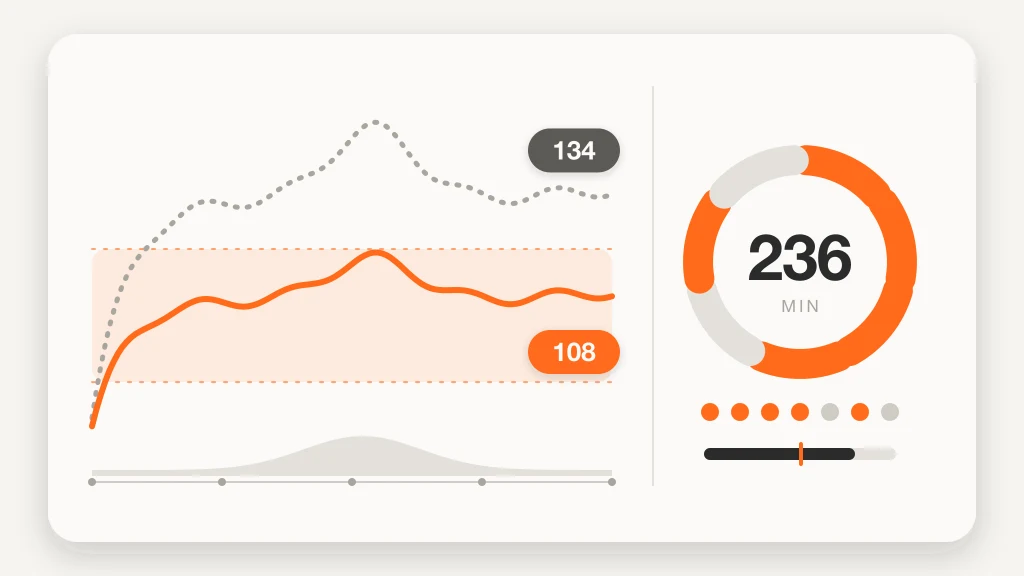
Illustrative scenario. Rosa, 52, 68 kg, commutes 6 km each way (about 22 minutes) four days a week on an e-bike and adds a 60-minute ride on Saturday. Her maximum heart rate is estimated at 168 bpm (220 − 52), so moderate effort is roughly 84–118 bpm (50–70%). On medium assist her commute averages 108 bpm (64%); on high assist it drops to 92 bpm (55%) and she barely notices the effort, so she uses high only on the steepest hill. The week adds up to 4 × 44 + 60 = 236 minutes, and her heart rate stream shows about 200 of them in the moderate range. At roughly 4.5 METs that is about 4.5 × 68 ≈ 306 kcal an hour, or around 1,200 kcal for the week; her watch's figure differs somewhat. Because cycling adds few steps, she tracks minutes instead. Figures are illustrative.
Action steps
- Record each commute with a cycling or e-bike profile on a watch or bike computer.
- Estimate your maximum heart rate and moderate range (about 50–70%), and confirm it with the talk test.
- Choose assist by effort: less on the flat, more on steep hills or tired days.
- Add up your minutes: aim for 150 or more a week at moderate effort, with a longer ride or a lower-assist day if you fall short.
- Add two muscle-strengthening sessions a week.
- Use a chest strap if wrist readings jump, and treat chest pain, fainting or palpitations with dizziness as reasons to stop and get help.
Related guides
- Calories burned by activity: MET values, per-hour tables and how wearables estimate them
- Heart rate zones explained: how to set and use them
- Daily steps: is 10,000 really the target?
- Blood pressure: categories, home measurement and what moves it
- Exercise for older adults: heart rate, strength, balance and fall prevention
FAQ
Do you burn calories on an electric bike? Yes. With pedal assist you still pedal, and studies find moderate-intensity effort: usually less than on a conventional bike but more than walking.
How many calories does an e-bike burn in an hour? For a 75 kg rider, roughly 225–450 kcal at moderate effort (3–6 METs), against about 600 kcal for a conventional ride at 19–22 km/h. Assist level, hills and wind move it either way.
Is bike commuting enough exercise? It can be, if the minutes are at moderate effort: 15 minutes each way, five days a week, makes 150 minutes. Add muscle-strengthening work twice a week.
Can bike commuting help weight loss? It adds energy use, but weight depends on overall intake and activity. A few hundred kcal per ride helps most when it replaces sitting, and a multi-week weight trend tells you more than one ride.
What heart rate should I aim for on an e-bike? Roughly 50–70% of your maximum for moderate effort, or the talk test. Lower the assist if you want to work harder.
References
- Bourne et al. (2018). Health benefits of electrically-assisted cycling: a systematic review. International Journal of Behavioral Nutrition and Physical Activity. https://doi.org/10.1186/s12966-018-0751-8
- Celis-Morales et al. (2017). Association between active commuting and incident cardiovascular disease, cancer, and mortality: prospective cohort study. BMJ. https://doi.org/10.1136/bmj.j1456
- Bull et al. (2020). World Health Organization 2020 guidelines on physical activity and sedentary behaviour. British Journal of Sports Medicine. https://doi.org/10.1136/bjsports-2020-102955
- Bent et al. (2020). Investigating sources of inaccuracy in wearable optical heart rate sensors. npj Digital Medicine. https://doi.org/10.1038/s41746-020-0226-6
For general information only. This is not medical advice — talk to a qualified professional about your health.
Keep reading
Sports
Walking for fitness and weight loss: pace, heart rate zones and how much is enough
9 min read
Devices & setup
Polar watches and MoveVitals: Polar Flow sync explained
3 min read
Devices & setup
Garmin Connect and MoveVitals: activities, health and Body Battery
3 min read
Devices & setup
How MoveVitals handles multiple devices: provenance, duplicates and conflicts
5 min read
Training science
Zone 2 training: the science and how to do it right
4 min read
Mobility & stretching
Mobility vs flexibility: what's the difference and what do you need?
3 min read