

Sports
Nordic walking: technique, calories and heart rate with poles
Nordic walking is brisk walking with poles you push against the ground, which brings the arms, shoulders and back into the work of the legs. This guide covers the technique, how much extra heart rate and calorie burn to expect compared with plain walking, and how watches cope with the arm swing.
Written by MoveVitals Editorial Collective
Community-authored educational content. Individual clinical review is identified only when a named review is actually recorded.
Editorial standards & corrections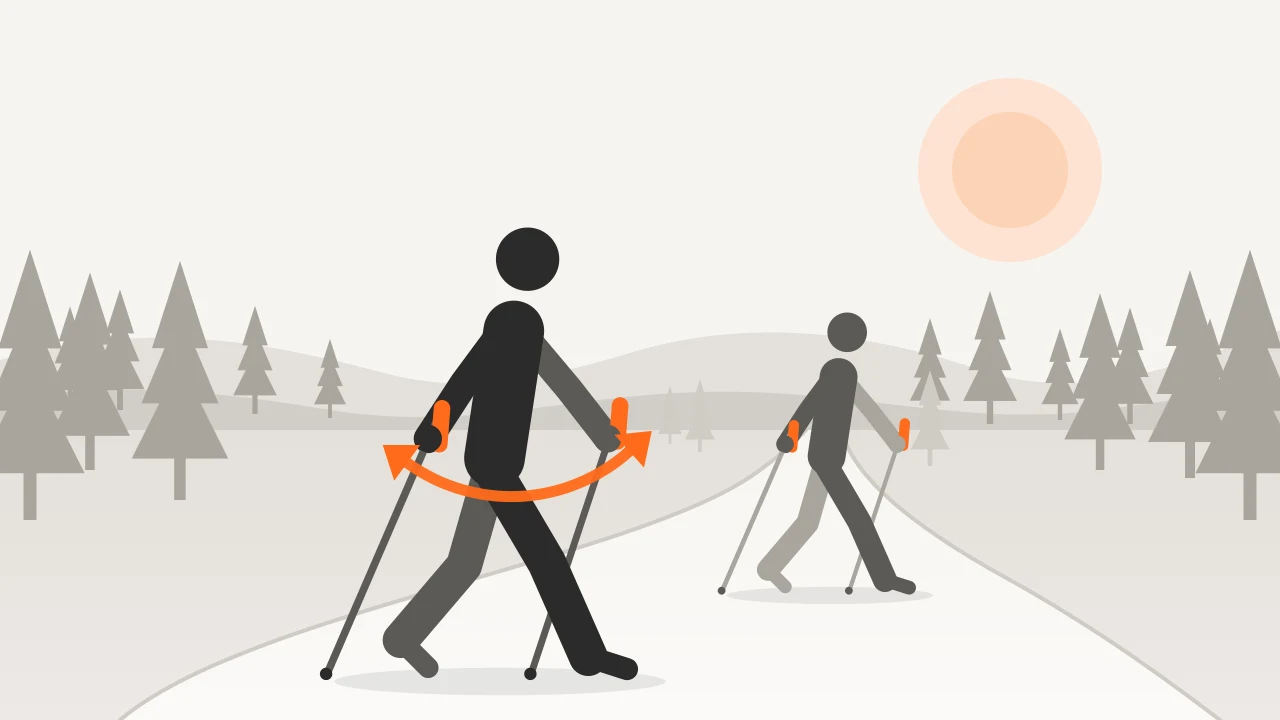
Key takeaways
- At the same speed, Nordic walking raises energy cost by roughly 10–25 % and heart rate by a few beats, sometimes 10 or more, while perceived effort stays similar or slightly higher.
- A common starting pole length is about 0.68 × your height, roughly 115 cm for someone 170 cm tall.
- The benefit comes from pushing poles angled behind you and opening the hand as it passes the hip; poles planted ahead of the body add little.
- Holding poles changes the arm swing wrist step counters rely on, so judge a walk by duration, GPS distance, heart rate and an effort of 5–6 out of 10.
- Check with your doctor first if you have a heart, bone or balance condition.
Nordic walking started in Finland as summer training for cross-country skiers. Today it is mostly a low-impact way to turn an ordinary walk into a fuller-body workout, and it suits all ages. The poles have a strap or glove-style grip so you can push through the hand and let go at the end of each stroke. That is the difference from trekking poles, which are mainly for balance on trails and descents (see hiking and trekking).
Nordic walking vs walking: what actually changes
| Aspect | Walking without poles | Nordic walking |
|---|---|---|
| Muscles used | Mainly legs and hips | Legs plus triceps, shoulders, upper back and core |
| Heart rate at the same speed | Baseline | Typically a few beats per minute higher, sometimes 10 or more |
| Energy cost | Baseline | Roughly 10–25 % higher, depending on technique and speed |
| Perceived effort | Baseline | Usually similar or slightly higher |
| Steps per kilometre | Baseline | Often fewer, because the stride lengthens |
A systematic review of controlled and observational studies concluded that Nordic walking beats brisk walking without poles on measures such as heart rate and oxygen consumption, and reported benefits for resting heart rate, blood pressure, exercise capacity and quality of life in a range of groups. Study quality varies, so treat the extra benefit as modest.
Technique: the cues that matter
- Size the poles. A common starting point is about 0.68 × your height: roughly 115 cm for someone 170 cm tall. With the tip on the ground beside you, the elbow should be near 90°.
- Stand tall. Eyes ahead, shoulders relaxed, a slight lean from the ankles rather than the waist.
- Walk as normal. Opposite arm and leg swing together. The pole tips trail diagonally behind you and touch down around your front heel.
- Push, then open. Keep a light grip while the pole is planted; as your hand passes the hip, push back and down, then open the hand and let the strap carry the pole forward.
- Let the stride grow. The push lengthens your step naturally. Roll from heel to toe rather than overreaching.
Common errors: poles too long (shrugged shoulders), tips planted ahead of the body, a clenched grip that never opens, short bent arms with no push, and skipping the straps.
What a watch records and gets wrong
- Distance and pace. GPS works well in open sky; tree cover and tall buildings add error. Because poles lengthen your stride, the same distance takes fewer steps.
- Steps. Wrist step counting expects a particular arm swing. With poles in your hands the pattern changes, so some watches undercount and some overcount. A study comparing pedometer and accelerometer readings in ordinary and Nordic walking found them poorly suited to comparing energy cost between the two. Test yours: count 100 steps by hand and compare. For pole walks, judge by distance and time rather than steps (see daily steps).
- Heart rate. Wrist sensors usually follow steady walking reasonably well, but a tight grip, gloves and cold can add noise. If the trace looks flat or lags, a chest strap such as the Polar H10 is the reference; see wrist heart rate accuracy.
Calories and effort: what to expect
Energy use is roughly MET × body weight × hours. The 2011 Compendium of Physical Activities lists brisk walking at about 5.5–6 km/h at around 4.3 METs. Assuming Nordic walking costs about 20 % more at the same speed (inside the range studies report, but not a guarantee) gives the estimates below. The full tables are in calories burned by activity.
| Body weight | Brisk walking, ~4.3 MET (kcal/h) | Nordic walking, ~5.2 MET (kcal/h) |
|---|---|---|
| 60 kg | ~260 | ~310 |
| 75 kg | ~320 | ~390 |
| 90 kg | ~390 | ~470 |
Aim for an effort of 5–6 out of 10: you can talk but not sing, which for many people is roughly 60–75 % of maximum heart rate (see heart rate zones). Because heart rate runs a little higher at the same speed, let effort set your pace rather than a fixed km/h. The World Health Organization recommends 150–300 minutes of moderate activity a week for adults, and Nordic walking counts as moderate.
Building it into your week
- Start with 2–3 walks of 20–40 minutes on flat ground and focus on the push. Triceps, lats and forearms usually feel it first.
- Build to 30–60 minutes, three or four times a week, mostly at a conversational effort.
- Once the technique is smooth, add one session with hills or intervals, for example 5 × 3 minutes brisk with strong pushes and 2 minutes easy.
- Loosen the upper back first with a few minutes of thoracic mobility so the arms swing freely.
Poles can steady your balance and encourage an upright posture, and many people find them comfortable with stiff knees or hips, although the evidence on joint load is mixed. If you have heart disease, osteoporosis, balance problems or recent surgery, ask your doctor or physiotherapist first. Stop and seek medical help for chest pain or pressure, fainting, palpitations with dizziness, or breathlessness out of proportion to the effort; a watch cannot diagnose any of these.
In MoveVitals
Walks from Apple Health, Garmin, COROS, Polar, Suunto and Strava arrive as walking activities (a Nordic walking label from the source is treated as walking) with duration, distance, heart rate and energy. Time in zone comes from the heart-rate stream. If a watch and a chest-strap app recorded the same walk, MoveVitals merges them into one session (how conflicts are resolved). Because pole walking can lower the step total, judge these sessions by distance, duration and heart rate.
Worked example
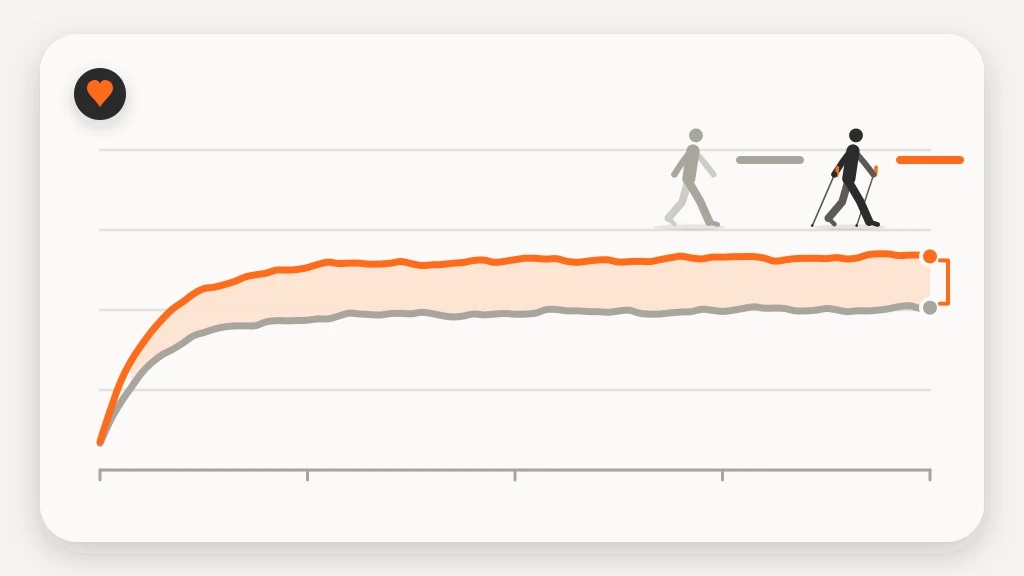
Illustrative scenario. Helen, 58, weighs 70 kg and walks the same 5 km loop in 50 minutes (6 km/h). Her estimated maximum is about 167 bpm (208 − 0.7 × 58). Without poles her watch shows an average of 112 bpm (about 67 %) and the effort feels like 4 out of 10. With poles at the same pace the average is 121 bpm (about 72 %) and the effort feels like 5. The MET estimates above give roughly 250 kcal for the plain walk (4.3 × 70 kg × 0.83 h) and 300 kcal with poles. Her watch's walking profile barely notices the difference (255 vs 270 kcal), and its step count drops from about 6,600 to 5,900 for the same loop because her stride is longer. Helen stops comparing step totals and tracks distance, time and average heart rate instead.
Action steps
- Size your poles (about 0.68 × your height), use the straps or glove grips and fit rubber tips for pavements.
- Practise the push on flat ground for 10 minutes: poles trailing behind, the hand opening at the end of each stroke.
- Build from 2–3 walks of 20–40 minutes to 30–60 minutes, three or four times a week, at an effort of 5–6 out of 10.
- Judge each walk by duration, GPS distance, heart rate and effort, and count 100 steps by hand to see how your watch copes with poles.
- Add one hill or interval walk a week once the technique is smooth, and check with your doctor first if you have a heart, bone or balance condition.
Related guides
- Walking for fitness and weight loss: pace, heart rate zones and how much is enough
- Heart rate zones explained: how to set and use them
- Calories burned by activity: MET values, per-hour tables and how wearables estimate them
- Exercise for older adults: heart rate, strength, balance and fall prevention
- Daily steps: is 10,000 really the target?
FAQ
Is Nordic walking better than regular walking? At the same speed it usually raises heart rate and energy cost and works the upper body, so you get more from the same time. The extra benefit is modest and depends on good technique.
Is Nordic walking good for older adults? Many older adults like it: it is low impact, sociable and the poles add stability. Ask your doctor first if you have a heart, bone or balance condition (see exercise for older adults).
Why does my watch show fewer steps with poles? Holding poles changes the arm swing that wrist step counters rely on, and the stride is longer. Count 100 steps by hand to see your watch's error and use distance and time instead.
References
- Tschentscher et al. (2013). Health Benefits of Nordic Walking: A Systematic Review. American Journal of Preventive Medicine. https://doi.org/10.1016/j.amepre.2012.09.043
- Polechoński et al. (2015). Applicability of pedometry and accelerometry in the calculation of energy expenditure during walking and Nordic walking. Journal of Physical Therapy Science. https://doi.org/10.1589/jpts.27.3525
- Ainsworth et al. (2011). 2011 Compendium of Physical Activities: A Second Update of Codes and MET Values. Medicine & Science in Sports & Exercise. https://doi.org/10.1249/MSS.0b013e31821ece12
- Bull et al. (2020). World Health Organization 2020 guidelines on physical activity and sedentary behaviour. British Journal of Sports Medicine. https://doi.org/10.1136/bjsports-2020-102955
- Tanaka et al. (2001). Age-predicted maximal heart rate revisited. Journal of the American College of Cardiology. https://doi.org/10.1016/S0735-1097(00)01054-8
For general information only. This is not medical advice — talk to a qualified professional about your health.
Keep reading
Sports
Walking for fitness and weight loss: pace, heart rate zones and how much is enough
9 min read
Sports
Japanese interval walking: the 3-minute fast / 3-minute slow method, step by step
8 min read
Sports
Hiking and trekking: heart rate on climbs, pacing and how to train for it
8 min read
Devices & setup
Polar watches and MoveVitals: Polar Flow sync explained
3 min read
Sports
Pickleball and your health data: heart rate zones, calories and joint load
6 min read
Devices & setup
How MoveVitals handles multiple devices: provenance, duplicates and conflicts
5 min read