

Sports
Treadmill vs outdoor running: calibrating pace, incline and heart rate
Treadmill and outdoor runs feel different for three reasons: there is no wind, the belt speed and the distance on your watch may not match reality, and indoor heat pushes heart rate up. A 1 % incline, a quick calibration and a few heart-rate habits make treadmill data comparable with your outdoor runs.
Written by MoveVitals Editorial Collective
Community-authored educational content. Individual clinical review is identified only when a named review is actually recorded.
Editorial standards & corrections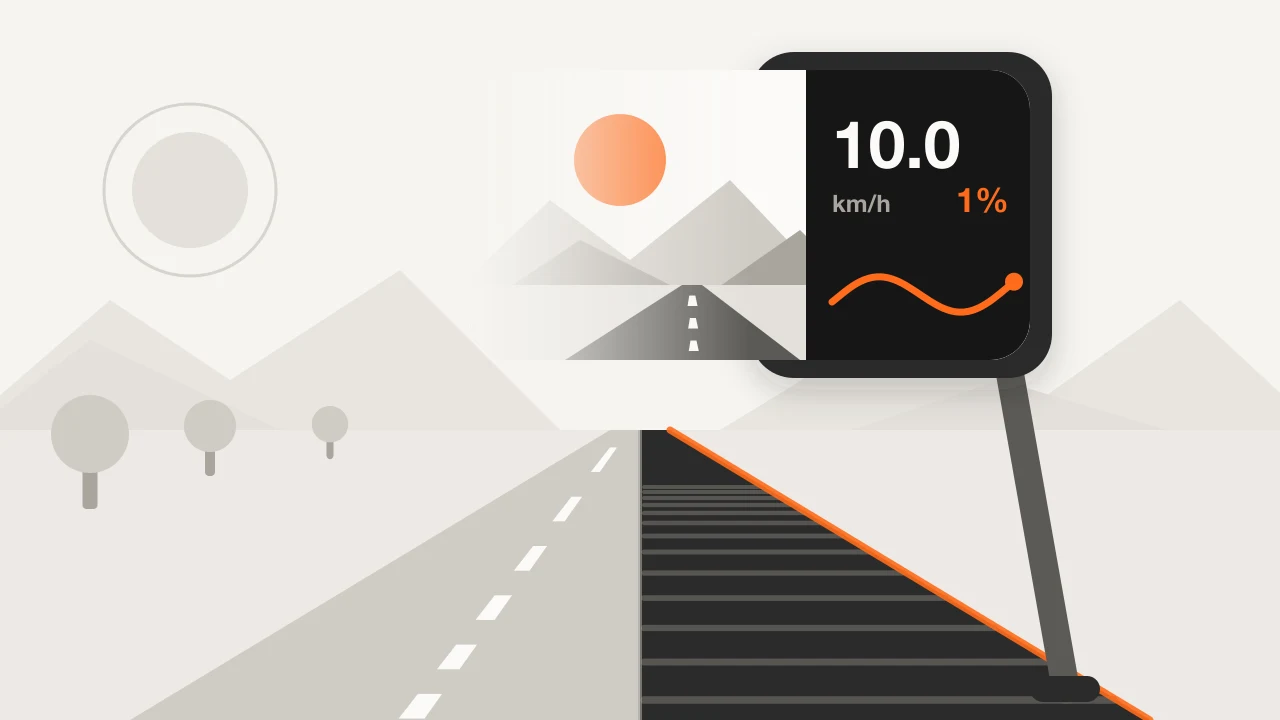
Key takeaways
- Use a 1 % incline for tempo, interval and race-pace work to match outdoor effort, and 0–1 % for easy runs.
- Treadmill speed converts directly to pace: 10.0 km/h is 6:00 per km, 12.0 km/h is 5:00 and 15.0 km/h is 4:00.
- To check a belt, tape a mark on it, film it for 60 seconds at 6 km/h and calculate turns × loop length × 0.06.
- Calibrate the watch to the treadmill's distance after a steady run of at least 20–30 minutes, because a few percent of error is common until then.
- In still, warm air heart rate creeps up at the same pace, so use a fan, a cooler room and drinks, and treat the talk test or RPE as a second check.
A treadmill run is not a worse run, just a different measuring environment. Pace, distance, calories and heart rate all behave a little differently, and a few minutes of set-up make the data trustworthy. This guide covers why the numbers differ, how to convert and calibrate them, and which workouts suit the treadmill. For outdoor pacing see running pace.
Why treadmill and outdoor data differ
| Factor | Treadmill | Outdoors | What to do |
|---|---|---|---|
| Air resistance | None | Grows with speed; headwind or tailwind | Use a 1 % incline for outdoor-equivalent effort |
| Surface and mechanics | Moving belt, even and slightly cushioned; mechanics are largely comparable with small differences at footstrike (Van Hooren 2020) | Hills, turns, camber, varied surfaces | Do not assume the same soreness; vary incline for variety |
| Speed source | Belt motor setting, which can be off by a few percent | GPS | Check the belt with a marker |
| Distance on a watch | Estimated from arm swing and cadence | GPS | Calibrate to the console distance, or use a footpod |
| Heat | Still, warm air and little cooling by evaporation | Wind, shade and changing temperature | Fan, cooler room, fluids |
None of this makes treadmill data worthless. Compare like with like (treadmill with treadmill, outdoors with outdoors) and use the corrections below when you mix them.
Pace, speed and the 1 % incline
Treadmills show speed in km/h or mph, runners think in min/km or min/mile. Use this table to convert:
| km/h | mph | min/km | min/mile |
|---|---|---|---|
| 8.0 | 5.0 | 7:30 | 12:04 |
| 9.0 | 5.6 | 6:40 | 10:44 |
| 10.0 | 6.2 | 6:00 | 9:39 |
| 11.0 | 6.8 | 5:27 | 8:47 |
| 12.0 | 7.5 | 5:00 | 8:03 |
| 13.0 | 8.1 | 4:37 | 7:26 |
| 14.0 | 8.7 | 4:17 | 6:54 |
| 15.0 | 9.3 | 4:00 | 6:26 |
| 16.0 | 9.9 | 3:45 | 6:02 |
Running outdoors means pushing through air, a cost that rises with speed. A classic laboratory study found that a 1 % treadmill grade best reflected the energy cost of outdoor running across the speeds it tested (Jones and Doust 1996). In practice, that gives a simple rule for treadmill pace versus outdoor pace: set 1 % for tempo runs, intervals and race-pace work, and 0–1 % for easy runs, where the difference is small. There is no further conversion factor; calibration matters more than any formula.
Beyond 1 %, incline raises effort quickly. Treat 2–3 % as a rolling-hill feel and 4–6 % as steep hill repeats, cut the speed when you add incline, and judge those efforts by heart rate and breathing, not by holding your flat pace. A belt also holds pace exactly, which is useful for pacing practice but removes the small self-corrections you make outdoors.
Calibrating the belt and your watch
- Check the belt. Measure the length of the belt loop, put a strip of tape on it, set a walking speed of 6 km/h (3.7 mph) and film the belt for 60 seconds while you walk on it, with the phone propped beside it. Speed (km/h) = turns per minute × loop length (m) × 0.06. For example, 30 turns on a 3.30 m loop is 99 m per minute, or 5.9 km/h. Within 1–2 % of the console is fine; a bigger gap means trusting a calibrated watch or footpod more than the console, or asking for the machine to be serviced.
- Calibrate the watch. After a steady run of at least 20–30 minutes, enter the treadmill's distance in the watch (most sports watches offer this at the end of an indoor run), so that its pace and stride estimate learn from it. Some watches also improve from GPS runs outdoors; menus differ by brand, so check yours.
- Consider a footpod or a connected treadmill. A stride sensor generally gives steadier indoor pace than wrist motion alone, and some treadmills broadcast speed and incline over Bluetooth so that a watch or app can record them.
- Choose your source. Once checked, use the console for pace and distance and the watch or strap for heart rate. Do not mix numbers from different sources when you compare runs.
Heart rate, heat and drift indoors
- Expect a higher heart rate at the same pace. In still, warm air you lose heat less efficiently, so heart rate creeps up and cardiac drift shows earlier.
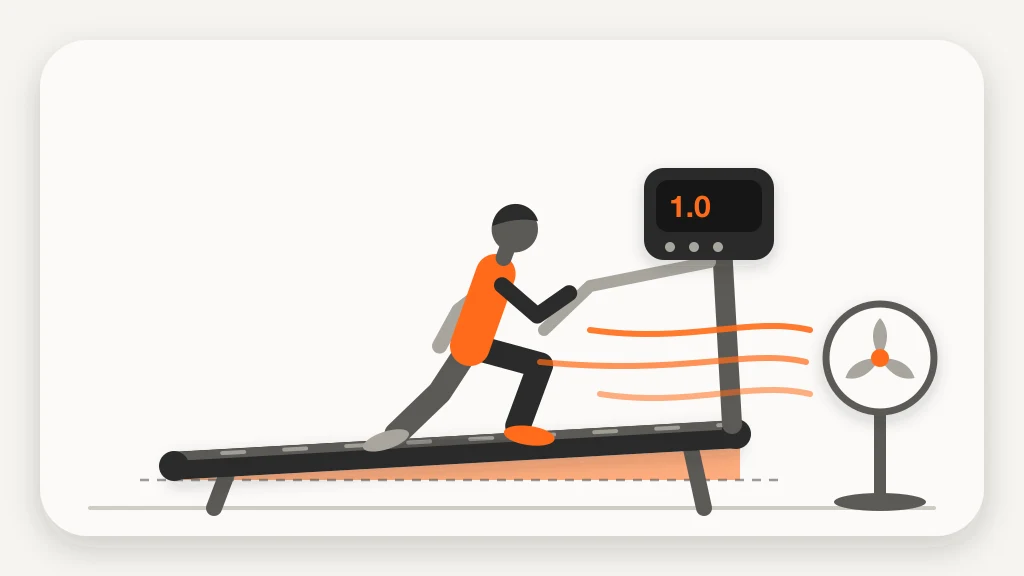
- Cool yourself. A fan aimed at your upper body, a cooler room and regular drinks keep indoor heart rate closer to your outdoor numbers.
- Zones need tolerance. Do not hold an outdoor heart rate zone rigidly in a hot room; use the talk test or RPE as a second check. Incline also raises heart rate, so hill repeats are an effort target, not a pace target.
- Wrist or strap. Optical accuracy varies by activity (Bent 2020). Wrist heart rate is generally fine on steady runs, while a chest strap is more reliable for intervals (wrist heart rate accuracy).
- When it looks wrong. If heart rate seems very high for an easy effort and heat does not explain it, see high heart rate during exercise. Stop and seek medical help for chest pain, fainting or palpitations with dizziness.
Treadmill workouts for runners
| Session | Structure | Speed and incline | Effort |
|---|---|---|---|
| Easy / zone 2 | 30–60 min continuous | Conversational speed, 0–1 % | RPE 3–4, fan on |
| Progression | 10 min easy, then raise speed by 0.5 km/h every 5 min for 20–25 min, 5 min cool-down | 1 % after the warm-up | Finish at RPE 6–7 |
| Tempo | 10 min warm-up, 20–30 min at threshold (or 2 × 12–15 min with 2–3 min easy), 10 min cool-down | Between 10K and half marathon pace, 1 % (tempo runs) | RPE 6–7 |
| Intervals | 10 min warm-up, 6 × 3 min hard with 2 min easy jog, 10 min cool-down | About 5K effort, 1 % (interval training) | RPE 8 |
| Hill repeats | 10 min warm-up, 8 × 1 min at 5–6 % incline with 90 s easy jog at 0–1 %, 10 min cool-down | Slower than flat pace, judged by effort | RPE 7–8 |
Set the speed before each repeat rather than chasing it on the move, step onto the side rails for big changes, use the safety clip, and avoid holding the handrails, which lowers the real effort. Keep most runs easy and add one or two of these sessions a week. Cadence works the same indoors (cadence).
Calories and common mistakes
Treadmill console calories assume an average person, and holding the handrails lowers the real energy cost, so treat them as rough. Watch estimates use heart rate and your profile and are also estimates; see calories burned by activity. A running cost of about 1 kcal per kg per kilometre is a useful check, and 1 % incline adds little. If your goal is fat loss, easy running matters more than any "fat-burn" setting; see running for weight loss.
- Comparing paces without 1 % or calibration. The same number means different things on different machines.
- Trusting the watch distance blindly. A few percent of error is common until it has been calibrated.
- Overheating. No fan or fluids makes heart rate and perceived effort climb.
- Running every session at one speed. Vary speed and incline instead of grinding the same pace.
- Holding the rails or looking down. It changes your form and lowers the effort.
In MoveVitals
Runs recorded on a treadmill arrive under the Treadmill sport when the source labels them as a treadmill, indoor or virtual run, for example Garmin's treadmill activity or a Zwift run via Strava (Zwift with MoveVitals). Runs from Apple Health arrive as plain runs. MoveVitals treats treadmill and outdoor runs as the same family for weekly running volume and when deciding whether two recordings are the same workout, such as a watch and another app via Strava, so one session is not counted twice. It shows the distance and pace each source recorded and does not correct them, so fix a calibration problem on the watch or treadmill where it starts. Heart rate streams stay with each source, so you can compare indoor and outdoor easy runs at similar pace and temperature.
Worked example
Illustrative scenario. Mia's threshold pace outdoors is about 4:55/km (12.2 km/h), and for winter she moves her tempo run onto a treadmill. First she films the belt: 30 turns in a minute on a 3.30 m loop is 99 m per minute, or 5.9 km/h at a 6.0 setting, within 1 %, so the console is reliable. Her 50-minute easy run shows 10.0 km on her watch (5:00/km) but 9.6 km on the console (about 5:13/km), a gap of roughly 4 %. She enters the console distance in the watch, and her next runs differ by 0.1 km or less. For the tempo session she sets 12.2 km/h at 1 %: 10 minutes easy, 2 × 15 minutes at tempo with 3 minutes jogging, then a cool-down. In a 24 °C room without a fan, her heart rate averages 171 bpm in the tempo blocks, against about 166 bpm outdoors at the same pace. The next week, with a fan, a cooler room and drinks, it is 167 bpm. She concludes that the extra beats were heat, not lost fitness. Figures are illustrative.
Action steps
- Check belt speed once: tape a mark on the belt, film it for 60 seconds at 6 km/h and calculate turns × loop length × 0.06.
- Calibrate your watch's distance to the treadmill after a steady 20–30 minute run, and re-check it after a few weeks.
- Set 1 % for tempo, intervals and race-pace work, and 0–1 % for easy runs.
- Use a fan, a cooler room and drinks, and read heart rate with some tolerance rather than rigidly.
- Use the templates once or twice a week and keep the rest of your running easy.
- Compare treadmill runs with treadmill runs and outdoor runs with outdoor runs.
Related guides
- Running pace: GPS accuracy, grade-adjusted pace and training paces
- Heart rate zones explained: how to set and use them
- Cardiac drift (decoupling): why heart rate rises at the same pace
- Tempo runs: how fast, how long and why they work
- Interval training and HIIT: designing sessions that work
FAQ
Is treadmill running easier than outdoor running? At the same displayed speed and 0 % incline it can feel easier, because there is no air resistance, which is why 1 % is used. In a warm room without a fan it can feel harder because heart rate and heat build up.
What incline should I use on the treadmill? Use 1 % for tempo, interval and race-pace work to match outdoor effort, and 0–1 % for easy runs. Use 2–6 % when you want hills, and lower the speed.
How do I convert treadmill pace to outdoor pace? At 1 % incline, the same speed is roughly the same effort as outdoors. Calibrating the belt and your watch matters more than any conversion factor; use the table above to convert between km/h, mph and pace.
Why is my heart rate higher on the treadmill? Still, warm air reduces cooling, so heart rate rises more and drifts earlier. A fan, a cooler room and fluids usually bring it closer to your outdoor numbers.
Are treadmill calorie counts accurate? They are rough estimates based on an average person, and holding the rails lowers the real cost. Your watch's number is an estimate too, so pick one source, stay with it and judge results by your weekly weight trend.
References
- Jones and Doust (1996). A 1% treadmill grade most accurately reflects the energetic cost of outdoor running. Journal of Sports Sciences. https://doi.org/10.1080/02640419608727717
- Van Hooren et al. (2020). Is Motorized Treadmill Running Biomechanically Comparable to Overground Running? A Systematic Review and Meta-Analysis of Cross-Over Studies. Sports Medicine. https://doi.org/10.1007/s40279-019-01237-z
- Bent et al. (2020). Investigating sources of inaccuracy in wearable optical heart rate sensors. npj Digital Medicine. https://doi.org/10.1038/s41746-020-0226-6
- Shcherbina et al. (2017). Accuracy in Wrist-Worn, Sensor-Based Measurements of Heart Rate and Energy Expenditure in a Diverse Cohort. Journal of Personalized Medicine. https://doi.org/10.3390/jpm7020003
For general information only. This is not medical advice — talk to a qualified professional about your health.
Keep reading
Training science
Zone 2 training: the science and how to do it right
4 min read
Training science
Polarized training (80/20): easy most of the time, hard some of the time
4 min read
Training science
Interval training and HIIT: designing sessions that work
4 min read
Sports
Trail running with a watch: heart rate, climbs and pacing by effort
7 min read
Mobility & stretching
Mobility vs flexibility: what's the difference and what do you need?
3 min read
Devices & setup
Strava and MoveVitals: workouts, streams and devices that arrive via Strava
3 min read