

Sports
Yoga and your wearable: heart rate, calories, HRV and stress
Yoga looks quiet in wearable data: heart rate usually stays well below running or cycling, calorie burn is modest, and the effect on HRV and stress is small and best judged overnight rather than mid-class. Knowing how a wrist sensor misreads poses lets you use yoga data without over-trusting it.
Written by MoveVitals Editorial Collective
Community-authored educational content. Individual clinical review is identified only when a named review is actually recorded.
Editorial standards & corrections
Key takeaways
- Gentle hatha is about 2.5 METs, or 150 kcal an hour at 60 kg and 190 at 75 kg, while power or fast vinyasa is about 4.0 METs, or 240 and 300.
- Plank, downward dog and arm balances bend the wrist and can make the optical signal drop out, so wear the watch snug about a finger-width above the wrist bone or use an armband or chest strap.
- A review of 59 studies found higher vagal-related HRV during practice and, in regular practitioners, at rest, but most studies were small and of limited quality.
- After a hard session, 20–40 minutes of gentle hatha, yin or restorative practice makes a good easy day, with benefits that are mostly relaxation, comfort and range of motion.
- Skip hot or power classes on recovery days, and if HRV is well below your usual range with resting heart rate up, choose restorative practice or rest.
Yoga is one of the most common activities in wearable logs and one of the least well measured. It is mostly slow, has little forward movement and loads the wrists, which is exactly where watches struggle. This guide explains what yoga looks like in your data, why sensors misread it and how to use it for recovery.
What yoga looks like in your data
| Style | Typical intensity | Heart rate you may see | MET | kcal per hour at 60 / 75 kg |
|---|---|---|---|---|
| Gentle hatha, slow flow | Light | Close to everyday levels, rising a little in standing poses | about 2.5 | 150 / 190 |
| Sun salutations, steady vinyasa | Light to moderate | Rises and falls with each flow | about 3.3–3.5 | 200 / 250 |
| Power or fast vinyasa, ashtanga | Moderate | Higher, can sit in zones 2–3 | about 4.0 | 240 / 300 |
| Yin and restorative | Light | Low, often falling during long holds | about 2 or less (estimate) | 120 / 150 or less |
| Hot yoga | Depends on the style | Raised by the heat as well as the effort | no standard value | Estimates may run high |
MET values for hatha (2.5), sun salutations (3.3) and power yoga (4.0) come from the Compendium of Physical Activities (Ainsworth 2011); the others are approximations. By convention, 3–6 METs counts as moderate intensity, so gentle yoga is light activity while fast flow can reach moderate. A systematic review of yoga's energy cost found most practices in the light range, with faster, sequence-based styles reaching moderate intensity (Larson-Meyer 2016). At 70 kg, an hour of hatha costs about 175 kcal (2.5 × 70), roughly what a 2.5 km run costs. For the full table and the formula, see calories burned by activity.
Heart rate during yoga does not track effort the way it does in running. Slow breathing, held poses and calm concentration keep it low, while heat, inversions, balance challenges and sustained muscle tension can push it up without much energy being spent. Treat the trace as a rough picture of the class, not a precise load measure.
Why wrist sensors misread poses
- Flexed, weight-bearing wrists. Plank, downward dog and arm balances bend the wrist and change how the sensor sits on the skin, so the optical signal can drop out or turn noisy. Optical accuracy generally varies with activity and contact (Bent 2020).
- Gripping and muscle tension. Clenching the forearm and moving tendons add motion artefact.
- Sweat and slipping. A damp band on a hot day or a mat moves more than you think.
- Little stepping. Estimates that lean on motion see almost nothing in yoga and tend to under-count, while estimates built on heart rate can over-count when heat or tension lifts heart rate.
- Wrong activity. Automatic detection of yoga is generally less reliable than for running or cycling. Start a Yoga activity manually; most sports watches and WHOOP have one, and Apple Watch has a Yoga workout.
Fixes: wear the watch snug about a finger-width above the wrist bone, try the other wrist or the forearm, and use an optical armband or a chest strap if you want a clean trace (see wrist heart rate accuracy). Otherwise accept the gaps and read the shape of the class.
Yoga, HRV and stress
A review of 59 studies on yoga and HRV found higher vagal-related HRV during practice and, in regular practitioners, at rest, but most studies were small and of limited quality, so firm conclusions are premature (Tyagi and Cohen 2016). Slow breathing, a core part of many classes, raises HRV while you do it (Laborde 2022); see slow breathing and HRV biofeedback.
What your watch shows needs careful reading. Stress scores are derived from heart rate and HRV, mid-class values are noisy because of movement, and some devices pause scoring during a recorded activity (stress scores). A better approach is to look at overnight HRV, resting heart rate and sleep averaged over weeks and compared with your own range (HRV, personal baseline). As with any evening exercise, a late, hot or intense class can raise sleeping heart rate and lower HRV that night.
Yoga as active recovery
- When. The day after a hard run, ride or lifting session, 20–40 minutes of gentle hatha, yin or restorative practice, plus hip and thoracic mobility work (hip mobility, mobility vs flexibility).
- What to expect. The benefits are mostly relaxation, comfort and range of motion rather than proven faster muscle repair, so treat it as an easy day, not a recovery hack (active recovery).
- What to avoid on recovery days. Hot or power classes, long strength-style holds and deep stretches into sore muscles.
- Check the data. If HRV is well below your usual range and resting heart rate is up, choose restorative practice or rest.
How much yoga, and does it count?
There is no single right number. Two to four sessions of 30–60 minutes a week, or 10–20 minutes daily, suit most people. Gentle yoga is light activity, so it does not replace 150 minutes of moderate aerobic activity a week; the WHO guidelines also recommend muscle-strengthening on two or more days, to which some strength-oriented styles can contribute (Bull 2020), and yoga adds mobility and balance. For weight loss the energy cost is modest, so pair it with walking or running (running for weight loss) and eating habits.
This is general information, not medical advice. If you feel faint, or have chest pain or palpitations with dizziness, stop and seek medical help. If you have a heart or blood pressure condition or are pregnant, ask your clinician about hot yoga and inversions.
In MoveVitals
Yoga workouts, and Pilates ones, arrive from Apple Health (including Apple Watch), Garmin, WHOOP, Oura, Polar, COROS, Suunto and Strava and are filed under one Yoga sport. Heart rate and calories come with each workout, each source's calories stay separate and are never added together, and duplicates are merged when two devices recorded the same class. HRV, resting heart rate and sleep from your wearables sit alongside, so you can compare nights after evening classes with other nights. Garmin's average stress is stored as its own metric, and other brands' stress values are kept separate (stress scores). MoveVitals does not infer the yoga style or a change in stress from a workout.
Worked example
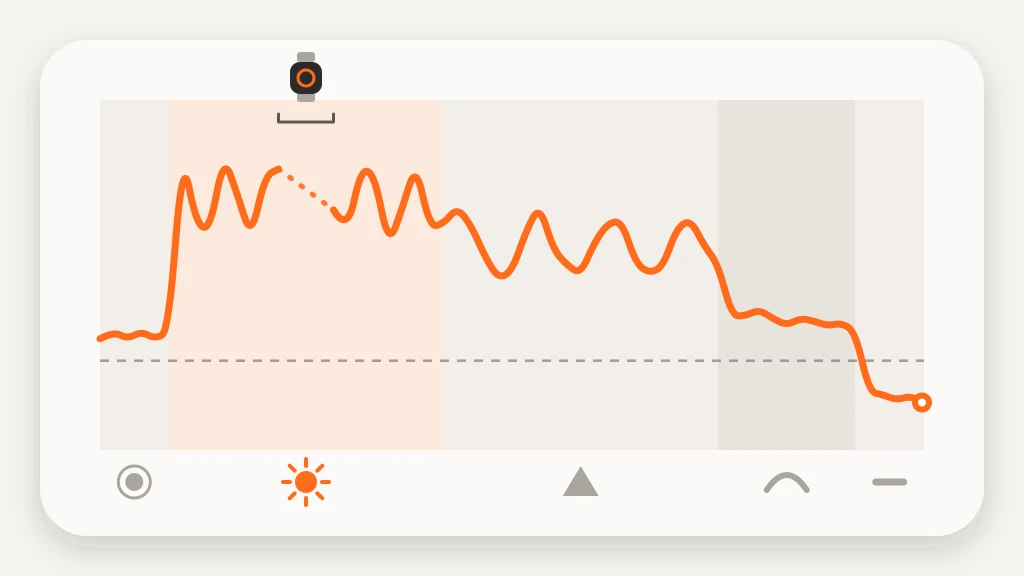
Illustrative scenario. Mei, 34, weighs 60 kg, has a maximum heart rate of about 186 bpm and takes a 60-minute vinyasa class with a Yoga activity running on her watch. Her heart rate is about 80 bpm during 5 minutes of centring, 110–131 bpm in the sun salutations, 95–115 bpm in standing and balance poses, 80–90 bpm in floor stretches and 62–66 bpm in the final 5 minutes of rest, below her pre-class 74 bpm. The average is 101 bpm and the peak 131 bpm, about 70 % of her maximum. For roughly four minutes of plank and downward-dog sequences the trace drops out because her wrist is bent; the next class she moves the watch a finger-width up her forearm and the gaps shrink. Her watch reports 190 kcal; the Compendium value for flow of about 3.5 METs gives 3.5 × 60 × 1 = 210 kcal, within 10 %. Over two weeks her overnight HRV after evening classes averages 51 ms against 49 ms on other evenings, inside her usual 44–56 ms range. She reads that as no detectable change rather than proof either way, and keeps yoga for mobility and how it feels. Figures are illustrative.
Action steps
- Start a Yoga activity manually and wear the watch snug, about a finger-width above the wrist bone, or on the other wrist.
- Read heart rate as a rough trace of the class: expect light intensity and gaps in weight-bearing poses, and use an armband or chest strap if you want clean data.
- Treat calories as estimates (gentle hatha about 2.5 METs, fast flow about 4) and cross-check with the MET table.
- Judge HRV and stress by overnight HRV, resting heart rate and sleep averaged over weeks against your own baseline, not by mid-class scores.
- Use gentle, yin or restorative sessions as active recovery after hard days and keep hot or power classes for days when you are fresh.
- Aim for 2–4 sessions a week alongside aerobic and strength training, and stop if you feel faint.
Related guides
- Slow breathing and HRV biofeedback: calming your nervous system
- Active recovery: when easy movement beats complete rest
- Stress scores on wearables: what they really measure
- Mobility vs flexibility: what's the difference and what do you need?
- Normal heart rate variability (HRV) by age: RMSSD vs SDNN
- Pilates and your wearable: why calories look low and what to track instead
FAQ
How many calories does yoga burn? It depends on style and body weight. Gentle hatha is about 2.5 METs, roughly 150–190 kcal an hour at 60–75 kg, and power or fast vinyasa about 4 METs, roughly 240–300 kcal. Your watch's figure is an estimate and can be off in either direction.
What heart rate is normal during yoga? There is no single number. Gentle classes often stay well below your running zones, flow classes rise and fall with each sequence, and hot classes can run higher because of the heat. Compare with your own range, and if the numbers seem very high for the effort, see high heart rate during exercise.
Does yoga improve HRV? HRV tends to rise during practice and may be higher at rest in regular practitioners, but the evidence is limited and varies by style. Look at overnight HRV and resting heart rate over several weeks rather than one class.
Why does my watch show gaps or odd calories during yoga? Flexed, weight-bearing wrists, gripping, sweat and a loose band disturb the optical sensor, and yoga has little motion for the watch to use. Start a Yoga activity, wear the watch snug a little higher on the forearm, or use a strap or armband.
How many times a week should I do yoga? Two to four sessions of 30–60 minutes suit most people, with gentle sessions fitting easily on recovery days. Add aerobic and strength training for fitness and weight goals, because yoga alone burns relatively little.
References
- Ainsworth et al. (2011). 2011 Compendium of Physical Activities: A Second Update of Codes and MET Values. Medicine & Science in Sports & Exercise. https://doi.org/10.1249/MSS.0b013e31821ece12
- Larson-Meyer (2016). A Systematic Review of the Energy Cost and Metabolic Intensity of Yoga. Medicine & Science in Sports & Exercise. https://doi.org/10.1249/MSS.0000000000000922
- Tyagi and Cohen (2016). Yoga and heart rate variability: A comprehensive review of the literature. International Journal of Yoga. https://doi.org/10.4103/0973-6131.183712
- Laborde et al. (2022). Effects of voluntary slow breathing on heart rate and heart rate variability: A systematic review and a meta-analysis. Neuroscience & Biobehavioral Reviews. https://doi.org/10.1016/j.neubiorev.2022.104711
- Bent et al. (2020). Investigating sources of inaccuracy in wearable optical heart rate sensors. npj Digital Medicine. https://doi.org/10.1038/s41746-020-0226-6
- Bull et al. (2020). World Health Organization 2020 guidelines on physical activity and sedentary behaviour. British Journal of Sports Medicine. https://doi.org/10.1136/bjsports-2020-102955
For general information only. This is not medical advice — talk to a qualified professional about your health.
Keep reading
Metrics explained
Resting heart rate: normal ranges and what changes it
4 min read
Devices & setup
How MoveVitals handles multiple devices: provenance, duplicates and conflicts
5 min read
Sports
Walking for fitness and weight loss: pace, heart rate zones and how much is enough
9 min read
Metrics explained
Normal heart rate variability (HRV) by age: RMSSD vs SDNN
6 min read
Metrics explained
VO2 max: what it means and how to improve it
4 min read
Metrics explained
Heart rate zones explained: how to set and use them
4 min read