

Sports
Swimming for fitness and weight loss: how often, how long and what to track
Swimming for weight loss works best as two to three regular sessions a week, built up from 20–30 minutes: it is low impact and kind to the joints, but the calorie count on your watch is only a rough estimate. Here is how often to swim, what a 30–45 minute session looks like and what a watch can track in the pool.
Written by MoveVitals Editorial Collective
Community-authored educational content. Individual clinical review is identified only when a named review is actually recorded.
Editorial standards & corrections
Key takeaways
- Beginners do best with 2 swims a week of 20–30 minutes in short 25–50 m repeats with 20–30 s rests, adding 5–10 minutes or one set at a time.
- Thirty minutes of actual easy to moderate freestyle at 70 kg uses about 6 METs or 210 kcal, against about 290 kcal for running at 8 km/h.
- In 45 minutes with rests at the wall, drills and kick sets, perhaps 30–35 minutes is real swimming, so real sessions usually land below calorie tables.
- Swimming counts toward the WHO's 150–300 minutes of moderate activity a week, but fat loss depends on your weekly energy balance rather than on one pool session.
- Swim where a lifeguard is present when starting out, and stop and seek medical advice for chest pain, fainting or palpitations with dizziness.
How often and how long should you swim?
The WHO 2020 guidelines recommend 150–300 minutes of moderate or 75–150 minutes of vigorous activity per week for adults, plus muscle-strengthening on two or more days. Swimming counts, and so does everything else, so the target is a weekly total rather than a pool target. At first, two or three swims a week with a rest day between works well for most people.
| Goal | Swims per week | Session length | Notes |
|---|---|---|---|
| Starting out | 2 | 20–30 min | Short repeats (25–50 m) with 20–30 s rests |
| General fitness | 2–3 | 30–45 min | Mostly steady, plus a few faster repeats |
| Weight loss with food changes | 3–4 | 40–60 min | Brisk walking on other days to reach the weekly total |
| Building swim fitness | 3–4 | 45–60 min | One session of faster repeats, one longer steady swim |
Progress by 5–10 minutes (or one extra set) at a time, and change only one thing per week. Moderate swimming feels like 5–6 out of 10 (see RPE): you are breathing hard but could say a few words at the wall.
Swimming calories: swimming vs running
Energy use is usually estimated in METs, multiples of resting energy use. In the Compendium of Physical Activities, easy-to-moderate freestyle laps are about 6 METs and fast, vigorous freestyle about 10, against about 4.3 for brisk walking and about 8.3 for running at 8 km/h. Calories ≈ MET × body weight (kg) × hours, and the result includes your resting energy.
| 30 minutes of actual movement, 70 kg | METs (approx.) | kcal (approx.) |
|---|---|---|
| Brisk walking, 5.6 km/h (3.5 mph) | 4.3 | 150 |
| Easy to moderate freestyle laps | 6 | 210 |
| Running, 8 km/h (5 mph) | 8.3 | 290 |
| Fast, vigorous freestyle | 10 | 350 |
Real sessions usually land below the table, for two reasons:
- Not all of the session is swimming. In 45 minutes with rests at the wall, drills and kick sets, perhaps 30–35 minutes is real swimming.
- Your watch estimates. Heart rate runs lower in water (see heart rate in swimming), wrist sensors are less reliable there and a watch cannot see your drag, so treat its calories as a range.
Is swimming or running better for fat loss? Per minute of continuous effort, running usually burns more; per week, the better choice is the one you will keep doing. Swimming is easy on knees and hips, which lets many people do more of it. For other activities see calories burned by activity.
Sample swim workouts for beginners: 30 and 45 minutes
These assume a 25 m pool. Rest 15–30 seconds between repeats and keep a steady effort (RPE 5–6) unless told otherwise.
| Session | Structure | Distance (approx.) |
|---|---|---|
| Beginner, about 30 min | Warm-up 200 m easy; drills 4 × 25 m, 20 s rest; main set 8 × 50 m steady, 25 s rest; cool-down 100 m easy | 800 m |
| Improver, about 45 min | Warm-up 300 m + 4 × 25 m drills; main set 3 × 200 m, 30 s rest, then 4 × 100 m, 20 s rest; kick 4 × 50 m with a board; cool-down 100 m | 1,700 m |
If you cannot swim 25 m in a row yet, swim half lengths, hold the wall or use a kickboard for part of each length. A rest at the wall is part of the session, not a failure.
Technique basics that change your numbers
- Body position. Look down, keep the head in line with the spine and the hips near the surface. A small, steady kick from the hips beats a big splashy one. Less drag means the same speed for less effort.
- Long before fast. Speed is stroke rate times distance per stroke. Beginners often spin their arms with short strokes; lengthen the stroke first and let the rate rise later.
- Shoulders and upper back. Swimming repeats an overhead movement hundreds of times, so build volume gradually and keep the upper back mobile (see thoracic mobility). Sharp or lasting shoulder pain is a reason to stop and ask a clinician.
On the watch, better efficiency tends to show as fewer strokes per length at the same pace or a lower SWOLF. Compare only the same stroke, pool and device — see swim pace, CSS and SWOLF.
What your watch tracks in the pool
In a pool the watch does not use GPS. Its accelerometer and gyroscope detect push-offs and turns to count lengths, and distance is lengths times the pool length you set.
| Data | How reliable | Tip |
|---|---|---|
| Lengths and distance | Generally good when the pool length is right and you turn cleanly | Check the pool length (25 m, 25 yd, 50 m) before you start |
| Pace per 100 m, rest time | Generally good | Pace is time ÷ distance × 100; rests are logged separately |
| Stroke type, stroke count, SWOLF | Less reliable in drills, kick sets and mixed strokes | Use for trends within the same stroke and pool |
| Heart rate | Often patchy; wrist optical is weaker in water | Spot-check with a 10-second pulse count at the wall |
For the limits of wrist sensors in general see how accurate is wrist heart rate?. Open water works differently (GPS, no lengths): see open-water swimming.
Common mistakes
- One non-stop swim to exhaustion. Short repeats with rests let you keep good technique for longer.
- Wrong pool length on the watch. Every distance, pace and SWOLF number is wrong if it is.
- Eating back the calories. Use the watch figure as a range, not a budget.
- Ignoring warning signs. Swim where a lifeguard is present when starting out, and stop and seek medical advice for chest pain, fainting or palpitations with dizziness.
In MoveVitals
Pool swims from Garmin, COROS, Polar, Suunto, WHOOP and Strava arrive as swim activities with the duration, distance and heart rate the source provides (Apple Watch swims come via Strava), and the same swim from two sources is merged. SWOLF and stroke counts stay in each maker's own app. Time in zone comes from the heart-rate stream, so treat it as approximate when the wrist trace is patchy; see training load.
Worked example
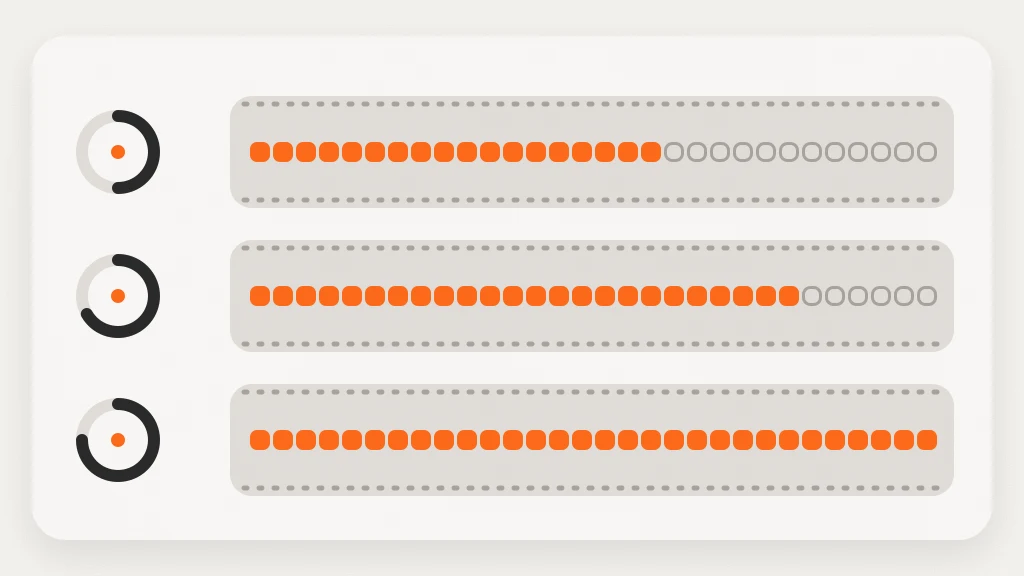
Illustrative scenario. Nina, 38, weighs 72 kg and swims in a 25 m pool. In week 1 she does two 30-minute sessions of 25–50 m repeats with 20–30 s rests, about 800 m each at roughly 2:35 per 100 m. She adds 5–10 minutes to one session every week or so, and by week 6 swims three times: 30, 40 and 45 minutes (about 900, 1,200 and 1,500 m) at around 2:15 per 100 m, with her stroke count down from 22 to 19 per length. Her watch reports 380 kcal for the 45-minute swim, but only about 35 minutes of it was swimming: 6 METs × 72 kg × 0.58 h ≈ 250 kcal. She plans with the lower figure. About 90 minutes of real swimming plus two brisk 30-minute walks bring her close to 150 minutes of moderate activity a week.
Action steps
- Start with two 20–30 minute swims a week built from short repeats and 20–30 s rests, not one non-stop swim.
- Set the pool length on your watch and use the pool-swim profile every time.
- Every week or two, add 5–10 minutes or one set, and make one session a little faster.
- Spend a few minutes of each swim on drills and track stroke count per length as a technique signal.
- Judge sessions by time, distance, pace per 100 m and effort; treat calories and wrist heart rate as rough.
- Add walking and some strength work to reach about 150 minutes a week and to protect your shoulders.
Related guides
- Swim pace per 100 m, CSS and SWOLF: reading your pool data
- Heart rate in swimming: why it runs lower, zones in the pool and wrist-sensor accuracy
- Calories burned by activity: MET values, per-hour tables and how wearables estimate them
- Cross-training: building fitness while sparing your joints
- Heart rate zones explained: how to set and use them
FAQ
How often should I swim to lose weight? Two to three times a week is a sensible start, building to three or four sessions of 40–60 minutes if you enjoy it. Weight loss depends on weekly energy balance, so combine swimming with other activity and your food choices.
Is swimming better than running for weight loss? Running usually burns more per minute of continuous effort, but swimming is gentler on the joints, so many people can do more of it. The best choice is the one you will keep doing.
What is a length, and what is a lap? A length is one way across the pool; a lap strictly means there and back, though many people use the words loosely. In a 25 m pool, 800 m is 32 lengths and 1 km is 40.
Why is my watch's swim heart rate low or missing? Heart rate runs lower in water and wrist optical sensors are less reliable there. Check it with a 10-second pulse count at the wall, and see the swimming heart rate guide.
References
- Bull et al. (2020). World Health Organization 2020 guidelines on physical activity and sedentary behaviour. British Journal of Sports Medicine. https://doi.org/10.1136/bjsports-2020-102955
- Ainsworth et al. (2011). 2011 Compendium of Physical Activities: A Second Update of Codes and MET Values. Medicine & Science in Sports & Exercise. https://doi.org/10.1249/MSS.0b013e31821ece12
For general information only. This is not medical advice — talk to a qualified professional about your health.
Keep reading
Sports
Walking for fitness and weight loss: pace, heart rate zones and how much is enough
9 min read
Mobility & stretching
Mobility vs flexibility: what's the difference and what do you need?
3 min read
Training science
Zone 2 training: the science and how to do it right
4 min read
Sports
Japanese interval walking: the 3-minute fast / 3-minute slow method, step by step
8 min read
Recovery & sleep
Overreaching and overtraining: warning signs and what to do
4 min read
Training science
Polarized training (80/20): easy most of the time, hard some of the time
4 min read