

Metrics explained
Heart rate in swimming: why it runs lower, zones in the pool and wrist-sensor accuracy
Swimming heart rate usually runs lower than in running at the same effort, so zones borrowed from land can be too high. Here is why, what is normal, how to set pool zones and how to measure it reliably.
Written by MoveVitals Editorial Collective
Community-authored educational content. Individual clinical review is identified only when a named review is actually recorded.
Editorial standards & corrections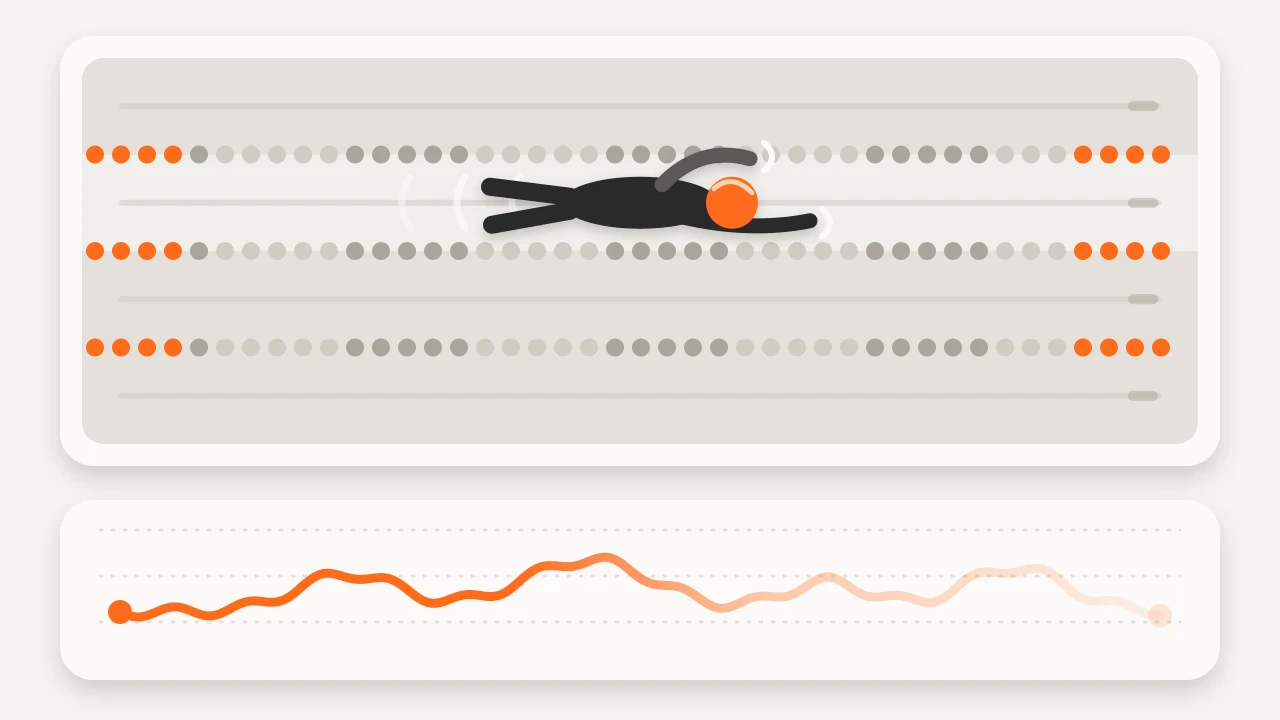
Key takeaways
- Lying horizontal, being cooled and pressed by water and using a smaller muscle mass let the heart deliver the same output with fewer beats, with gaps from running of a few bpm to 15–20 bpm.
- Without a swim test, start from roughly your running maximum minus 10–15 bpm, then apply zone 2 at 60–70 % and zone 4 at 80–90 %.
- A 40-year-old with a 180 bpm running maximum has a rough swim maximum of 165–170 bpm and a pool zone 2 of about 101–117 bpm, give or take 10 bpm.
- Bluetooth and ANT+ barely travel through water, so use a memory-recording strap or armband, or count your pulse for 10 seconds at the wall and multiply by six.
- Run a maximum test only when healthy, rested and watched, and for chest pain, dizziness, fainting or palpitations stop at the wall, get out and seek medical care.
Swimming heart rate vs running: why it runs lower
- Body position and water pressure. Lying horizontal and being squeezed by water pushes blood toward the chest, which raises stroke volume, so the heart delivers the same output with fewer beats.
- Cooling. Water carries heat away, so less blood goes to the skin and the heart has less thermoregulation to support.
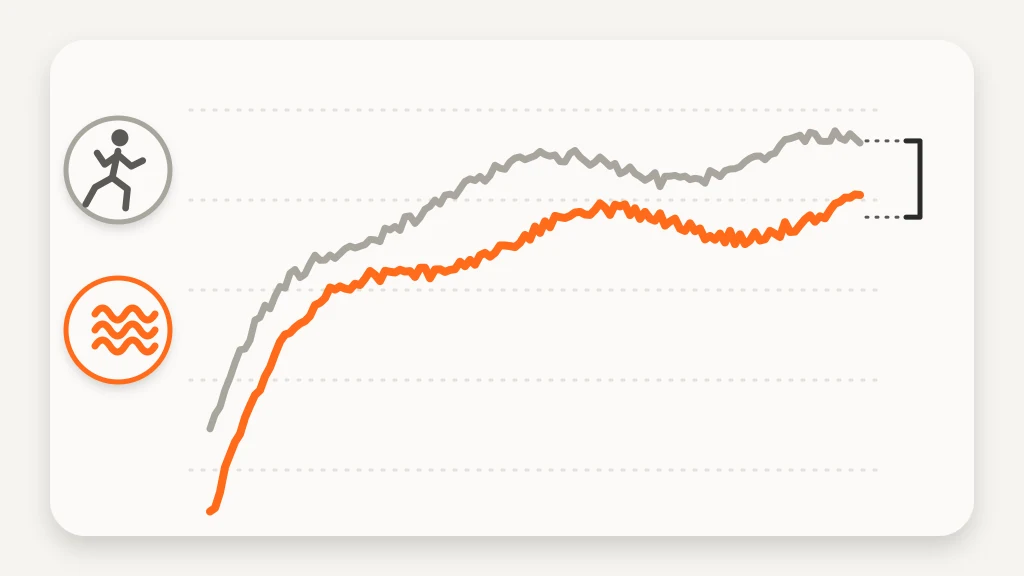
- Smaller active muscle mass. Swimming is arm-led. In the study above peak oxygen uptake was also lower in the water (3.58 vs 3.97 L/min), while at the same oxygen uptake heart rates were similar. The gap shows mainly in hard efforts, where you cannot reach your running peak.
- Breathing. Face immersion and controlled breathing can slow the heart slightly (the "diving reflex"), more with cold water and breath-holding, but it is a minor factor for most swimmers.
So "about 10 bpm lower" is an average: individual gaps run from a few bpm to 15–20 bpm.
What is a normal heart rate when swimming?
There is no single normal: it depends on age, fitness and effort. A heart rate of 120 bpm may be an easy swim for one person and hard for another, so compare it with your own swim maximum. As a starting point, here is a swim heart rate by age table (Tanaka running maximum, rough swim maximum of that minus 10–15 bpm, and zone 2 as 60–70 % of the mid-point):
| Age | Running max | Rough swim max | Zone 2 in the pool |
|---|---|---|---|
| 20 | 194 bpm | 179–184 bpm | ≈ 109–127 bpm |
| 30 | 187 bpm | 172–177 bpm | ≈ 105–122 bpm |
| 40 | 180 bpm | 165–170 bpm | ≈ 101–117 bpm |
| 50 | 173 bpm | 158–163 bpm | ≈ 96–112 bpm |
| 60 | 166 bpm | 151–156 bpm | ≈ 92–107 bpm |
| 70 | 159 bpm | 144–149 bpm | ≈ 88–103 bpm |
Treat every number as ±10 bpm; your own test beats any table (see maximum heart rate).
How to set your swimming heart rate zones
- Do a swim test, only when healthy and rested, with someone watching. Never test hard alone, and ask a doctor first if you are unsure. After 10–15 minutes easy with a few builds, swim three 100 m repeats building effort (about 80 %, 90 %, all-out) with 60–90 seconds rest. Count your pulse for 10 seconds straight after each and multiply by six. Heart rate falls within seconds of stopping, so the count slightly underestimates the true peak.
- Apply the five-zone percentages to that swim maximum (see heart rate zones): zone 2 is 60–70 %, zone 4 is 80–90 %.
- Cross-check with pace and effort. In the pool, pace is often the better anchor; see swim pace, CSS and SWOLF. Stroke rate is swimming's cadence (see cadence). Short 25–50 m repeats are too brief for heart rate, which lags, so judge them by pace and feel.
How to measure heart rate in the water
| Method | Works in water? | Notes |
|---|---|---|
| Wrist optical in swim mode | Partly | Many watches record wrist heart rate in the pool, but less often and less reliably than on land: water between skin and sensor, wrist angles, push-offs |
| Chest strap streaming to a watch | No | Bluetooth and ANT+ signals barely travel through water, and straps can slip on push-offs |
| Swim-capable strap or armband with memory | Yes | Records in the water and syncs afterwards, for example Polar Verity Sense or Garmin HRM-Tri and HRM-Swim; check your model's manual |
| 10-second pulse count at the wall | Yes | Neck or wrist, count for 10 seconds straight after stopping, multiply by six |
A swimming heart rate monitor is therefore either a memory-recording strap or armband, or your own fingers. For the general limits of optical sensors see wrist heart rate accuracy, and for strap basics the Polar H10 guide.
Common mistakes
- Importing running zones. They push you to swim harder than intended to "reach" the numbers.
- Trusting a wrist trace without a spot-check. Compare it with a wall count once.
- Using heart rate for 25–50 m repeats. It lags; use pace and feel.
- Testing your maximum alone or when unwell. If you get chest pain, dizziness, fainting or palpitations, stop at the wall, get out and seek medical care.
If fat loss is the goal, weekly swimming time and energy balance matter more than the exact zone (see the fat-burning heart rate zone). Swimming is also a low-impact option on easy days (see cross-training).
In MoveVitals
Swim workouts arrive from Garmin, Polar, COROS, Suunto, WHOOP and Strava (Apple Watch swims come via Strava) and are recognised as swimming. MoveVitals keeps every record with its source, and groups the same swim sent by two providers when they overlap by at least 50 % of the shorter recording; the heart rate shown follows your source priorities. Time in zone is calculated from the heart-rate stream, so treat it as approximate when the wrist trace is patchy, and compare swims with swims rather than with runs.
Worked example
Illustrative scenario. Maya, 36, has a running maximum of about 188 bpm. In her first pool sessions her watch showed 140–150 bpm on what felt like hard 100s, which did not match her running-based zones. She runs a swim test: 600 m easy with drills, then three 100 m swims building effort with 75 seconds rest. Her 10-second counts straight after each are 24, 27 and 29 beats, or 144, 162 and 174 bpm. She sets her swim maximum at about 175 bpm, 13 below her running maximum, which also shows her wrist trace was reading low. Zone 2 is 60–70 % of 175, or 105–123 bpm; zone 4 is 80–90 %, or 140–158 bpm. Her running zone 4 (150–169 bpm) would have meant swimming at 86–97 % of her swim maximum. She now uses heart rate for continuous sets, pace for 25–50 m repeats, and spot-checks the watch against a wall count. Figures are illustrative.
Action steps
- Do not import running zones: start from a swim maximum, or roughly your running maximum minus 10–15 bpm.
- When healthy and rested, with someone watching, run the three-repeat swim test and take 10-second pulse counts at the wall.
- Choose how you will measure: a swim-capable strap or armband with memory, or wall counts. Treat wrist swim traces as rough.
- Use heart rate for continuous and long sets, and pace or effort for short repeats. Compare swim with swim.
- Keep conditions consistent (pool temperature, time of day, fatigue) and re-check your zones every 6–12 weeks.
Related guides
- Heart rate zones explained: how to set and use them
- Maximum heart rate: formulas, field tests and why age-based estimates fail
- Heart rate recovery: how fast your heart rate drops after exercise
- How accurate is wrist heart rate? Optical sensors vs chest straps, by sport
- Cross-training: building fitness while sparing your joints
- Open-water swimming with a watch: GPS tracks, sighting, cold water and safety
- Swimming for fitness and weight loss: how often, how long and what to track
FAQ
Why is my heart rate lower when I swim? You are horizontal, cooled and pressed by water, and you use a smaller muscle mass, so the heart delivers the same output with fewer beats and peaks lower. In one study peak swimming heart rate was about 9 bpm below peak treadmill heart rate.
What is a normal heart rate when swimming? There is no single number. Easy swimming sits well below your maximum; estimate your swim maximum (running maximum minus 10–15 bpm) and use the table above. For a 40-year-old, zone 2 is roughly 101–117 bpm.
Can I use my running heart rate zones for swimming? Not directly. Your swimming maximum is usually lower, so percentages of a running maximum overstate the effort needed.
Does my watch measure heart rate accurately in the pool? Often it records something, but less reliably than on land. Spot-check it against a 10-second wall count, or use a memory-recording strap or armband. A Garmin or any other sports watch faces the same physical problem: water between the skin and the sensor.
What heart rate burns fat when swimming? The same principles as on land apply: weekly time and energy balance matter most. Zone 2 in the pool is about 60–70 % of your swim maximum; see the fat-burning heart rate zone.
References
- Hauber et al. (1997). Heart Rate Response to Submaximal and Maximal Workloads During Running and Swimming. International Journal of Sports Medicine. https://doi.org/10.1055/s-2007-972644
- Tanaka et al. (2001). Age-predicted maximal heart rate revisited. Journal of the American College of Cardiology. https://doi.org/10.1016/S0735-1097(00)01054-8
- Gillinov et al. (2017). Variable Accuracy of Wearable Heart Rate Monitors during Aerobic Exercise. Medicine & Science in Sports & Exercise. https://doi.org/10.1249/MSS.0000000000001284
For general information only. This is not medical advice — talk to a qualified professional about your health.
Keep reading
Training science
Zone 2 training: the science and how to do it right
4 min read
Sports
Trail running with a watch: heart rate, climbs and pacing by effort
7 min read
Metrics explained
Heart rate zones explained: how to set and use them
4 min read
Devices & setup
How MoveVitals handles multiple devices: provenance, duplicates and conflicts
5 min read
Devices & setup
Strava and MoveVitals: workouts, streams and devices that arrive via Strava
3 min read
Metrics explained
Resting heart rate: normal ranges and what changes it
4 min read