

Metrics explained
Strength training heart rate: what your wearable shows — and what it can’t
Strength training heart rate is spiky and only loosely tied to how heavy you lift, so a wearable captures the cardio side of a session but misses most of the load. Here is what to trust and what to log instead.
Written by MoveVitals Editorial Collective
Community-authored educational content. Individual clinical review is identified only when a named review is actually recorded.
Editorial standards & corrections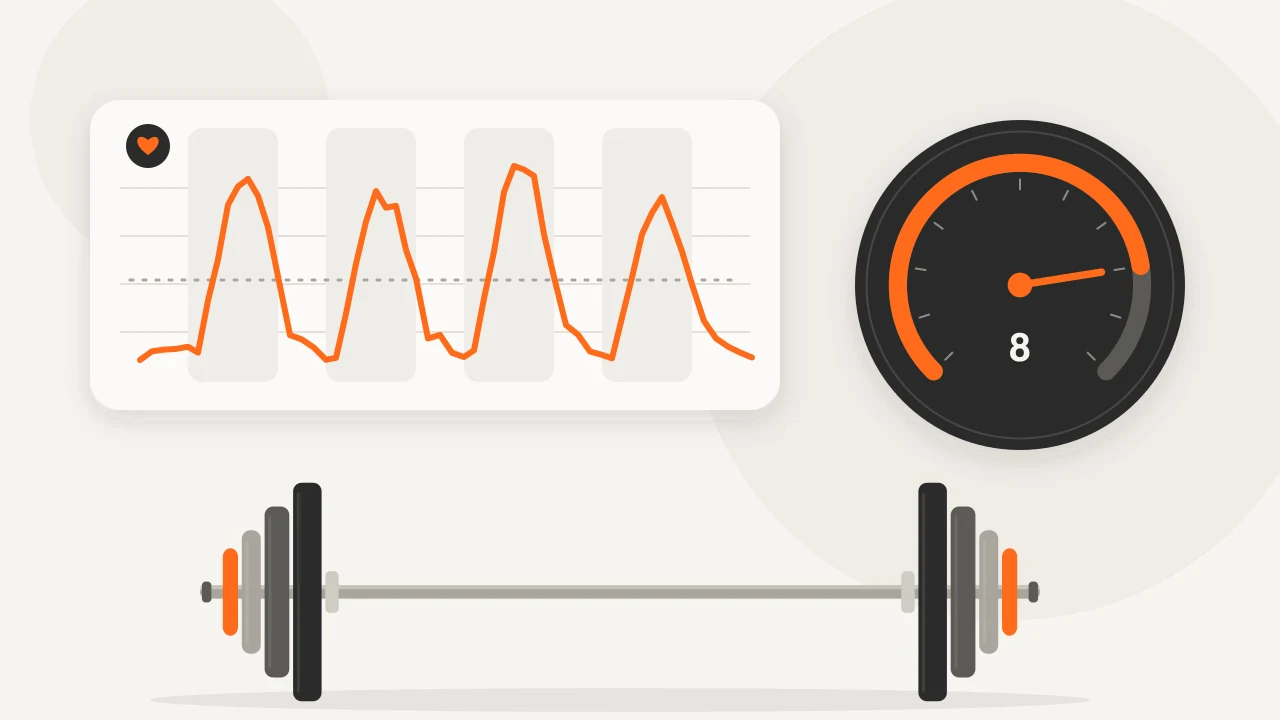
Key takeaways
- A set of squats lasts 20–40 seconds and rests run 1–3 minutes, so session heart rate often averages only 50–70 % of maximum, and a low heart rate does not mean a weak session.
- The Compendium of Physical Activities rates light-to-moderate resistance training at roughly 3.5 METs and vigorous lifting at about 6 METs.
- Log sets × reps × load, RPE or reps in reserve, and session RPE × minutes, because that is the real workload and the number you can compare with runs and rides.
- Rest roughly 2–3 minutes for heavy compound lifts and 60–90 seconds for lighter work, and keep it consistent when comparing sessions.
- Straining with a held breath pushes heart rate and blood pressure up sharply, so take care on hard reps.
A set of squats lasts 20–40 seconds. Your heart rate needs longer than that to respond, then lingers through the rest that follows, so a lifting session looks like a row of hills rather than a plateau. That is normal, and it is why the numbers that work for running or cycling mislead in the gym.
Why heart rate behaves differently when you lift
- Set–rest rhythm. Heart rate climbs through a set and falls during the 1–3 minutes of rest. A heavy set of 3–5 reps can be over before it has fully responded, so the hardest work often produces a modest number.
- Muscle mass involved. Squats, deadlifts and rows raise heart rate far more than curls or lateral raises at the same perceived effort.
- Bracing and breath-holding. Many lifters hold their breath on hard reps (the Valsalva manoeuvre). In experienced lifters this produced very large but brief blood-pressure peaks on heavy leg presses (MacDougall 1985), and heart rate often swings along with them.
- Strength is not an oxygen problem. Heavy, low-rep work with long rests trains force production, so a low heart rate does not mean a weak session.
Averaged over a whole session, heart rate often sits somewhere around 50–70 % of maximum, with peaks well above that on leg days and in short-rest circuits. That is why “my heart rate won’t go up when I lift” is usually normal, and why heart rate zones are the wrong ruler for strength work.
What a wearable can and can’t see
| Signal | Reliability when lifting | Why |
|---|---|---|
| Session start, end and duration | Good | Simple timing |
| Wrist optical heart rate | Mixed to weak | Gripping, wrist flexion and sudden changes in effort disturb the optical signal; error during activity is on average higher than at rest (Bent 2020) |
| Chest-strap or optical armband heart rate | Best available | Less motion artefact; see the Polar H10 guide |
| Calories | Weak | Estimated from heart rate, motion and body data; in a lab comparison no wrist device kept energy-expenditure error below 20 % (Shcherbina 2017) |
| Rep and set counting | Rough | Works best for simple repeated movements; check it against your log |
| Next-morning HRV, resting heart rate and sleep | Good | Measured while you are still |
Wrist heart rate is not useless: a session average and the rough shape of the trace are fine. Just do not read individual spikes or the “max” as truth. If you want reliable heart rate for lifting, a chest strap or an optical armband is the better tool.
Does lifting count as cardio, and how many calories does it burn?
Not in the way running does. Health guidelines treat lifting as muscle-strengthening activity, recommended on at least two days a week on top of aerobic activity (WHO 2020). Circuits built from big lifts with 30–60 seconds of rest can hold heart rate in the moderate-to-high range long enough to give a real aerobic effect; heavy sets with long rests mostly do not.
For calories, the Compendium of Physical Activities rates light-to-moderate resistance training at roughly 3.5 METs and vigorous lifting at about 6 METs. For a 70 kg person that is very roughly 250–420 kcal per hour in total, including about 70 kcal they would burn at rest anyway. Treat the watch figure as that kind of order of magnitude, not a budget. See calories burned for the three energy measures and calories burned by activity for per-activity values.
What to log instead
| Log | Why it matters |
|---|---|
| Exercise, sets × reps × load (volume load = sets × reps × kg) | The real workload, and the basis for progressive overload |
| RPE or reps in reserve (RIR) per work set | Shows how close to failure you trained; on the RIR-based RPE scale, RPE 7–9 means roughly 1–3 reps left (Zourdos 2016) |
| Session RPE × minutes | One number you can compare with runs and rides — see RPE (Foster 2001) |
| Rest between sets | Roughly 2–3 minutes for heavy compound lifts, 60–90 seconds for lighter work; keep it consistent when comparing sessions |
| Duration and start time | A late session can affect sleep for some people |
If you track one heart-rate metric, make it how quickly heart rate falls between sets and after the session — see heart rate recovery. With the same load and rest, it is a rough conditioning signal.
How a lifting day shows up in HRV, resting heart rate and sleep
The most useful wearable data about lifting often arrives the next morning. Responses vary a lot, and many people see little change after a moderate session. A heavy leg day, a new exercise or hard sets close to failure (and the soreness that follows) can coincide with a lower HRV and a higher resting heart rate for a day or two. A late session can raise overnight heart rate and delay sleep. Muscle soreness itself does not show up in HRV. Compare readings with your own range (personal baseline) and look for a pattern over several days, not one night.
Safety. Straining with a held breath pushes heart rate and blood pressure up sharply. If you get chest pain or pressure, fainting or near-fainting, or palpitations with dizziness while lifting, stop and seek medical advice, whatever the watch says. If you have high blood pressure or a heart condition, ask your doctor how to lift and breathe safely.
Combining lifting with cardio, and common mistakes
Heart-rate-based load scores (TRIMP, strain, relative effort) under-count lifting for the same reason heart rate under-represents it — see training load. Use session RPE × minutes for every session so the units match, then compare weekly totals. Keep hard leg days away from key runs or rides (strength training for endurance athletes).
- Chasing a zone or a calorie target in the gym.
- Treating wrist peaks and “max heart rate” as accurate.
- Calling a session easy because its strain or load score is low.
- Reacting to one low HRV reading after a heavy day instead of the trend.
In MoveVitals
Strength sessions that arrive from Garmin, WHOOP, Polar, COROS or Strava (including Apple Watch workouts uploaded to Strava) are stored as activities with the duration, heart rate and calories the source supplies. Next to them you see the following morning’s HRV, resting heart rate and sleep from the devices you wear overnight, such as WHOOP, Oura, Garmin, Polar or COROS. If two devices record the same session — say a WHOOP strap and a Garmin watch — MoveVitals can group them into one activity and pick fields by your priorities, so a chest-strap heart rate can outrank a wrist reading; the originals stay untouched in each service (how MoveVitals resolves conflicts). Keep sets, reps and loads in your own log.
Worked example
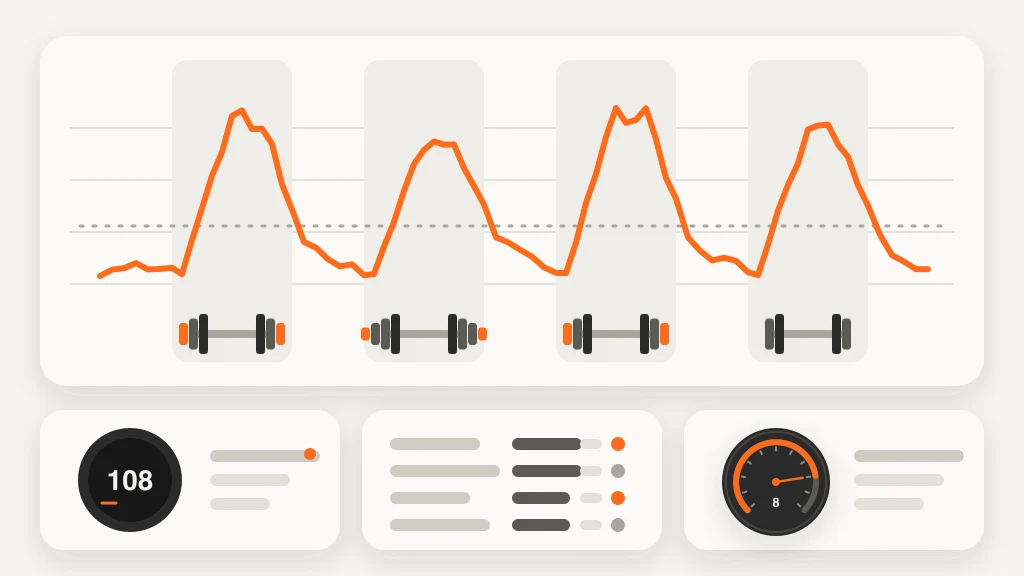
Illustrative scenario. Priya, 34, 65 kg, has an estimated maximum heart rate of about 186 bpm. She lifts for 60 minutes: back squat 4 × 5 at 80 kg, bench press 4 × 6 at 50 kg, barbell row 3 × 8 at 45 kg and Romanian deadlift 3 × 8 at 70 kg, resting 2–3 minutes between sets. Her watch reports an average of 108 bpm (about 58 % of maximum), a wrist peak of 152 bpm and 295 kcal. On another day a chest strap shows squat-set peaks near 165 bpm, so she treats the wrist peak as a rough guide. A MET-based estimate for her weight gives roughly 230–390 kcal, so the watch figure is plausible but not precise. Her log tells the real story: volume load is 1,600 + 1,200 + 1,080 + 1,680 = 5,560 kg, and a session RPE of 8 × 60 minutes = 480 units, four times a 40-minute easy run at RPE 3 (120 units), even though a heart-rate score would probably rank the run higher. The next morning her HRV is 41 ms against a usual 50–56 ms and her resting heart rate is 56 instead of 52; both are back to normal two days later, so she keeps her easy run and moves the intervals by a day. Figures are illustrative.
Action steps
- Treat heart rate as a side note when you lift: do not chase a zone or a calorie number.
- Log every session: exercises, sets × reps × load, RPE or reps in reserve, rest, and session RPE × minutes.
- If you want heart rate, use a chest strap or optical armband and read session averages and between-set recovery, not single peaks.
- After unusually hard sessions, compare the next mornings’ HRV, resting heart rate and sleep with your own baseline for a few days.
- Use session RPE to add lifting to your weekly training load alongside cardio.
Related guides
- Progressive overload: the principle behind every improvement
- RPE (rate of perceived exertion): the sensor you always carry
- Training load explained: TRIMP, TSS, strain and relative effort
- Normal heart rate variability (HRV) by age: RMSSD vs SDNN
- Strength training for endurance athletes
- CrossFit and functional fitness: heart rate, WODs and wearable accuracy
- Calisthenics and bodyweight training: tracking progress without a barbell
FAQ
What heart rate is normal when lifting weights, and are there weight training heart rate zones? There is no target. Averaged over a session it often lands around 50–70 % of maximum, with brief peaks well above that on leg exercises or with short rests, and it falls back toward resting levels between long-rest sets. Judge a lifting session by effort (RPE), not by a zone.
Why won’t my heart rate go up when I lift? Heavy sets are short, rests are long, and the limit is force rather than oxygen delivery. A wrist sensor can also read low or lag while you grip a bar. It is usually normal. If you feel chest tightness, dizziness or unwell while lifting, stop and see a doctor.
Does weight lifting count as cardio? Not by default. It counts as muscle-strengthening activity. Short-rest circuits with big lifts can add an aerobic effect, but heavy sets with long rests mostly train strength.
How accurate are strength training calories burned on a watch? Only roughly. Wrist devices estimate energy expenditure poorly even in steady cardio, and lifting is stop-and-go. Use the figure as an order of magnitude.
What happens to HRV after strength training? It varies. Many people see little change; after a heavy leg day, a new exercise or sets near failure, HRV can be lower and resting heart rate higher for a day or two. Compare with your own baseline and look at several days.
References
- MacDougall et al. (1985). Arterial blood pressure response to heavy resistance exercise. Journal of Applied Physiology. https://doi.org/10.1152/jappl.1985.58.3.785
- Bent et al. (2020). Investigating sources of inaccuracy in wearable optical heart rate sensors. npj Digital Medicine. https://doi.org/10.1038/s41746-020-0226-6
- Shcherbina et al. (2017). Accuracy in Wrist-Worn, Sensor-Based Measurements of Heart Rate and Energy Expenditure in a Diverse Cohort. Journal of Personalized Medicine. https://doi.org/10.3390/jpm7020003
- Zourdos et al. (2016). Novel Resistance Training–Specific Rating of Perceived Exertion Scale Measuring Repetitions in Reserve. Journal of Strength and Conditioning Research. https://doi.org/10.1519/JSC.0000000000001049
- Foster et al. (2001). A New Approach to Monitoring Exercise Training. The Journal of Strength and Conditioning Research. https://doi.org/10.1519/1533-4287%282001%29015%3C0109:anatme%3E2.0.co;2
- Bull et al. (2020). World Health Organization 2020 guidelines on physical activity and sedentary behaviour. British Journal of Sports Medicine. https://doi.org/10.1136/bjsports-2020-102955
- Ainsworth et al. (2011). 2011 Compendium of Physical Activities. Medicine & Science in Sports & Exercise. https://doi.org/10.1249/MSS.0b013e31821ece12
For general information only. This is not medical advice — talk to a qualified professional about your health.
Keep reading
Sports
Walking for fitness and weight loss: pace, heart rate zones and how much is enough
9 min read
Training science
Zone 2 training: the science and how to do it right
4 min read
Metrics explained
Resting heart rate: normal ranges and what changes it
4 min read
Training science
Polarized training (80/20): easy most of the time, hard some of the time
4 min read
Sports
Japanese interval walking: the 3-minute fast / 3-minute slow method, step by step
8 min read
Training science
Interval training and HIIT: designing sessions that work
4 min read