

Recovery & sleep
Recovery after strength training: rest days, DOMS and what HRV and resting heart rate show
Strength training recovery time depends on the muscle, the exercise and how close to failure you trained — usually about 48–72 hours before you train the same muscles hard again. Muscle soreness is a poor readiness signal, and HRV, resting heart rate and sleep add context rather than a verdict.
Written by MoveVitals Editorial Collective
Community-authored educational content. Individual clinical review is identified only when a named review is actually recorded.
Editorial standards & corrections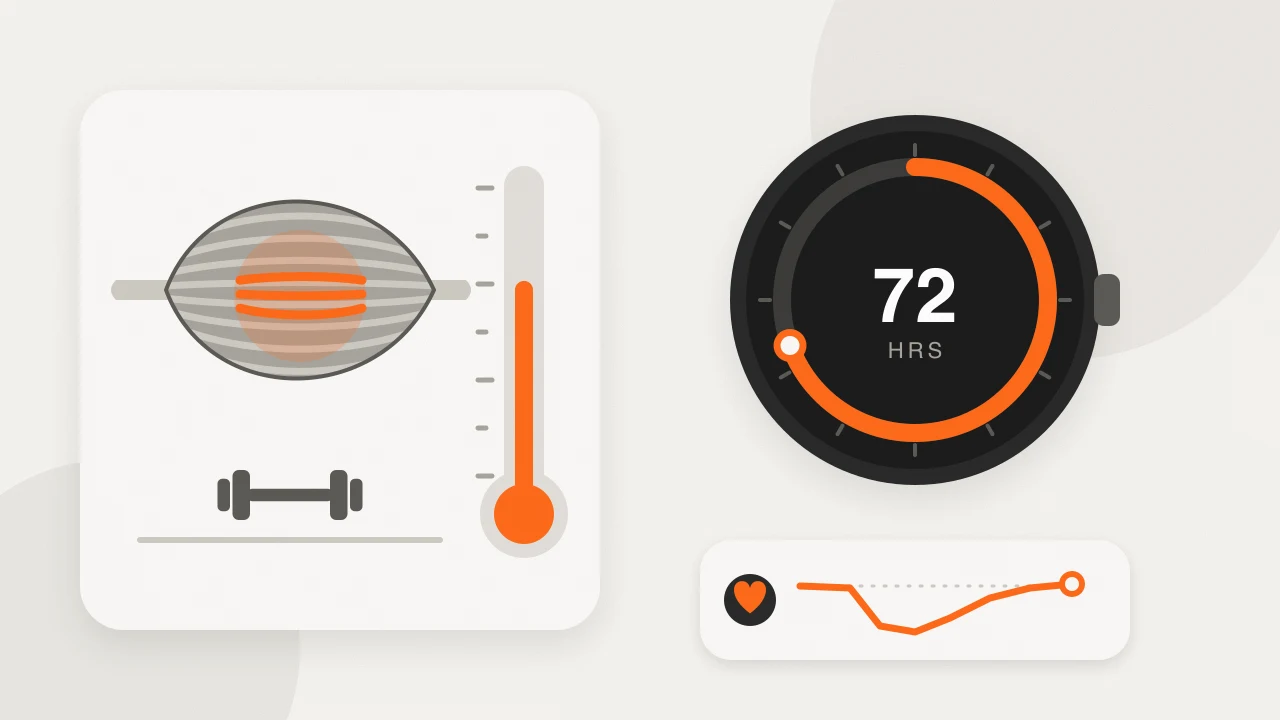
Key takeaways
- Light or moderate sessions with several reps in reserve need about 24–48 hours before the same muscles train hard again, while unfamiliar exercises or big jumps in volume can need 72–96 hours or more.
- With soreness of 0–3 out of 10 and readings near baseline, train as planned; at 7 or more, or with sharp pain, rest the area.
- A resting heart rate 5 or more bpm above baseline for several days points to fatigue, while one night of low HRV calls only for stopping 2–3 reps short of failure.
- Recovery rests on about 7–9 hours of sleep, roughly 1.6–2.2 g of protein per kg a day and a deload every 4–8 weeks.
- Sharp joint pain, or soreness still increasing after a week, is not DOMS and deserves advice.
How many rest days between workouts?
Recovery is not one clock. Strength, soreness, tendons and energy stores recover at different speeds, so the answer depends on the session:
| Session | Typical wait before training the same muscles hard again |
|---|---|
| Light to moderate, several reps in reserve | About 24–48 h |
| Heavy compound lifts or sets near failure | About 48–72 h |
| Unfamiliar exercises, big jumps in volume, long lowering phases | 72–96 h or more |
These are rules of thumb. Experienced lifters often recover faster from familiar work, partly because muscle damage falls as you repeat a routine (Damas 2016). Training each muscle about twice a week tends to build more muscle than once a week (Schoenfeld 2016), but total weekly volume matters most: if sessions leave you wrecked, spread the sets over more days. A practical pattern is two to four sessions a week with at least one full rest day, plus active recovery on some of the others.
Delayed onset muscle soreness: what it is and why it misleads
DOMS is the aching, tenderness and stiffness that builds after unfamiliar or lengthening-heavy work. It typically peaks 24–72 hours later and fades within about a week (Cheung 2003). It reflects how sensitive the muscle is to unaccustomed work, not how much it grew or how good the session was. After a few exposures it shrinks even though training is just as productive. Soreness can be high while strength is fine, or absent while you are run down from poor sleep, so use it to choose exercises, not to decide whether you have recovered.
How to ease soreness after a workout? Light movement, sleep, enough protein and energy, and massage all help a little. Foam rolling modestly reduces perceived soreness, and stretching has not been shown to prevent it. Cold-water immersion can reduce soreness, but regular use after lifting may blunt long-term strength and muscle gains (Roberts 2015) — see cold water immersion. Reviews of recovery methods find small to moderate benefits, mostly for perceived soreness (Dupuy 2018).
Safety. Sharp joint pain, or soreness that is still increasing after a week, is not DOMS. See a doctor promptly for severe pain with marked swelling, dark tea- or cola-coloured urine or weakness after unusually intense exercise.
HRV after lifting: what your wearable usually shows
| Signal | Typical pattern after a very hard session | Caveat |
|---|---|---|
| HRV | May dip for a day or two; little change after moderate sessions | One night is noisy; a rolling average is more informative (Plews 2013). It does not track soreness — see HRV |
| Resting heart rate | May run a few bpm higher for a night or two | 5 or more bpm above baseline for several days points to fatigue, poor sleep, alcohol, heat or illness — see resting heart rate |
| Sleep | A late or very hard session can delay sleep and raise overnight heart rate | Sleep is the biggest recovery lever — see sleep duration |
If your resting heart rate looks high after a workout, check which one you mean. Right after a session heart rate takes several minutes to settle — see heart rate recovery. The number to compare is your overnight or morning resting heart rate. A high reading with chest pain, fainting or palpitations with dizziness is a reason to stop training and seek medical advice.
Train, adjust or rest: a decision table
| What you see | Suggested action |
|---|---|
| Soreness 0–3/10; HRV, resting heart rate and sleep near your baseline | Train as planned |
| Soreness 4–6/10 in the target muscles; readings normal | Train; choose other muscle groups or cut load and sets on the sore ones |
| One night of low HRV, resting heart rate 1–3 bpm up, or short sleep | Adjust: keep the session, stop 2–3 reps short of failure, cut about 20–30 % of the sets |
| Soreness 7+/10 or sharp pain | Rest the area, walk easily, get advice if the pain is sharp or persistent |
| HRV low and resting heart rate high for 3+ days, poor sleep, heavy fatigue | Rest or take an easy week; check sleep, food, stress and illness — see overtraining and deload weeks |
These are rules of thumb, not medical thresholds. If the same pattern keeps appearing, the cause is usually total load, sleep or fuel.
What actually speeds recovery
- Sleep regularly, about 7–9 hours for most adults.
- Protein of roughly 1.6–2.2 g per kg a day for lifters, with enough total energy (protein for recovery).
- Easy movement on rest days, and planned deload weeks every 4–8 weeks.
- Less alcohol, which tends to lower HRV and fragment sleep (alcohol, HRV and sleep).
Common mistakes: chasing soreness as proof of a good session, training to failure on every set, reacting to a single HRV reading, and adding many new exercises in the same week.
In MoveVitals
Overnight HRV, resting heart rate and sleep from the devices you wear to bed, such as WHOOP, Oura, Garmin, Polar or COROS, sit next to the strength session from the day before, so you can line up a heavy leg day with the next two mornings. MoveVitals compares each reading with your personal baseline (the median of your previous 60 days, with at least 14 days of data needed) and flags only sustained changes, so one low reading after leg day is expected (personal baseline). Strength sessions from Garmin, WHOOP, Polar, COROS, Strava or Apple Health arrive as activities. A wearable cannot measure soreness, so jot a 0–10 score in your training log.
Worked example
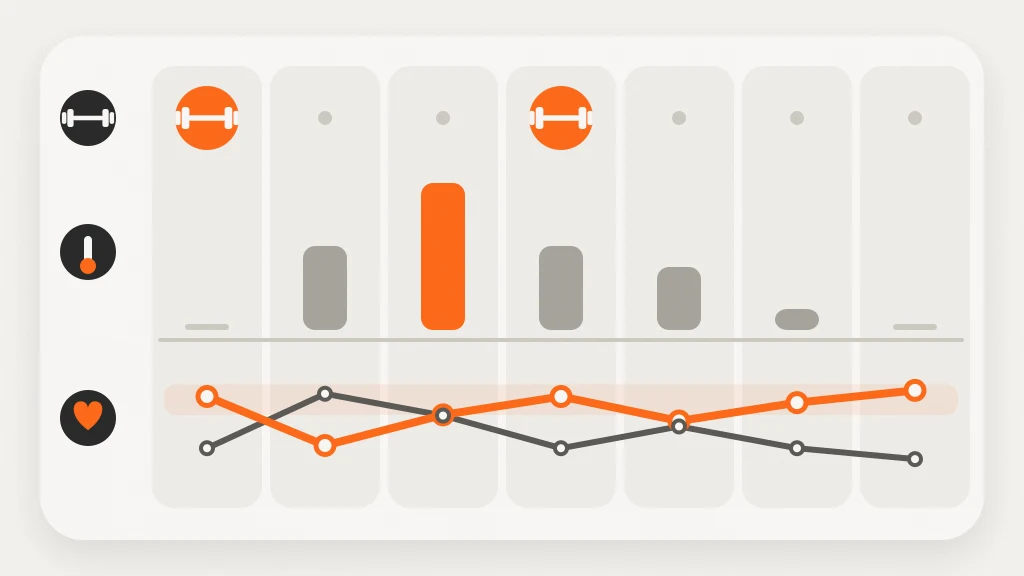
Illustrative scenario. Diego, 38, 80 kg, trains lower body on Monday (squats 4 × 5 at 100 kg, Romanian deadlifts 3 × 8 at 90 kg) and upper body on Thursday. His usual HRV is about 48–56 ms and his resting heart rate about 52 bpm. Tuesday morning: HRV 44 ms, resting heart rate 57 bpm, quads 4/10 sore. He walks 30 minutes and skips the gym. Wednesday: soreness peaks at 7/10 and stairs hurt, yet HRV is 49 and resting heart rate 55, nearly back, so soreness and the wearable tell different stories. Thursday: HRV 52, resting heart rate 52, quads 4/10. He trains upper body as planned and leaves legs alone. Friday: HRV 48 and resting heart rate 54 after a harder-than-usual upper session, so he keeps the weekend easy; by Sunday HRV is 53 and resting heart rate 51. Figures are illustrative.
Action steps
- Leave about 48–72 hours before you train the same muscles hard again, and keep one or two full rest days a week.
- Rate soreness 0–10 in your log, but do not use it alone to decide whether to train.
- Compare HRV, resting heart rate and sleep with your own baseline across several days, not one morning.
- When readings are off, adjust rather than skip: stop sets short of failure, cut some sets or switch muscle groups.
- Protect sleep and protein, and plan an easier week every 4–8 weeks.
Related guides
- Active recovery: when easy movement beats complete rest
- Protein for recovery: how much, when and from what
- How much sleep do you need? Sleep duration and sleep debt
- Deload weeks: why planned easy weeks make you fitter
- Normal heart rate variability (HRV) by age: RMSSD vs SDNN
FAQ
How long should I rest between strength workouts? About 48–72 hours before the same muscles get a hard session; less for light work, more after unfamiliar or very high-volume training. Different muscle groups can train on consecutive days.
How many rest days a week do I need? Most people do well with at least one full rest day, and often two or three days without lifting. Add more when sleep, HRV or motivation slip.
Can I train sore muscles? Mild to moderate soreness is fine if movement feels normal; lighten the load or train other muscles. Sharp pain or soreness that is getting worse is a reason to rest.
Is a high resting heart rate after a workout a problem? Not by itself. Heart rate stays elevated for minutes after exercise. A resting heart rate 5 or more bpm above your baseline for several days, with poor sleep, suggests you need more recovery.
References
- Cheung et al. (2003). Delayed Onset Muscle Soreness. Sports Medicine. https://doi.org/10.2165/00007256-200333020-00005
- Damas et al. (2016). Resistance training-induced changes in integrated myofibrillar protein synthesis are related to hypertrophy only after attenuation of muscle damage. The Journal of Physiology. https://doi.org/10.1113/JP272472
- Schoenfeld et al. (2016). Effects of Resistance Training Frequency on Measures of Muscle Hypertrophy: A Systematic Review and Meta-Analysis. Sports Medicine. https://doi.org/10.1007/s40279-016-0543-8
- Dupuy et al. (2018). An Evidence-Based Approach for Choosing Post-exercise Recovery Techniques to Reduce Markers of Muscle Damage, Soreness, Fatigue, and Inflammation: A Systematic Review With Meta-Analysis. Frontiers in Physiology. https://doi.org/10.3389/fphys.2018.00403
- Roberts et al. (2015). Post-exercise cold water immersion attenuates acute anabolic signalling and long-term adaptations in muscle to strength training. The Journal of Physiology. https://doi.org/10.1113/JP270570
- Plews et al. (2013). Training Adaptation and Heart Rate Variability in Elite Endurance Athletes: Opening the Door to Effective Monitoring. Sports Medicine. https://doi.org/10.1007/s40279-013-0071-8
For general information only. This is not medical advice — talk to a qualified professional about your health.
Keep reading
Recovery & sleep
Your personal baseline: why "normal for you" beats population averages
4 min read
Devices & setup
How MoveVitals handles multiple devices: provenance, duplicates and conflicts
5 min read
Devices & setup
WHOOP and MoveVitals: what syncs and how to get the most from it
3 min read
Metrics explained
Normal heart rate variability (HRV) by age: RMSSD vs SDNN
6 min read
Metrics explained
Resting heart rate: normal ranges and what changes it
4 min read
Recovery & sleep
Overreaching and overtraining: warning signs and what to do
4 min read