

Sports
Badminton: heart rate spikes, calories and recovery between games
Badminton heart rate can jump to 170–190 bpm in a hard rally and fall again within seconds, which is why wrist watches and calorie counts struggle with the sport. This guide covers what is normal by age, how many calories singles and doubles burn, and how to recover between games.
Written by MoveVitals Editorial Collective
Community-authored educational content. Individual clinical review is identified only when a named review is actually recorded.
Editorial standards & corrections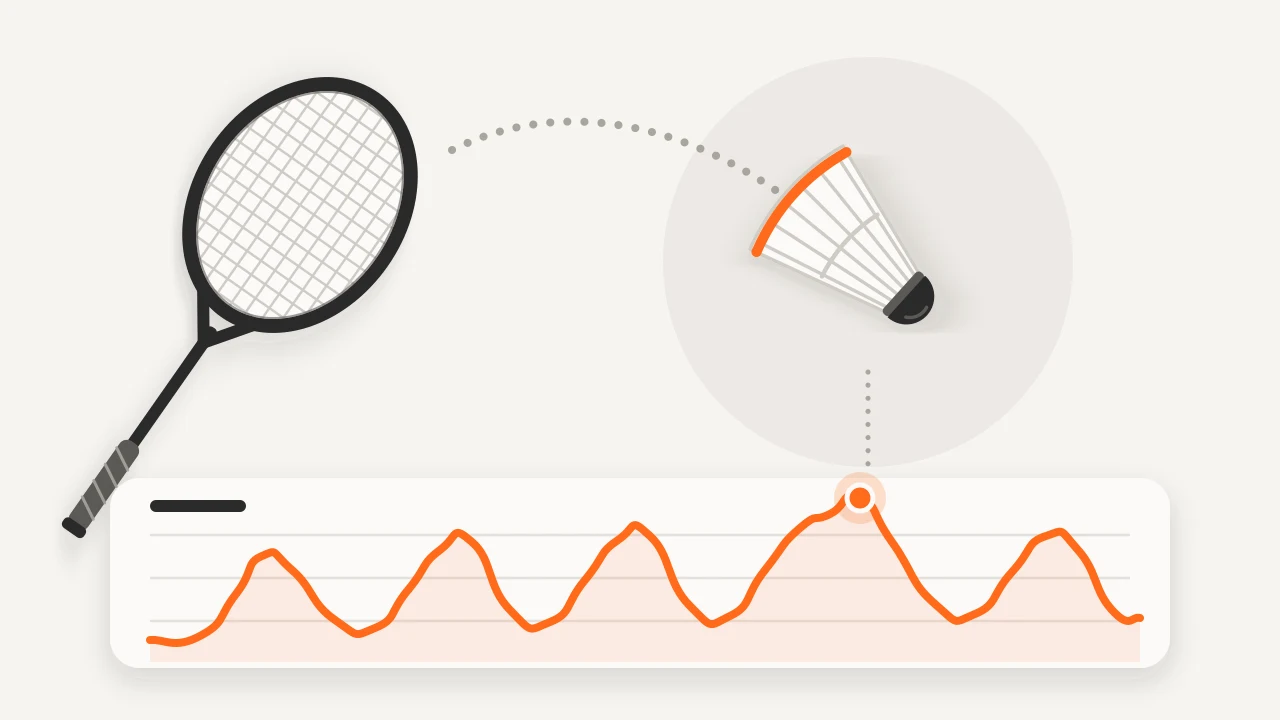
Key takeaways
- A badminton rally typically lasts 3–10 seconds and is followed by roughly 15–25 seconds of retrieving and serving, so heart rate falls between points but rarely to resting level.
- Estimated maximum heart rate is about 194 bpm at age 20 and 166 at 60, and individual maxima often differ from the formula by 10–12 bpm, so judge peaks against your own maximum, not a fixed 180.
- An hour of social badminton at 5.5 METs burns about 330 kcal at 60 kg and 410 at 75 kg; competitive play at 7 METs burns about 420 and 525.
- A chest strap shows true peaks and between-point recovery, while wrist optical sensors average over several seconds and underestimate short peaks.
- Seek medical help for chest pain, fainting or palpitations with dizziness on court, whatever your heart rate reads.
Badminton is an intermittent sport. A rally is a few seconds of lunges, jumps and overhead smashes, followed by a short pause while the shuttle is picked up and served. Studies of competitive players usually report match-average heart rates around 80–90 % of maximum, with peaks at or near maximum and breaks too short for full recovery. Recreational games are gentler, but the shape is the same: a saw-tooth heart-rate trace that drifts upward as the match goes on (see cardiac drift).
A game in numbers
| Phase | What happens | Heart rate |
|---|---|---|
| Rally | Typically 3–10 s of lunges, jumps and smashes | Climbs fast; peaks at the end of long rallies |
| Between points | Roughly 15–25 s of retrieving, serving, towel | Falls, but rarely to resting level |
| Mid-game break | Up to 60 s at 11 points (laws of the game) | Drops clearly; sip water |
| Between games | Up to 120 s | Partial recovery |
What is a normal badminton heart rate?
There is no single right number: it depends on age, fitness and effort. The table uses the Tanaka estimate of maximum heart rate (208 − 0.7 × age) and a typical hard-rally peak of roughly 90–100 % of it.
| Age | Estimated max (bpm) | Hard-rally peaks (bpm) |
|---|---|---|
| 20 | 194 | ~175–194 |
| 30 | 187 | ~168–187 |
| 40 | 180 | ~162–180 |
| 50 | 173 | ~156–173 |
| 60 | 166 | ~149–166 |
| 70 | 159 | ~143–159 |
Individual maxima often differ from the formula by 10–12 bpm, so a peak a few beats above the table may simply be your real maximum — see maximum heart rate for field tests. A reading of 180 or even 190 in a young, fit player is not a warning sign by itself. For someone in their 50s or 60s, the same number is above the formula's average: first check that it is real (see the sensor section below), then ask whether you need to push that hard.
Older recreational players. There is no universal safe ceiling. Many find doubles, longer breaks and a game average around 70–85 % of their measured maximum more sustainable. If you are over 40–50, have been inactive, have high blood pressure or heart disease, or take medication that affects heart rate, ask your doctor which ceiling suits you. Stop and seek medical help for chest pain or pressure, fainting or near-fainting, palpitations with dizziness, or breathlessness out of proportion to the effort. A watch cannot diagnose any of these — see also high heart rate during exercise.
Calories: singles and doubles
Energy use is roughly MET × body weight (kg) × hours. The Compendium of Physical Activities lists social singles and doubles at about 5.5 METs and competitive badminton at about 7.0.
| Play | MET | 60 kg (kcal/h) | 75 kg (kcal/h) | 90 kg (kcal/h) |
|---|---|---|---|---|
| Social singles or doubles | 5.5 | ~330 | ~410 | ~495 |
| Competitive play | 7.0 | ~420 | ~525 | ~630 |
Singles means covering the whole court alone, so at the same level it usually costs more than doubles. But an hour on the booking sheet is rarely an hour of play: rotations, shuttle changes and waiting can take a third or more of it, so count the minutes you are actually playing. The full table for other sports is in calories burned by activity.
What wearables get right and wrong
- No GPS indoors. Distance is meaningless; look at duration, heart rate and energy.
- Wrist optical sensors lag and smooth. They average over several seconds or more, so short peaks are underestimated and dips between points look shallow. A tight grip, wrist flexion and sweat add noise and can lock onto the swing rhythm.
- Chest straps follow every beat. An ECG-based strap such as the Polar H10 reacts within seconds and is the better tool for peaks and between-point recovery; most watches and apps pair with one over Bluetooth.
- Wear the watch on the non-racket wrist, snug above the wrist bone, and be suspicious of a flat line at 150–160 bpm or a sudden spike far above your known maximum.
- Pick a badminton or racket-sport profile if your watch has one; a generic profile still records heart rate. Calories are model estimates either way — see wearable heart rate accuracy.
Fitness training and recovery
Badminton needs an aerobic base, so you recover quickly between rallies, plus repeatable bursts.
- Aerobic base: one or two easy sessions a week (jogging, cycling, brisk walking) in zone 2.
- Rally-style intervals: after a warm-up, 6–8 × 20–30 s of hard footwork or shadow drills with 40–60 s easy between — see interval training.
- Strength: one or two short sessions of lunges, split squats, calf raises and shoulder work, progressed gradually.
- Warm-up: 10 minutes before play (warm-up routine), plus ankle mobility.
- Tendon load: ankles, knees, shoulders and Achilles tendons are the usual overload sites, and tendons adapt more slowly than muscles. A common trigger is stacking hard sessions (a night league and a morning tournament) or adding a session overnight.
- Recovery signals: heart rate recovery after a game, and next-morning resting heart rate or HRV against your baseline. Halls are warm and still, so rehydrate: hydration and electrolytes.
Common mistakes
- Chasing a fixed number such as 180 instead of judging effort against your own maximum.
- Trusting wrist peaks and calories as measurements.
- Playing hard two days running and ignoring tight calves or Achilles.
- Counting the whole court booking as exercise time.
In MoveVitals
Badminton sessions from Apple Health, Garmin, COROS, Polar, Suunto, Strava and WHOOP arrive as racket-sport activities with duration, heart rate and energy. When a watch and a chest-strap app recorded the same game, MoveVitals merges the duplicate and picks fields by your priorities — for example heart rate from the strap and energy from the watch (how conflicts are resolved). Time in zone comes from the heart-rate stream, so a strap recording shows how long you really spent near your maximum.
Worked example
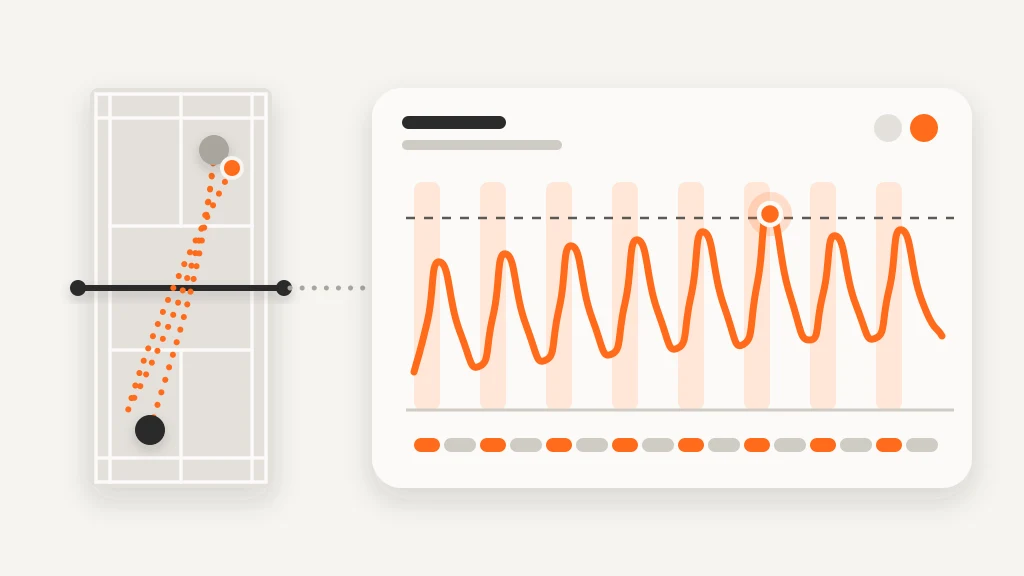
Illustrative scenario. Mei, 42, weighs 62 kg and plays club doubles on Tuesdays and Fridays. Her estimated maximum is about 179 bpm (208 − 0.7 × 42). Her watch shows game peaks near 165 bpm and breaks that dip to about 150. On a chest strap for one evening, peaks reach 176 bpm (about 98 % of her estimate) and breaks dip to about 140, so the watch had smoothed both. Her 90-minute booking holds about 60 minutes of real play: 5.5 × 62 kg × 1 h ≈ 340 kcal, not the roughly 510 kcal the whole 90 minutes would suggest. She has no symptoms, so she keeps the strap pattern as her baseline. When her calves felt tight she moved a Saturday match to Sunday and added calf raises twice a week.
Action steps
- Estimate your maximum heart rate with the Tanaka formula as a placeholder, then replace it with the highest reliable value from a hard session on a chest strap.
- Wear a chest strap for a few games to see true peaks and between-point recovery; use the watch for duration and trends.
- Judge heart rate against your own maximum and how you feel, not a fixed 180; seek medical help for chest pain, fainting or palpitations with dizziness.
- Plan 2–3 sessions a week with no more than two hard days in a row, one easy aerobic session and 1–2 short leg and calf strength sessions.
- Warm up for 10 minutes, keep your ankles mobile and rehydrate in warm halls.
- Estimate calories from the minutes you actually play, and judge results by your weight trend rather than the watch figure.
Related guides
- Calories burned by activity: MET values, per-hour tables and how wearables estimate them
- Maximum heart rate: formulas, field tests and why age-based estimates fail
- Heart rate recovery: how fast your heart rate drops after exercise
- Polar H10 chest strap with MoveVitals: accurate heart rate and HRV
- Ankle mobility: the knee-to-wall test and exercises that work
- Table tennis: heart rate, calories and reaction training
FAQ
Is a heart rate of 180 bpm normal in badminton? For a younger, fit player, yes: peaks of 170–190 bpm are common in hard rallies. For someone in their 50s or 60s, 180 is above the average formula maximum; check the reading with a chest strap and talk to a doctor if you have symptoms or a heart condition.
How many calories does an hour of badminton burn? Roughly 330–525 kcal for a 60–75 kg player at 5.5–7 METs, depending on intensity and how much of the hour is real play.
Why does my watch miss the peaks? Wrist optical sensors average over several seconds and are disturbed by grip and swing, so short spikes are flattened and breaks look shallower than they are.
Which smartwatch is best for badminton? Features matter more than brand: a snug, comfortable fit, a racket-sport or generic profile, Bluetooth pairing with a chest strap and a way to lock the screen. Wrist heart rate will always lag in this sport.
How often can I play per week? Many recreational players manage two to three sessions; leave an easier day after hard ones and cut back if your calves, Achilles or shoulders stay sore.
References
- Phomsoupha & Laffaye (2015). The Science of Badminton: Game Characteristics, Anthropometry, Physiology, Visual Fitness and Biomechanics. Sports Medicine. https://doi.org/10.1007/s40279-014-0287-2
- Faude et al. (2007). Physiological characteristics of badminton match play. European Journal of Applied Physiology. https://doi.org/10.1007/s00421-007-0441-8
- Tanaka et al. (2001). Age-predicted maximal heart rate revisited. Journal of the American College of Cardiology. https://doi.org/10.1016/S0735-1097(00)01054-8
- Ainsworth et al. (2011). 2011 Compendium of Physical Activities: A Second Update of Codes and MET Values. Medicine & Science in Sports & Exercise. https://doi.org/10.1249/MSS.0b013e31821ece12
- Gillinov et al. (2017). Variable Accuracy of Wearable Heart Rate Monitors during Aerobic Exercise. Medicine & Science in Sports & Exercise. https://doi.org/10.1249/MSS.0000000000001284
For general information only. This is not medical advice — talk to a qualified professional about your health.
Keep reading
Sports
Pickleball and your health data: heart rate zones, calories and joint load
6 min read
Sports
Padel with a wearable: heart rate, calories and recovery between matches
7 min read
Sports
Walking for fitness and weight loss: pace, heart rate zones and how much is enough
9 min read
Training science
Zone 2 training: the science and how to do it right
4 min read
Sports
Japanese interval walking: the 3-minute fast / 3-minute slow method, step by step
8 min read
Devices & setup
Strava and MoveVitals: workouts, streams and devices that arrive via Strava
3 min read