

Recovery & sleep
The menstrual cycle and your training data
Hormone changes across the cycle shift temperature, resting heart rate and HRV in predictable ways. Knowing the pattern prevents misreading your data — and helps you plan.
Written by MoveVitals Editorial Collective
Community-authored educational content. Individual clinical review is identified only when a named review is actually recorded.
Editorial standards & corrections
Key takeaways
- In the luteal phase, days 15–28 of a typical 28-day cycle, skin temperature rises 0.2 to 0.5 °C after ovulation and resting heart rate rises 1 to 4 bpm, so readiness scores can drop even when you are well.
- Compare HRV, resting heart rate and temperature with the same phase in previous cycles, not with last week.
- Research does not support a universal rule to train hard only in certain phases, so adjust hard sessions to your symptoms.
- Normal cycle length ranges from 21 to 35 days; see a doctor if periods stop or become irregular, because missing periods in active women can signal low energy availability (RED-S).
The phases (typical 28-day cycle)
| Phase | Days (approx.) | Hormones |
|---|---|---|
| Menstrual | 1–5 | Oestrogen and progesterone low |
| Follicular | 1–13 | Oestrogen rising |
| Ovulation | ~14 | Oestrogen peak, LH surge |
| Luteal | 15–28 | Progesterone high, oestrogen moderate |
Cycle length normally ranges from 21 to 35 days.
What changes in your data
| Metric | Typical luteal-phase change |
|---|---|
| Skin / body temperature | +0.2 to +0.5 °C after ovulation |
| Resting heart rate | +1 to +4 bpm |
| HRV | Often slightly lower |
| Respiratory rate | Slightly higher |
| Sleep | Some people sleep worse in the late luteal phase |
These shifts can make recovery scores look lower in the luteal phase even when you're well. Oura, WHOOP and Apple Watch use temperature to estimate cycle phases.
Training considerations
- Research does not support a universal rule to train hard only in certain phases; individual responses differ.
- Track symptoms (energy, cramps, sleep) alongside data for a few cycles to see your pattern.
- Some people feel strongest in the follicular phase; adjust hard sessions if symptoms are heavy.
- Fuel well — the luteal phase slightly raises energy expenditure.
Red flags
Missing periods (amenorrhoea) in active women can signal low energy availability (RED-S), which harms bones and health — see carbohydrate fuelling. Seek medical advice.
Worked example
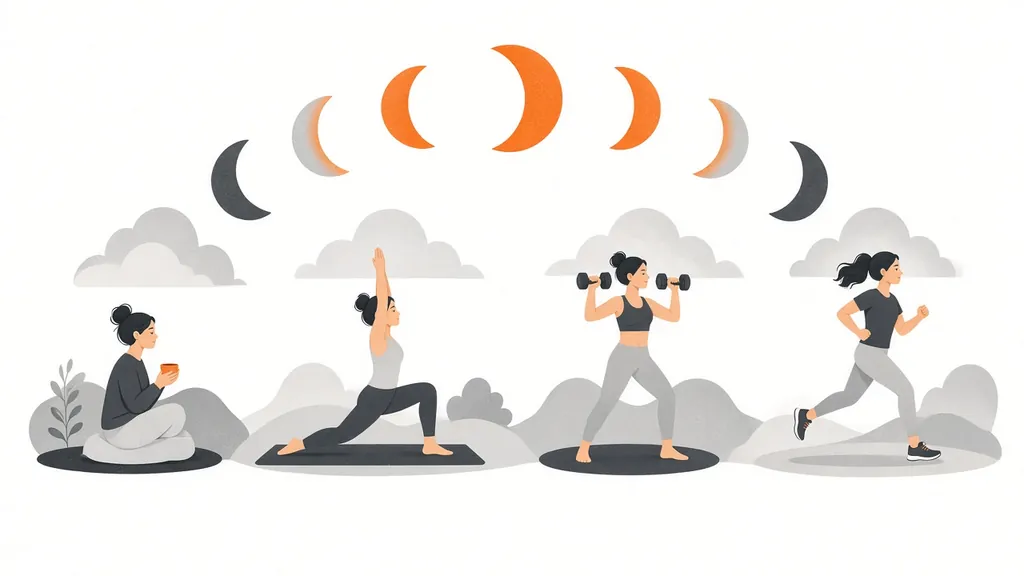
Illustrative scenario. Sofia logs her cycle in her app for three months. In the luteal phase (after ovulation) her wearable shows skin temperature about 0.3–0.4 °C above her follicular baseline, resting heart rate 3–5 bpm higher and overnight HRV a little lower — normal patterns that made her readiness score dip each month. Because the McNulty et al. (2020) meta-analysis found only trivial, inconsistent performance differences across phases on average, she doesn't rearrange her whole plan. Instead she notes how she personally feels, schedules her hardest sessions flexibly, and prioritises sleep and carbohydrate on symptomatic days.
Action steps
- Log period start dates so your app can label phases.
- Compare HRV, resting HR and temperature with the same phase in previous cycles, not with last week.
- Note symptoms (cramps, sleep, mood) alongside training quality.
- Adjust hard sessions to how you feel, not a generic phase rule.
- See a doctor if periods stop or become irregular — it can signal low energy availability.
Related guides
- Skin temperature and temperature deviation: how to read them
- Normal heart rate variability (HRV) by age: RMSSD vs SDNN
- Oura Readiness score: the contributors and how to use them
- Your personal baseline: why "normal for you" beats population averages
- Perimenopause and menopause: training, sleep and what your wearable data shows
FAQ
Does hormonal contraception change these patterns? Yes — many methods flatten the natural hormone swings.
Can temperature tracking be used as contraception? Not on its own; it is not a reliable method by itself.
Is it safe to train hard during my period? For most people yes; adjust if symptoms such as heavy bleeding or pain make it uncomfortable.
Does hormonal contraception change these patterns? Yes, combined pills suppress the natural temperature and hormone rhythm, so the patterns usually flatten.
Why does my readiness score drop before my period? Higher temperature and resting heart rate in the late luteal phase are read as strain by many algorithms.
References
- McNulty et al. (2020). The Effects of Menstrual Cycle Phase on Exercise Performance in Eumenorrheic Women: A Systematic Review and Meta-Analysis. Sports Medicine. https://doi.org/10.1007/s40279-020-01319-3
- Shaffer et al. (2017). An Overview of Heart Rate Variability Metrics and Norms. Frontiers in Public Health. https://doi.org/10.3389/fpubh.2017.00258
- Thomas et al. (2016). Position of the Academy of Nutrition and Dietetics, Dietitians of Canada, and the American College of Sports Medicine: Nutrition and Athletic Performance. Journal of the Academy of Nutrition and Dietetics. https://doi.org/10.1016/j.jand.2015.12.006
For general information only. This is not medical advice — talk to a qualified professional about your health.
Keep reading
Devices & setup
How MoveVitals handles multiple devices: provenance, duplicates and conflicts
5 min read
Metrics explained
Normal heart rate variability (HRV) by age: RMSSD vs SDNN
6 min read
Metrics explained
Resting heart rate: normal ranges and what changes it
4 min read
Devices & setup
WHOOP and MoveVitals: what syncs and how to get the most from it
3 min read
Devices & setup
Oura Ring and MoveVitals: sleep, readiness and temperature in one place
3 min read
Recovery & sleep
Alcohol, HRV and sleep: what your wearable shows the night after
3 min read