

Metrics explained
Sleep efficiency: what percentage of time in bed you actually sleep
Sleep efficiency is the share of your time in bed spent asleep. Above 85 % is generally considered good; low values point to trouble falling or staying asleep.
Written by MoveVitals Editorial Collective
Community-authored educational content. Individual clinical review is identified only when a named review is actually recorded.
Editorial standards & corrections
Key takeaways
- Sleep efficiency is time asleep divided by time in bed × 100, so 7 h 12 min asleep in 8 hours in bed gives 90 %.
- A sleep latency of 10–20 minutes is typical, while regularly falling asleep in under 5 minutes can signal sleep deprivation.
- If you can't sleep after about 20 minutes, get up and do something calm in dim light; this is a core element of CBT-I, the first-line treatment for chronic insomnia.
- Very high efficiency of 98–100 % every night can mean the device counts quiet wakefulness as sleep, or that you are sleep-deprived.
- Seek help from a doctor or CBT-I practitioner if efficiency stays below about 85% with daytime impairment.
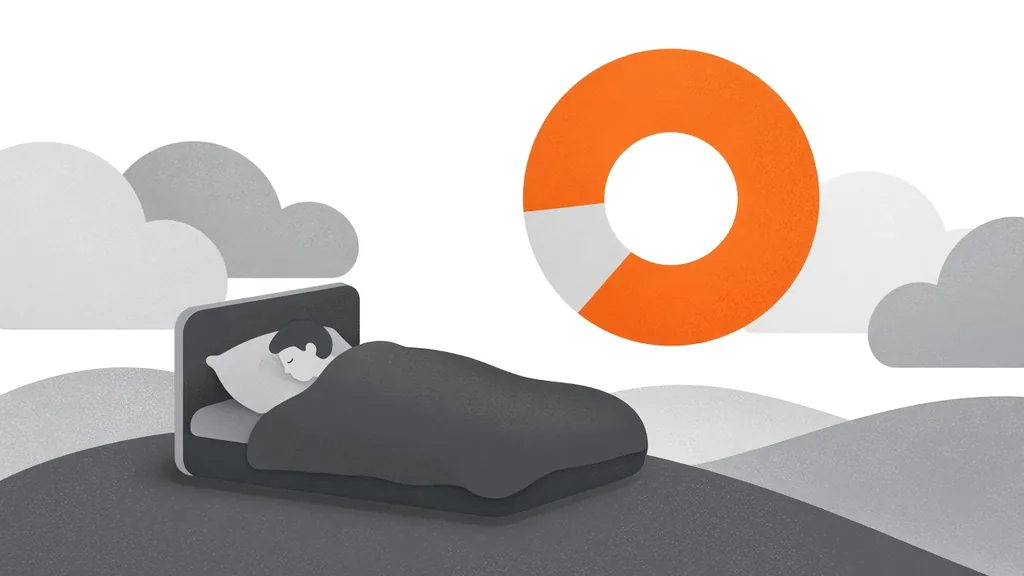
Sleep efficiency = time asleep ÷ time in bed × 100. If you are in bed for 8 hours and asleep for 7 h 12 min, your efficiency is 90 %. WHOOP, Oura and Withings report it directly.
Reference values
| Efficiency | Interpretation |
|---|---|
| ≥ 90 % | Very good |
| 85–89 % | Good |
| 75–84 % | Fair — some difficulty falling or staying asleep |
| < 75 % | Poor — worth addressing, especially if persistent |
Two parts of efficiency
- Sleep latency: how long it takes to fall asleep. 10–20 minutes is typical; under 5 minutes regularly can signal sleep deprivation.
- Wake after sleep onset (WASO): time awake during the night. Brief awakenings are normal; long ones reduce efficiency.
How to improve it
- Go to bed when sleepy, not just tired.
- Don't stay in bed awake for long; if you can't sleep after ~20 minutes, get up and do something calm in dim light.
- Keep a consistent wake time, even at weekends.
- Avoid alcohol, which causes awakenings in the second half of the night.
- Keep the room cool and dark; reduce noise.
These are core elements of CBT-I, the first-line treatment for chronic insomnia. Persistent insomnia deserves professional help.
Caveats
Very high efficiency (98–100 %) every night can mean the device is counting quiet wakefulness as sleep, or that you are sleep-deprived. Trends matter more than precision.
Worked example
Illustrative scenario. Kai spends 8 h 30 min in bed but sleeps 6 h 50 min — an efficiency of about 80%. His data show ~35 minutes to fall asleep and ~45 minutes awake during the night. He tries a simple version of sleep restriction used in CBT-I principles: going to bed only when sleepy, getting up if awake for more than ~20 minutes, and a fixed 06:30 alarm, so time in bed drops to about 7 h 30 min. After three weeks he sleeps around 6 h 55 min in 7 h 30 min — about 92% efficiency — and feels more rested. Numbers are illustrative; formal sleep restriction should be guided by a clinician, especially if you have insomnia.
Action steps
- Calculate efficiency as time asleep ÷ time in bed using a 1–2 week average.
- Keep a fixed wake time; it's the strongest lever for consolidating sleep.
- Go to bed when sleepy, not just because it's a set time.
- If awake for roughly 20 minutes, get up and do something calm in dim light.
- Seek help from a doctor or CBT-I practitioner if efficiency stays below ~85% with daytime impairment.
Related guides
- How much sleep do you need? Sleep duration and sleep debt
- Sleep hygiene: evidence-based habits for better sleep
- Sleep stages: light, deep and REM sleep explained
- Using health data without obsession (orthosomnia and data anxiety)
FAQ
Is 100 % efficiency good? Not necessarily — it may signal sleep debt.
Does reading in bed lower my score? Yes, if your device counts it as time in bed. Some devices let you mark bedtime.
What counts as a good sleep efficiency? About 85% or higher is commonly used as a marker of good sleep quality in adults.
Why is my efficiency lower on wearables than I expect? Wearables can misclassify quiet wakefulness or still periods; compare trends rather than one-night values.
References
- Ohayon et al. (2017). National Sleep Foundation's sleep quality recommendations: first report. Sleep Health. https://doi.org/10.1016/j.sleh.2016.11.006
- Chinoy et al. (2021). Performance of seven consumer sleep-tracking devices compared with polysomnography. Sleep. https://doi.org/10.1093/sleep/zsaa291
- Irish et al. (2015). The role of sleep hygiene in promoting public health: A review of empirical evidence. Sleep Medicine Reviews. https://doi.org/10.1016/j.smrv.2014.10.001
For general information only. This is not medical advice — talk to a qualified professional about your health.
Keep reading
Metrics explained
How much sleep do you need? Sleep duration and sleep debt
4 min read
Recovery & sleep
Sleep hygiene: evidence-based habits for better sleep
4 min read
Metrics explained
Sleep stages: light, deep and REM sleep explained
4 min read
Metrics explained
Blood oxygen (SpO2): what wearables measure and when to worry
4 min read
Devices & setup
How MoveVitals handles multiple devices: provenance, duplicates and conflicts
5 min read
Metrics explained
Resting heart rate: normal ranges and what changes it
4 min read