

Sports
Team sports with a wearable: volleyball, rugby, handball and hockey load
A watch records heart rate and duration well in team sports but misses jumps, collisions and short sprints, so session RPE is the practical way to track load across training and matches. This guide covers what wearables can and cannot show in volleyball, rugby, handball and hockey, and how to plan a week.
Written by MoveVitals Editorial Collective
Community-authored educational content. Individual clinical review is identified only when a named review is actually recorded.
Editorial standards & corrections
Key takeaways
- Session load is RPE from 0 to 10, rated about 30 minutes afterwards, times the minutes, so a 90-minute practice at RPE 6 scores 540 AU.
- Put the hardest session three or four days before the match, a lighter one the day before or two days before, and an easy day afterwards.
- Competitive rugby, handball and field hockey run at about 8 METs, or about 600 kcal an hour at 75 kg, against about 225 kcal for casual volleyball.
- Many leagues and referees do not allow watches or hard items in matches, especially in contact sports, so check the rules first.
- After a blow to the head with headache, confusion or nausea, follow your sport's concussion protocol and see a doctor.
Volleyball, rugby, handball and hockey (field or ice) share a stop-start pattern: bursts of sprinting, jumping or contact, then walking, rotating or waiting. Team sport training load has two sides. Internal load is what a session costs you: heart rate, effort and how fast you recover. External load is what you did: distance, speed, accelerations, jumps and collisions.
What a watch captures, and what it misses
| Sport | Watch or strap records well | Watch misses or distorts |
|---|---|---|
| Volleyball (indoor) | Duration, average heart rate, energy estimate | No GPS indoors; jumps and landings are not counted; heart rate looks modest because rests are long |
| Rugby | Duration, heart rate (strap), outdoor distance | Tackles, scrums and contact; watches are often not allowed in matches |
| Handball | Duration, heart rate | No GPS indoors; jump throws, contact and quick direction changes |
| Hockey (field or ice) | Duration, heart rate, field-hockey distance outdoors | No GPS on an ice rink; stick grip and contact disturb wrist sensors |
- Heart rate. A chest strap follows short bursts better than a wrist sensor, which averages over several seconds (see wrist heart rate accuracy). Heart rate says little about a jump or a collision, which cost effort but barely move the number.
- GPS. Consumer watches typically sample location about once a second. That is enough for total distance and average speed outdoors, but it smooths short sprints and changes of direction. Rugby GPS tracking at club level uses higher-rate units worn in a vest.
- Rules. Many leagues and referees do not allow watches or hard items in matches, especially in contact sports. Check your competition's rules; a soft chest strap or a watch used for training only is often the workaround.
Session RPE: the practical load metric
Rate each session 0–10 about 30 minutes afterwards and multiply by the minutes (the whole session, warm-up included). The result is in arbitrary units (AU). Foster's session-RPE method has been checked against heart-rate-based measures in many team sports, and it counts what a watch cannot: jumping, contact, decision-making and stress (see RPE).
| Day | Session | Minutes | RPE | Load (AU) |
|---|---|---|---|---|
| Tue | Practice: conditioning and skills | 90 | 6 | 540 |
| Thu | Practice: tactics and set plays | 75 | 5 | 375 |
| Sat | Match, including warm-up | 100 | 6 | 600 |
| Sun | Easy recovery walk | 30 | 2 | 60 |
| Week | 1,575 |
Use the same rating for gym work and extra conditioning. Compare yourself with your own history and with players in the same role: a libero, a prop and a winger load differently.
Planning the week: training plus match
- The match is the biggest block. Put the hardest session three or four days before it, a lighter, sharper one the day before or two days before, and an easy day afterwards.
- Change load gradually. A popular guide is to compare the last 7 days with the average of the last 4 weeks. A ratio near 1.0 means little change; well above about 1.5 is a flag to look closer. This acute:chronic ratio is debated, with critics arguing it is a poor injury predictor, so use it to start a conversation, not as a rule. Athletes with a high, steady base tolerate more than those who jump from a low base (see training load and fitness, fatigue and form).
- Condition for the sport. For handball fitness training or hockey conditioning, twice a week add repeated-sprint work that resembles the game, such as 6–10 × 15 seconds hard with 45 seconds easy (interval training), plus an aerobic base, strength work and landing practice for jumpers.
Calories: what a game burns
Energy use is roughly MET × body weight × hours of actual play. These 2011 Compendium values are approximate; time on the bench, time-outs and waiting do not count. Full tables are in calories burned by activity.
| Activity | MET | 60 kg (kcal/h) | 75 kg (kcal/h) | 90 kg (kcal/h) |
|---|---|---|---|---|
| Volleyball, casual | 3.0 | ~180 | ~225 | ~270 |
| Volleyball, competitive indoor | 4.0 | ~240 | ~300 | ~360 |
| Beach volleyball | 8.0 | ~480 | ~600 | ~720 |
| Rugby, handball, field hockey (competitive) | ~8 | ~480 | ~600 | ~720 |
Volleyball calories are lower than the effort suggests because of long rests. Heart rate follows suit: average heart rate in recreational volleyball is often moderate, perhaps 60–75 % of maximum, with higher peaks after long rallies and blocks. Do not read that as an easy session; the jumping load is not in the number.
Recovery and injuries
- Recovery signals. Check heart rate recovery after sessions and next-morning resting heart rate and HRV against your own baseline. After a hard match, a raised resting heart rate and a lower HRV are normal for a day or so. Late evening matches can also delay sleep.
- Head knocks. After a blow to the head with headache, confusion or nausea, follow your sport's concussion protocol and see a doctor. A recovery score is not a return-to-play test.
- Warning signs. Stop and seek medical help for chest pain, fainting or palpitations with dizziness; a watch cannot diagnose them. If fatigue lingers for weeks, see overtraining.
Common mistakes
- Judging load by heart rate alone in jumping and contact sports.
- Rating only matches, or never rating at all, so training is invisible.
- Treating the acute:chronic ratio as an exact threshold.
- Wearing a hard watch in contact training, or ignoring league rules.
In MoveVitals
Volleyball sessions from Apple Health, Garmin, COROS, Polar, Suunto, Strava and WHOOP arrive as volleyball activities. Sports without a dedicated type, such as rugby, handball or hockey, arrive as generic activities. Both carry duration, heart rate and energy where the source recorded them. If a watch and a chest-strap app recorded the same session, MoveVitals merges the duplicate and picks fields by your priorities (how conflicts are resolved). Club GPS vests and team platforms are separate systems and are not read. Session RPE is something you record yourself; heart rate, duration and energy from your device are the objective data to compare it against. For other ball sports see basketball and football.
Worked example
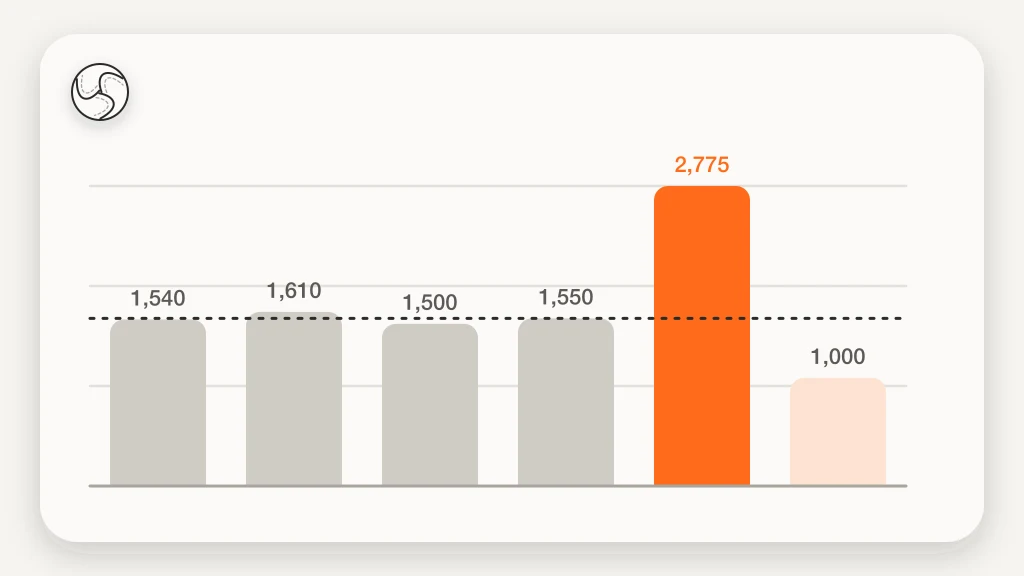
Illustrative scenario. Marta, 29, plays club volleyball. Her four recent weeks are 1,540, 1,610, 1,500 and 1,550 AU (average about 1,550). Her estimated maximum is about 188 bpm (208 − 0.7 × 29), yet her watch shows a match average of only about 125 bpm (roughly 67 %): rallies are short and rests long. She still rates matches 6–7 out of 10 because of the jumping and diving. The tournament weekend is Saturday, three matches totalling 180 minutes at RPE 7 (1,260 AU), and Sunday, two matches of 120 minutes at RPE 7 (840 AU). She keeps Tuesday's 540 AU practice, cuts Thursday to a 45-minute light session at RPE 3 (135 AU) and reaches 2,775 AU, about 1.8 × her recent average. Because that ratio is high, she plans the next week at around 1,000 AU (two light practices, no gym, an early night) and watches her morning resting heart rate and knees, then returns to roughly 1,550 AU the week after.
Action steps
- Rate every session 0–10 about 30 minutes afterwards and multiply by the minutes: practices, matches and gym work.
- Keep your watch or strap for the objective side: duration, average heart rate and heart rate recovery, plus morning resting heart rate against your baseline.
- Plan the week around the match: harder work early, a lighter day before and an easy day after.
- Change weekly load gradually; compare each week with the average of the last four and look closer when it is well above about 1.5 ×.
- Check your league's rules on watches before match day, and consider a chest strap or training-only watch.
- Protect the usual weak points (ankles, knees, shoulders) with warm-ups and strength work, and follow concussion protocols.
Related guides
- Training load explained: TRIMP, TSS, strain and relative effort
- RPE (rate of perceived exertion): the sensor you always carry
- Fitness, fatigue and form (CTL, ATL, TSB): the performance management chart
- Heart rate recovery: how fast your heart rate drops after exercise
- Overreaching and overtraining: warning signs and what to do
FAQ
What is a normal heart rate in volleyball? Casual play is often moderate, perhaps 60–75 % of maximum, because rests are long, with higher peaks after long rallies. Judge against your own maximum and use effort ratings for the jumping load.
How many calories does volleyball burn? Roughly 180–360 kcal an hour for casual to competitive indoor play at 60–90 kg, and about double that on sand. Count the minutes you actually play.
Can a watch track rugby, handball or hockey? It records duration and heart rate, and distance outdoors. It cannot capture contact, jumps or short accelerations well, and watches are often banned in matches.
References
- Foster et al. (2001). A New Approach to Monitoring Exercise Training. The Journal of Strength and Conditioning Research. https://doi.org/10.1519/1533-4287%282001%29015%3C0109:anatme%3E2.0.co;2
- Haddad et al. (2017). Session-RPE Method for Training Load Monitoring: Validity, Ecological Usefulness, and Influencing Factors. Frontiers in Neuroscience. https://doi.org/10.3389/fnins.2017.00612
- Soligard et al. (2016). How much is too much? (Part 1) International Olympic Committee consensus statement on load in sport and risk of injury. British Journal of Sports Medicine. https://doi.org/10.1136/bjsports-2016-096581
- Gabbett (2016). The training–injury prevention paradox: should athletes be training smarter and harder? British Journal of Sports Medicine. https://doi.org/10.1136/bjsports-2015-095788
- Impellizzeri et al. (2020). Acute:Chronic Workload Ratio: Conceptual Issues and Fundamental Pitfalls. International Journal of Sports Physiology and Performance. https://doi.org/10.1123/ijspp.2019-0864
- Ainsworth et al. (2011). 2011 Compendium of Physical Activities: A Second Update of Codes and MET Values. Medicine & Science in Sports & Exercise. https://doi.org/10.1249/MSS.0b013e31821ece12
For general information only. This is not medical advice — talk to a qualified professional about your health.
Keep reading
Training science
Zone 2 training: the science and how to do it right
4 min read
Training science
Polarized training (80/20): easy most of the time, hard some of the time
4 min read
Sports
Japanese interval walking: the 3-minute fast / 3-minute slow method, step by step
8 min read
Training science
Interval training and HIIT: designing sessions that work
4 min read
Sports
Trail running with a watch: heart rate, climbs and pacing by effort
7 min read
Sports
Walking for fitness and weight loss: pace, heart rate zones and how much is enough
9 min read