

Sports
Basketball: heart rate, load and recovery for a stop-start sport
Basketball packs sprints, jumps and cuts between walking breaks, so heart rate swings constantly. A wearable helps you read basketball heart rate, calories per hour and the recovery you need after a late-night game.
Written by MoveVitals Editorial Collective
Community-authored educational content. Individual clinical review is identified only when a named review is actually recorded.
Editorial standards & corrections
Key takeaways
- Average basketball heart rate runs from about 50–65 % of max when shooting around to 75–90 % in a full-court game, with energy use of roughly 300 to 600 kcal per hour for a 70 kg adult.
- For a healthy 20-year-old with a maximum near 200, 180 bpm is about 90 % of max: hard, and normal at the end of a fast break.
- Dribbling and contact confuse optical wrist sensors, and organised games often ban watches, so use a chest strap where you can and judge the game by average heart rate and time per zone.
- Ankle sprains are the most common basketball injury and knees take repeated landings, so warm up for 10 minutes and build how often you play gradually.
- Stop and seek medical care for chest pain or pressure, fainting, unusual breathlessness, or palpitations with dizziness.
Most official games are four quarters of 10 or 12 minutes, but stoppages, free throws and timeouts stretch them to well over an hour. Pick-up games are played to a score instead, often 3-on-3 on a half court or 5-on-5 on a full court. The format decides how much of your time is work and how much is waiting.
What a basketball game looks like on a heart rate trace
Fast breaks, defensive slides, screens and jumps push heart rate up within seconds; free throws, dead balls, substitutions and timeouts let it fall back, though rarely all the way. Reviews of competitive games generally report average heart rates that are high relative to maximum, with a lot of time near it (heart rate zones). Pick-up is more variable: a game with many players rotating in has far more rest than a short-sided run where nobody sits.
| Format | Typical effort | Average heart rate (% of max) | Estimated energy, 70 kg adult |
|---|---|---|---|
| Shooting around, little defence | Light | ~50–65 % | ~300 kcal/h |
| Casual half-court or 3-on-3 | Moderate to vigorous | ~65–80 % | ~400–450 kcal/h |
| Full-court pick-up or league game | Vigorous | ~75–90 % | ~500–600 kcal/h |
These are rule-of-thumb ranges, not measurements. The energy column is roughly MET × body weight (kg) × hours, using Compendium of Physical Activities values of about 4.5 for shooting baskets, 6 for casual non-game play and 8 for a game. Watches report active energy, which excludes resting energy and reads lower; both are estimates that can be well off (calories burned, calories burned by activity).
Is 180 bpm normal in basketball?
For a healthy 20-year-old with a maximum near 200, 180 bpm is about 90 %: hard, and normal at the end of a fast break. The same reading in a 55-year-old means something different, and "220 − age" can be off by 10 bpm or more, so a measured maximum is the better anchor (maximum heart rate). Heat, a poor night's sleep, caffeine and illness all lift heart rate for the same effort, and a wrist sensor may be reading ball-handling motion instead of your pulse; check with a chest strap before worrying.
Stop and seek medical care for chest pain or pressure, fainting, unusual breathlessness, or palpitations with dizziness. Fainting during exercise always deserves a medical check. A watch cannot rule a heart problem in or out, and medicines such as beta-blockers lower heart rate and make percent-of-max zones misleading. See high heart rate during exercise.
Basketball conditioning: the engine and the legs
A game is repeated sprints and jumps on top of an aerobic base. Easy sessions of 30–60 minutes at zone 2 help you recover between possessions. Short intervals copy the game, for example 6–10 runs of 20–30 seconds hard with an equal or longer easy rest, once or twice a week (interval training). Add strength and landing practice, such as squats, calf raises and soft, controlled jump landings, and increase it gradually.
Jumps, cuts and impact: what a watch cannot see
Ankle sprains are the most common basketball injury, and knees take repeated landings. A watch does not measure jumps or landing load, and heart rate only partly reflects it. Track sessions as minutes × effort rating (RPE, training load), and avoid sudden jumps in how often you play: spikes relative to what your body is used to are associated with more injuries in team sports, although exact ratios are debated. Warm up for 10 minutes before playing (warm-up) and work on ankle mobility. Rest a sore ankle, and see a clinician if it swells or you cannot put weight on it.
Wearing a watch on the court
- Heart rate. Dribbling keeps the wrists moving and contact adds knocks, which can confuse optical sensors and make readings lag. A chest strap is generally more accurate in stop-start exercise (wrist vs chest strap accuracy, Polar H10).
- Safety. Organised games often ban watches and jewellery, and a hard watch can hurt you or an opponent. Take it off or use a strap.
- Sport profile. Many watches list basketball; otherwise use a generic profile. Calorie estimates differ by profile.
- GPS. Indoor courts give none, and a court is only about 28 m long. Use duration, heart rate and active energy. See which wearable for your sport.
Late games, sleep and recovery
Most pick-up runs and leagues play in the evening. Adrenaline, bright lights and a late finish can push sleep later, and wearables often show a higher overnight heart rate and lower HRV after a hard game, usually settling within a day or two (personal baseline). Finish with a 5–10 minute walk, eat and drink, dim the lights and keep caffeine away from the evening (caffeine and sleep, sleep hygiene). If overnight heart rate stays high or sleep suffers after several games a week, ease off.
In MoveVitals
Basketball sessions arrive as ordinary workouts from whichever source recorded them: Garmin, Polar, COROS, Suunto or WHOOP through their direct connections, or Apple Watch sessions that reach your Strava account. If the source has no basketball type, the session may arrive as a general workout; MoveVitals reads the sport name the source sends. Duration, heart rate and calories are what the device supplied, and time in heart rate zones is calculated from the heart rate stream when the source provides one. If a watch and a chest strap both recorded the game, MoveVitals groups them as one session (how MoveVitals handles multiple devices). Overnight heart rate and HRV come from your ring or watch through its own connection, so you can see the night after next to the game. Direct Apple Health sync is planned, not available.
Worked example
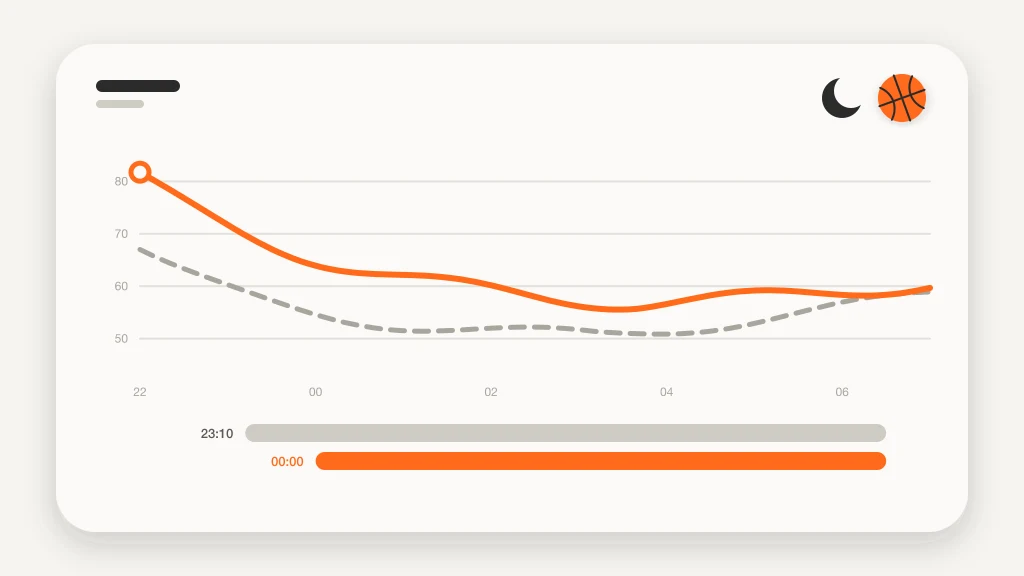
Illustrative scenario. Wei, 27, plays two hours of full-court pick-up from 8 to 10 pm, with three games to 11 and short waits in between. His maximum is about 192 bpm. A chest strap shows an average of 149 bpm (78 %), peaks of 188 bpm and about 25 % of the time above 163 bpm (85 %), falling to around 110 bpm during the waits. His watch reports about 780 active kcal. He usually falls asleep around 11:10 pm, but that night it is midnight; his overnight heart rate averages 59 bpm against his usual 53, with a lowest value of about 56 against 51, and HRV is lower than normal. He moves games an hour earlier, adds a cool-down walk and stops caffeine after mid-afternoon. A week later, after a similar game, sleep starts about 20 minutes late. Numbers are illustrative.
Action steps
- Choose the basketball profile (or a generic one), use a chest strap if you can, and take the watch off for contact games.
- Judge a game by average heart rate, time per zone and how quickly heart rate drops during stoppages, not by peaks or calories alone.
- Warm up for 10 minutes and build how often you play gradually, with extra care for ankles and knees.
- Log sessions as minutes × RPE to see your weekly load.
- After late games, cool down, dim the lights and compare the next night's heart rate and sleep with your own baseline; space out hard games.
Related guides
- Heart rate zones explained: how to set and use them
- Heart rate recovery: how fast your heart rate drops after exercise
- Ankle mobility: the knee-to-wall test and exercises that work
- Sleep hygiene: evidence-based habits for better sleep
- Training load explained: TRIMP, TSS, strain and relative effort
FAQ
What is a normal heart rate when playing basketball? Averages of roughly 50–90 % of maximum depending on format, with peaks close to maximum in full-court play. Individual variation is large, so use your own zones.
How many calories does basketball burn per hour? Roughly 300–600 kcal for a 70 kg adult, depending on whether you shoot around or play a full game. A watch usually reports active energy, which reads lower; both are estimates.
Which watch is best for basketball? One with a basketball or generic sport profile and good battery life. In games, a chest strap is steadier and safer than a watch on the wrist.
How do you recover after a late-night basketball game? Cool down, eat and drink, dim the lights and aim for your usual sleep. Overnight heart rate and sleep may need a day or two to settle.
References
- Ainsworth et al. (2011). 2011 Compendium of Physical Activities: a second update of codes and MET values. Medicine & Science in Sports & Exercise. https://doi.org/10.1249/MSS.0b013e31821ece12
- Stojanović et al. (2018). The activity demands and physiological responses encountered during basketball match-play: a systematic review. Sports Medicine. https://doi.org/10.1007/s40279-017-0794-z
- Gabbett (2016). The training–injury prevention paradox: should athletes be training smarter and harder? British Journal of Sports Medicine. https://doi.org/10.1136/bjsports-2015-095788
- Shcherbina et al. (2017). Accuracy in wrist-worn, sensor-based measurements of heart rate and energy expenditure in a diverse cohort. Journal of Personalized Medicine. https://doi.org/10.3390/jpm7020003
For general information only. This is not medical advice — talk to a qualified professional about your health.
Keep reading
Sports
Walking for fitness and weight loss: pace, heart rate zones and how much is enough
9 min read
Sports
Pickleball and your health data: heart rate zones, calories and joint load
6 min read
Sports
Padel with a wearable: heart rate, calories and recovery between matches
7 min read
Training science
Zone 2 training: the science and how to do it right
4 min read
Sports
Japanese interval walking: the 3-minute fast / 3-minute slow method, step by step
8 min read
Devices & setup
Strava and MoveVitals: workouts, streams and devices that arrive via Strava
3 min read