

Sports
Football (soccer): distance, sprints and heart rate from a wearable
A football (soccer) match mixes long stretches of walking and jogging with repeated sprints. A watch or GPS tracker can show distance covered, high-speed running and heart rate, but what the numbers mean depends on the format and the sensor.
Written by MoveVitals Editorial Collective
Community-authored educational content. Individual clinical review is identified only when a named review is actually recorded.
Editorial standards & corrections
Key takeaways
- An amateur 11-a-side player covers roughly 5–9 km in 60–90 minutes, 7-a-side about 4–6 km and 5-a-side or futsal about 3–5 km with heart rate high and steady.
- Most consumer watches sample position about once a second, so they suit total distance on an open pitch but miss short sprints, while club GPS vests sample ten times a second.
- Average match heart rate is roughly 70–90 % of maximum depending on level and format, and chest straps are generally more accurate than wrist sensors in stop-start exercise.
- Muscle soreness commonly peaks 24–48 hours after a match, so plan an easy day after and build sprint work gradually.
A professional match is two 45-minute halves plus stoppage time, and amateur leagues often play shorter halves. Recreational football is more varied: 11-a-side on a full pitch, 7-a-side, or 5-a-side and futsal on small courts, typically for 40–60 minutes. The format changes distance, heart rate and recovery needs more than any other factor.
How far do footballers run?
Elite outfield players typically cover about 9–13 km in a match, midfielders usually the most and centre-backs and strikers a little less. Most of that is walking and jogging; high-speed running and sprinting are a small but decisive share. Recreational players cover less, depending on age, fitness, position, pitch size and length of game. Studies of elite players generally report average heart rates in the region of 80–90 % of maximum over a match, with sprints near maximum.
| Format | Typical duration | Distance covered (rough) | Heart rate profile |
|---|---|---|---|
| 11-a-side, elite outfield player | 90 min | ~9–13 km | High average, peaks near max |
| 11-a-side, amateur | 60–90 min | ~5–9 km | Moderate to high, varies by position |
| 7-a-side | 50–60 min | ~4–6 km | Moderate to high |
| 5-a-side or futsal | 40–60 min | ~3–5 km | High and steady, little time to rest |
These are rough ranges, not measurements. For energy, the Compendium of Physical Activities lists about 7 METs for casual football and 10 for competitive play, so roughly 490–700 kcal an hour for a 70 kg adult; watches usually report less because they count active energy only (calories burned by activity).
High-speed running and sprints: what the labels mean
Tracking systems split distance into speed bands. Thresholds differ between systems, but many use roughly 19–20 km/h for high-speed running and about 25 km/h for sprinting. Sprints are short, usually a few seconds and often under 30 m, so a sprint count depends heavily on how a system defines one. Accelerations and decelerations tax the legs even below sprint speed. Do not compare sprint numbers from different devices or apps, and ignore pace per kilometre: distance, time in speed bands and heart rate tell you more.
Heart rate in 11-a-side vs 5-a-side
In 11-a-side, heart rate depends on position and moment: a midfielder who covers the pitch spends more time high than a goalkeeper or a centre-back who holds a line. In 5-a-side and futsal the pitch is small and you are involved constantly, so heart rate often stays high for long stretches, even though total distance is lower. Rotating substitutes give breaks. Judge either format by average heart rate and time per zone (heart rate zones), and compare the second half with the first: a big drop in distance or high-speed running suggests fatigue.
Watch, GPS vest or chest strap
- Watch GPS. Most consumer watches sample position about once a second. That is fine for total distance on an open pitch but less accurate for short sprints, accelerations and sharp turns, and it tends to underestimate peak speed (running pace and GPS accuracy).
- GPS vests and pods. Clubs use units that sample ten times a second, with software that reports speed bands and sprints. They are more precise for short bursts but not directly comparable with watch output.
- Heart rate. Chest straps are generally more accurate than wrist sensors in stop-start exercise (wrist vs chest strap accuracy, Polar H10).
- Indoors and rules. Futsal and covered 5-a-side give no GPS, so use duration and heart rate. Organised matches may restrict watches and jewellery for safety; check your league. For picking a device, see which wearable for your sport.
Football conditioning: aerobic base and repeated sprints
Football fitness is an aerobic base plus the ability to repeat sprints. Easy runs or cycling at zone 2 build the base. Hard intervals, for example four blocks of four minutes hard with three minutes easy, raise aerobic capacity (interval training). Add short sprints of 20–30 m with generous rest, and strength work such as hamstring and calf training, once or twice a week. Hamstring strains typically happen when sprinting, so build high-speed running gradually (injury prevention).
Weekly load around a match
A match is usually the heaviest session of the week. Track every session as minutes × effort rating, so a 90-minute match at an RPE of 8 is 720 units (RPE, training load). Sudden jumps in load compared with what you are used to are associated with more injuries in team sports, although exact ratios are debated. Keep the day before a match light, the day after easy, and cut training if you play twice in a week. See active recovery and overreaching and overtraining.
Recovery after matches: sleep and soreness
Muscle soreness commonly peaks 24–48 hours after a match, especially after lots of sprinting, accelerating and braking (recovery after strength training and soreness). Evening kick-offs raise heart rate and body temperature and can delay sleep; wearables often show a higher overnight heart rate and lower HRV after a hard match, usually settling in a day or two (sleep duration, personal baseline). Eat and drink after playing (protein for recovery), and treat repeated high resting heart rate or poor sleep as a reason to ease off. Compare with your own baseline, not other players. For another stop-start team sport see basketball, and for volleyball, rugby and others see team sports load.
In MoveVitals
Football sessions arrive as ordinary workouts from whichever source recorded them: Garmin, Polar, COROS, Suunto or WHOOP through their direct connections, or Apple Watch sessions that reach your Strava account. Sport names such as football, soccer and futsal map to MoveVitals' soccer type. Distance (where there is GPS), duration, heart rate and calories are what the device supplied, and time in heart rate zones is calculated from the heart rate stream when the source provides one. Football-specific outputs such as sprint counts or speed bands depend on what the device or app exports, so do not expect them in every workout. If a watch and a chest strap both recorded the match, MoveVitals groups them as one session (how MoveVitals handles multiple devices). Overnight heart rate and HRV come from your ring or watch through its own connection. Direct Apple Health sync is planned, not available.
Worked example
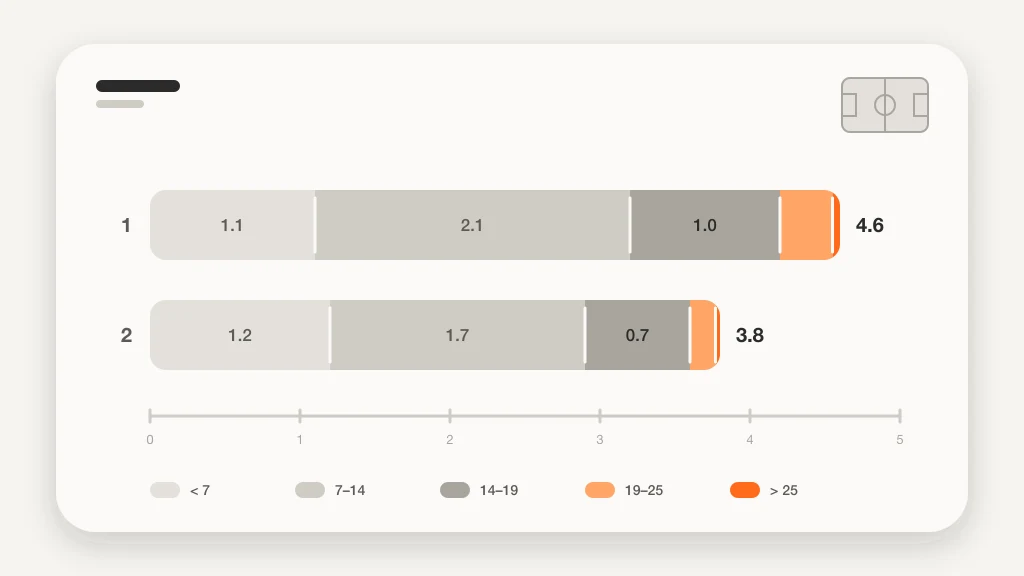
Illustrative scenario. Diego, 31, plays central midfield in a 90-minute 11-a-side league match. His measured maximum heart rate is about 190 bpm. His watch shows 8.4 km, an average of 156 bpm (82 %) and about 24 minutes above 161 bpm (85 %). The club's GPS pod report splits the distance by speed: 4.6 km in the first half and 3.8 km in the second, with about 600 m above roughly 19 km/h in total, 80 m of it above 25 km/h. High-speed running falls from about 400 m in the first half to 200 m in the second, a sign of fatigue. His week is two 70-minute sessions at an RPE of 5 (350 units each) plus the match at 720, about 1,420 units. He keeps Monday to an easy walk, trims Tuesday's session to technical work, and checks that his overnight heart rate (58 bpm against a usual 54) is back to normal by Tuesday. Numbers are illustrative.
Action steps
- Choose the football or soccer profile on your watch, use a chest strap for heart rate if you can, and check whether your league allows watches.
- Judge a match by distance, time per heart rate zone and how much high-speed running you still do late, not by pace.
- Compare the first and second half; a large drop signals fatigue or limits to your conditioning.
- Build sprint and high-speed running gradually, add strength work, and plan an easy day after the match.
- Compare overnight heart rate and sleep after matches with your own baseline, and cut training in a two-match week.
Related guides
- Training load explained: TRIMP, TSS, strain and relative effort
- Heart rate recovery: how fast your heart rate drops after exercise
- Running pace: GPS accuracy, grade-adjusted pace and training paces
- How much sleep do you need? Sleep duration and sleep debt
- Overreaching and overtraining: warning signs and what to do
FAQ
How far does a footballer run in a match? Elite outfield players cover roughly 9–13 km. Amateur players usually cover less, about 5–9 km in 11-a-side, and less again in small-sided games.
What is a normal heart rate during a football match? Averages of roughly 70–90 % of maximum depending on level and format, with sprints near maximum. Small-sided games often keep it high for longer.
Can I use a watch instead of a GPS vest? For total distance and heart rate, a watch is a reasonable tool. It is less accurate for sprints and quick turns, and a vest's speed-band reports are not directly comparable.
How long does it take to recover from a football match? Soreness often peaks a day or two later. After a hard or late match, overnight heart rate and sleep can take a day or two to settle.
References
- Bangsbo et al. (2006). Physical and metabolic demands of training and match-play in the elite football player. Journal of Sports Sciences. https://doi.org/10.1080/02640410500482529
- Mohr et al. (2003). Match performance of high-standard soccer players with special reference to development of fatigue. Journal of Sports Sciences. https://doi.org/10.1080/0264041031000071182
- Scott et al. (2016). The validity and reliability of global positioning systems in team sport: a brief review. Journal of Strength and Conditioning Research. https://doi.org/10.1519/JSC.0000000000001221
- Gabbett (2016). The training–injury prevention paradox: should athletes be training smarter and harder? British Journal of Sports Medicine. https://doi.org/10.1136/bjsports-2015-095788
- Ainsworth et al. (2011). 2011 Compendium of Physical Activities: a second update of codes and MET values. Medicine & Science in Sports & Exercise. https://doi.org/10.1249/MSS.0b013e31821ece12
For general information only. This is not medical advice — talk to a qualified professional about your health.
Keep reading
Sports
Trail running with a watch: heart rate, climbs and pacing by effort
7 min read
Training science
Zone 2 training: the science and how to do it right
4 min read
Metrics explained
Resting heart rate: normal ranges and what changes it
4 min read
Sports
Japanese interval walking: the 3-minute fast / 3-minute slow method, step by step
8 min read
Training science
Polarized training (80/20): easy most of the time, hard some of the time
4 min read
Training science
Interval training and HIIT: designing sessions that work
4 min read