

Sports
Mountain biking with a wearable: heart rate, intermittent power and recovery
Mountain bike heart rate and power are spiky: surges on climbs, coasting on descents and a heart rate that lags behind both. Read normalised power, variability index and time in zone instead of averages, and plan recovery for rough terrain.
Written by MoveVitals Editorial Collective
Community-authored educational content. Individual clinical review is identified only when a named review is actually recorded.
Editorial standards & corrections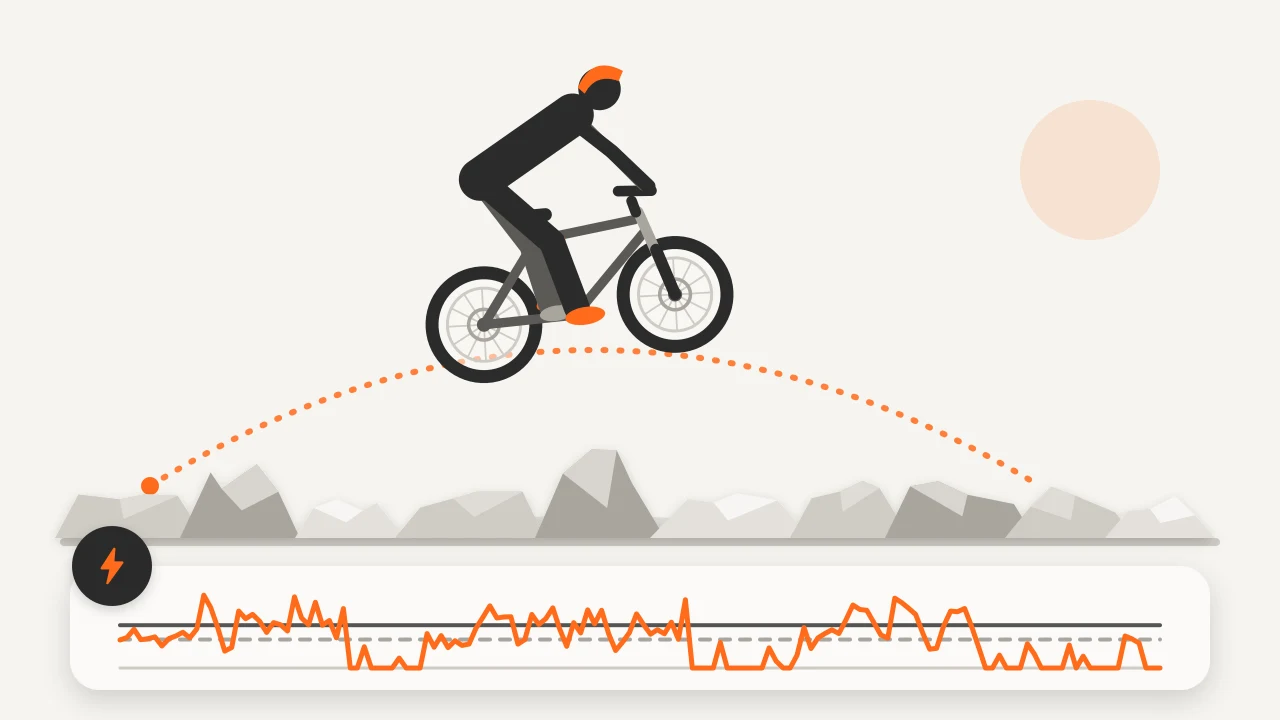
Key takeaways
- Variability index, normalised power divided by average power, is about 1.00–1.05 on a steady road ride and often 1.2 or more on trails.
- Heart rate lags effort by 30–60 seconds, so it smooths power spikes, and adrenaline, braking and grip keep it high on descents even when power is near zero.
- XC rewards threshold power and repeated surges, with laps of roughly 1–1.5 hours, while enduro depends on aerobic base, repeatability, technique and upper-body endurance.
- Chest straps are generally more accurate than wrist optical sensors when vibration, grip and wrist angle disturb the signal.
- Long technical days load grip, forearms, neck and back, so check resting heart rate and HRV against your baseline and ease off when they are off.
Mountain biking is intermittent exercise: hard climbs, short punches over roots and rocks, then descents where you barely pedal but your arms, legs and focus work hard. That breaks several tools built for steady road riding.
Why heart rate and power look spiky
- Power jumps to several hundred watts for a few seconds on steps and punchy climbs, then drops to 0 W while you coast, so a large share of a trail ride can sit at zero watts.
- Heart rate lags effort by 30–60 seconds, so it smooths the spikes. It often stays high on descents because of adrenaline, braking, gripping and heat, so it can read high while power reads zero.
- Averages mislead. Apps differ on whether the zeros count in average power, so check the setting before comparing rides or sources (heart rate vs power).
Metrics that help
| Metric | What it shows | How to use it |
|---|---|---|
| Normalised power (NP) | A weighted average that emphasises surges, an estimate of the physiological cost | Compare with average power and FTP |
| Variability index (VI) | NP ÷ average power: about 1.00–1.05 on a steady road ride, often 1.2 or more on trails | A high VI means stop-start riding; judge the ride by NP, not average |
| Time in zone | Minutes in each power or heart rate zone | See how much was easy, threshold or all-out (heart rate zones) |
| Heart rate recovery | The drop in the first minute after a hard climb (heart rate recovery) | Compare yourself on the same climb over weeks; a faster drop generally goes with better fitness |
| Work (kJ) and ascent | Total energy output (roughly 1 kJ ≈ 1 kcal burned) and metres climbed | A common currency for very different rides |
NP and training-load scores come from power or heart rate, so they can understate the muscular and mental cost of rough descents (training load).
XC versus enduro
Mountain biking fitness training depends on the discipline, and enduro fitness training looks very different from XC.
| XC (cross-country) | Enduro | |
|---|---|---|
| Format | Laps of roughly 1–1.5 h, fast starts, repeated climbs | Timed descents of a few minutes linked by untimed climbs, 3–6 h days |
| What decides it | Threshold power, repeated surges, starts | Aerobic base, repeatability, technique, upper-body and core endurance |
| Heart rate | Near threshold with surges | Low on climbs, high and erratic on stages |
| Training focus | Threshold and VO2 max intervals, short hard starts | Zone 2 volume, short maximal efforts with full recovery, strength |
An XC mountain bike training plan can start with three rides: intervals (for example 5 × 4 minutes near FTP with 4 minutes easy), an easy hour with 6–8 hard starts of 20–30 seconds, and a long trail ride of 2–3 h at mostly endurance effort. Add one or two strength sessions (strength training for endurance). Beginners can borrow the structure of a road cycling plan and keep the intervals shorter.
Devices: what to trust on rough ground
- Heart rate: chest straps are generally more accurate than wrist optical sensors when vibration, grip and wrist angle disturb the signal (Bent et al. 2020).
- Power: crank, spider and hub meters sit out of the way; pedal-based meters are more exposed to rock strikes. Expect noisy short-term readings on rough ground (power meter types).
- GPS and altitude: tree cover and tight switchbacks shorten tracks, and a barometric altimeter drifts with the weather, so set the altitude at the start. Total ascent differs between devices.
Recovery after rough terrain
Long technical days load more than the legs: braking and landing are eccentric work, while grip, forearms, neck and back work isometrically. Expect resting heart rate a few beats higher and HRV lower for a night or two (resting heart rate), and look at your own trend before choosing the next ride. Hip and thoracic mobility help in the attack position (hip mobility, thoracic mobility). Data cannot detect a concussion: after a crash with a head impact, confusion, vomiting or a worsening headache, see a doctor.
In MoveVitals
Rides from Garmin, Wahoo, COROS, Suunto, Polar and Strava (Apple Watch workouts via Strava) arrive with heart rate, power, cadence, altitude and GPS streams where the device recorded them. Average and normalised power are available for each ride, so you can work out VI yourself, and a ride that reaches MoveVitals from two services is kept once, labelled with the original device (how conflicts are resolved). Overnight HRV and resting heart rate from WHOOP, Oura, Garmin or COROS sit on the same timeline, so you can see how a technical day showed up the next morning.
Worked example
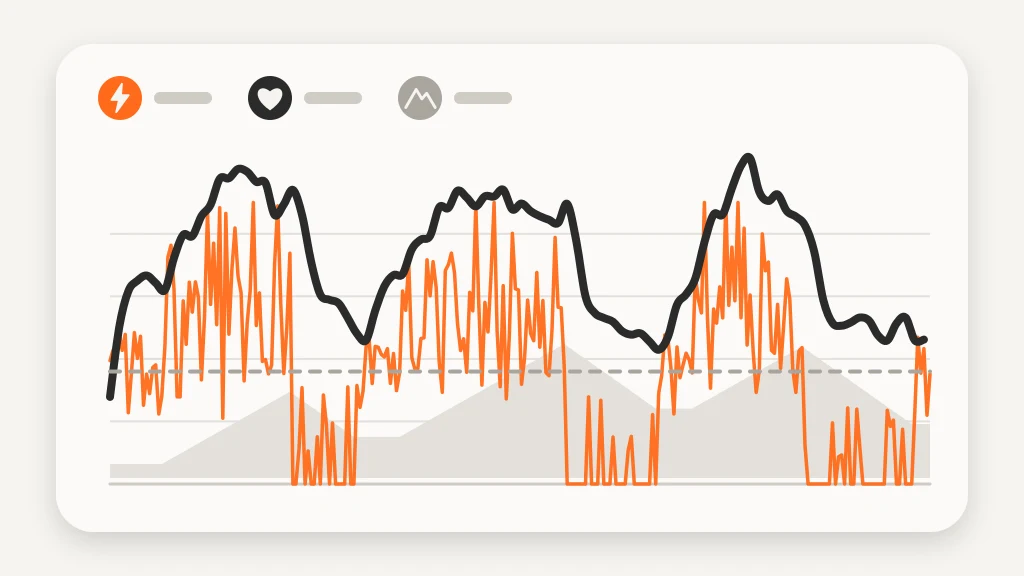
Illustrative scenario. Lena, 34, with an FTP of 230 W, rides a 24 km (15 mile) XC loop with 650 m (2,130 ft) of climbing in 90 minutes. Her average power is 130 W because about 20 % of the ride is coasting at 0 W, but normalised power is 185 W, so VI is 185 ÷ 130 ≈ 1.42 and NP is about 80 % of FTP: a solid endurance ride, not an easy one. Her heart rate averages 148 bpm, peaks at 178 bpm on the last steep pitch and stays near 155 bpm on the descent although power is near zero. In the first minute after the main climb it falls 22 bpm; on the same climb eight weeks earlier it fell 16 bpm. The next morning her resting heart rate is 4 bpm above her usual and her HRV is lower, so she rides easy. Figures are illustrative.
Action steps
- Wear a chest strap and, if you can, a power meter; set zones from your FTP or maximum heart rate.
- After each ride, compare normalised power, VI and time in zone, not only average power or speed.
- Match training to your discipline: threshold and VO2 max intervals plus starts for XC; zone 2 volume, repeated short efforts and strength for enduro.
- On climbs, pace by heart rate and RPE rather than chasing power spikes.
- After rough days, check resting heart rate and HRV against your baseline, and ease off when they are off.
Related guides
- Heart rate zones explained: how to set and use them
- Heart rate vs power vs pace: which should you train with?
- FTP (functional threshold power): what it is and how to test it
- Heart rate recovery: how fast your heart rate drops after exercise
- Training load explained: TRIMP, TSS, strain and relative effort
FAQ
What heart rate should I ride a mountain bike at? There is no single number. Set your mountain bike heart rate zones from your own maximum heart rate or threshold (heart rate zones), keep long climbs near the top of zone 2 on endurance days, and expect XC racing to sit near threshold with surges. Heart rate will spike on climbs and stay high on descents.
Why is my heart rate high on descents? Adrenaline, braking, gripping the bars, heat and the delay of the heart rate signal all keep it up, even when power is near zero.
Is normalised power useful on a mountain bike? Yes, as a better estimate of effort than average power, but it was designed for road riding. Very short hard efforts and technical sections can still make it over- or understate the cost, so read it with heart rate and RPE.
Do I need a power meter for mountain biking? No. Heart rate, RPE and time in zone are enough for most riders; power mainly helps with precise intervals and with comparing climbs over time.
References
- Impellizzeri & Marcora (2007). The physiology of mountain biking. Sports Medicine. https://doi.org/10.2165/00007256-200737010-00005
- Bent et al. (2020). Investigating sources of inaccuracy in wearable optical heart rate sensors. npj Digital Medicine. https://doi.org/10.1038/s41746-020-0226-6
For general information only. This is not medical advice — talk to a qualified professional about your health.
Keep reading
Training science
Zone 2 training: the science and how to do it right
4 min read
Training science
Polarized training (80/20): easy most of the time, hard some of the time
4 min read
Devices & setup
Strava and MoveVitals: workouts, streams and devices that arrive via Strava
3 min read
Metrics explained
VO2 max: what it means and how to improve it
4 min read
Training science
Interval training and HIIT: designing sessions that work
4 min read
Sports
Trail running with a watch: heart rate, climbs and pacing by effort
7 min read