

Sports
Gravel cycling: training for long mixed-surface rides and races
Gravel riding is long, variable-power effort on loose ground, so the training that pays off is durability and fuelling, not just a bigger FTP. Here is how to train for a 100–200 km gravel event, from the weekly structure to carbohydrate per hour.
Written by MoveVitals Editorial Collective
Community-authored educational content. Individual clinical review is identified only when a named review is actually recorded.
Editorial standards & corrections
Key takeaways
- A gravel ride's variability index, normalised power divided by average power, is often 1.10–1.20 against 1.05–1.10 on the road, so average power flatters a surgy ride.
- Durability is how well you hold power after hours of work: compare power divided by heart rate in the two halves of a steady 3-hour-plus ride and aim for a fall of about 5 % or less.
- Sustainable normalised power is about 70–80 % of FTP for 3–4 hour events, 62–72 % for 5–7 hours and 55–65 % for 8 hours or more.
- On a bumpy bike small and frequent beats big and rare: start fuelling in the first half hour and set a timer for every 20–30 minutes.
- A 12-week gravel block builds from 6–8 weekly hours and a 2.5–3.5 hour long ride in base to 10–12 hours and 5.5–6.5 hours in the specific phase.
How gravel differs from road riding
Road fitness transfers well: the aerobic engine that carries a 100 km road ride carries a gravel ride too. What changes is the demand. Loose surfaces raise rolling resistance, so you go slower for the same power; short climbs, corners and rough sections break the effort into surges; and events are long and often self-supported, so a mistake with food or pacing costs hours, not minutes.
| Road ride | Gravel ride | |
|---|---|---|
| Typical event time | 2–6 h | 4–12 h or more |
| Power pattern | Steadier, more drafting | More surges, more stops and starts |
| Variability index (normalised power ÷ average power) | Often 1.05–1.10 | Often 1.10–1.20 |
| Speed at the same power | Higher | Lower on loose or rough ground |
| Main limiter | Threshold power | Durability, fuelling, handling |
Tyres matter more than most riders expect. Gravel tyres of about 38–45 mm are usually run at lower pressure than road tyres; on rough ground a wider, softer tyre often rolls faster and spares your hands and back, while on smooth tarmac it is slower. Test pressures on your own routes. If you are choosing a gravel bike, fit and tyre clearance matter more than the badge; for how power meters compare, see power meters compared.
What your devices record on gravel
| Signal | Gravel caveat |
|---|---|
| Power | The most useful number. Average power flatters a surgy ride; normalised power and the variability index show the real load. Kilojoules of work roughly equal kilocalories burned |
| Heart rate | Chest straps are generally steadier than wrist optical sensors on rough ground, where vibration and a tight grip move the watch |
| GPS speed and distance | Tree cover and canyons add noise, and speed on loose ground is a poor guide to effort |
| Elevation gain | Barometric and GPS-derived totals differ between devices, so compare rides recorded the same way |
| Battery | Check that your head unit or watch lasts a full 8–12 h in the mode you will use |
Durability: training for hour six
Durability is how well you hold power, and how little your heart rate and effort drift, after hours of work. Researchers treat it as a quality separate from fresh threshold power (Maunder et al., 2021): two riders with the same FTP can produce quite different power after 3,000 kJ of riding. Gravel rewards the one who holds up.
A simple check: on a steady ride of three hours or more, compare power divided by heart rate in the first and second halves. A fall of less than about 5 % suggests your aerobic system is holding up; 8–10 % or more points to fuelling, heat, pacing or fitness limits (a rule of thumb; see cardiac drift). To build it:
- Ride long zone 2 sessions, growing to 4–6 hours.
- Add tempo or sweet-spot blocks in the last hour of a long ride, when you are tired.
- Use back-to-back days (for example 4 h then 2.5 h) as the event gets close.
Pace by power, not speed. Rough planning ranges for normalised power as a share of FTP for a trained rider:
| Event length | Sustainable normalised power |
|---|---|
| 3–4 h | About 70–80 % |
| 5–7 h | About 62–72 % |
| 8 h or more | About 55–65 % |
Start at the low end; the ranges vary widely with fitness, terrain and heat.
Fuelling by the hour
On gravel, fuelling often decides the result. Guidance for endurance events is about 30–60 g of carbohydrate per hour for efforts of one to 2.5 hours and up to 90 g per hour beyond that, using a glucose-plus-fructose mix to reach the top end (Jeukendrup, 2014; Thomas et al., 2016).
| Ride length | Carbohydrate | Fluid and sodium |
|---|---|---|
| Under 1 h | Not needed for most riders | Water |
| 1–2.5 h | 30–60 g/h | Roughly 400–800 mL/h, depending on heat and sweat rate |
| Over 2.5–3 h | 60–90 g/h with a trained gut | Add sodium as your sweat loss requires |
On a bumpy bike, small and frequent beats big and rare: start in the first half hour, set a timer for every 20–30 minutes, mix gels, chews and real food, and carry more than you think because aid stations can be far apart. Rehearse the whole plan on long rides, since the gut adapts; see carbohydrate fuelling and hydration and electrolytes. You cannot replace everything you burn: at about 140 W an hour costs roughly 500 kcal, and 70 g of carbohydrate is about 280 kcal.
A gravel bike training plan: one week and a 12-week block
For a 100–200 km event, three to five rides a week are enough if one is long.
- Long ride (weekend): gravel or similar surface, mostly zone 2, with your race fuelling plan.
- Second ride (next day): 1.5–3 hours easy to moderate once the build starts.
- One quality session: sweet-spot or threshold intervals, such as 3 × 15 min or 2 × 20 min.
- Strength and an easy spin: one or two short strength sessions; see strength training for endurance athletes.
| Weeks | Phase | Weekly hours | Longest ride |
|---|---|---|---|
| 1–4 | Base | 6–8 | 2.5–3.5 h |
| 5–8 | Build | 8–10 | 4–5.5 h |
| 9–10 | Specific | 10–12 | 5.5–6.5 h, plus a second day |
| 11–12 | Taper | 6–8, falling | Short openers only |
Make weeks 4 and 8 lighter (see deload weeks). The hours assume you already ride about 6 hours a week; for a 100 km event, a longest ride of 3–4 hours is enough.
Common mistakes
- Doing only intervals and never riding for five hours.
- Going out with the road-speed group in the first hour and paying for it later.
- Trying new food or drink on race day.
- Ignoring tyre pressure, hands and back until they fail.
In MoveVitals
Gravel rides from Garmin, Wahoo, COROS, Polar, Suunto or Strava arrive as rides alongside your road and mountain-bike sessions. Average and normalised power, heart rate, cadence and elevation come through as each source provides them, and a ride that reaches MoveVitals from both a head unit and Strava is merged into one and labelled with the original device (how conflicts are resolved). Time in heart-rate zone is calculated from the stream, and you can compare power and heart rate on one timeline to see drift on your long rides. Overnight HRV, resting heart rate and sleep from WHOOP, Oura, Garmin or Polar show how you are absorbing big weekend rides; compare them with your own baseline.
Worked example
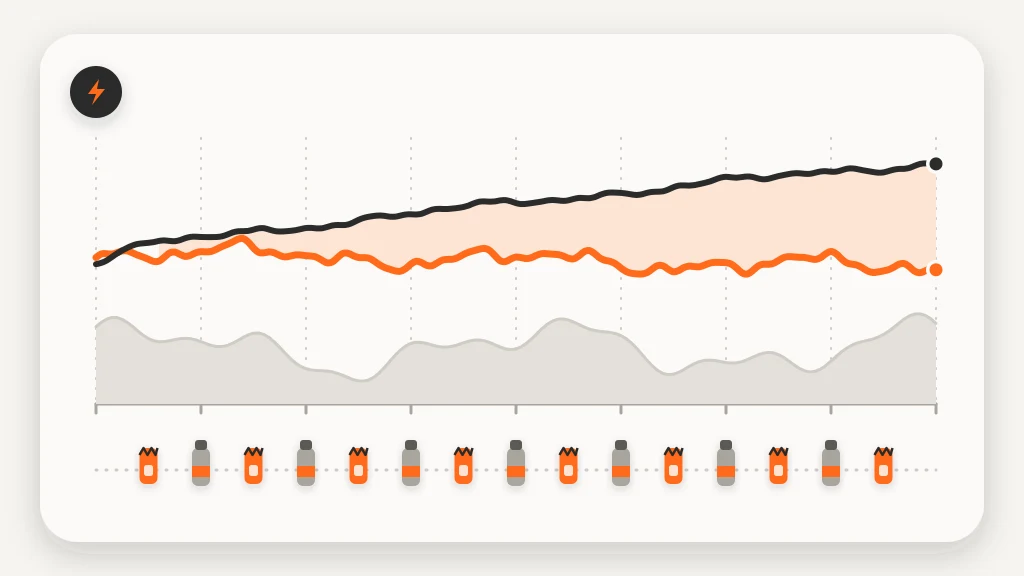
Illustrative scenario. Lena has an FTP of 220 W and targets a 160 km race in about 8 hours. Her pacing plan is a normalised power of 135–145 W, about 61–66 % of FTP. At 140 W for 8 hours that is about 4,000 kJ, roughly 4,000 kcal; 70 g of carbohydrate per hour supplies about 2,240 kcal, a little over half. On a 5-hour practice ride she holds 138 W at 129 bpm in the first half and 133 W at 139 bpm in the second, a power-to-heart-rate fall of about 11 %. She had eaten only about 30 g per hour. Four weeks later, on the same route and eating about 65 g per hour from the first half hour, she rides 137 W at 128 bpm and then 134 W at 132 bpm, a fall of about 5 %. Heat, sleep and pacing also matter, so she treats it as a trend, not a verdict. Figures are illustrative.
Action steps
- Set your FTP and zones, then write down the event's duration, the aid-station gaps and your target longest ride.
- Build one long ride a week toward 60–75 % of expected event time, mostly zone 2, adding a tempo block late in the ride.
- Rehearse fuelling at 60–90 g of carbohydrate per hour with the products you will race on, on a 20–30 minute timer.
- Check durability every 4–6 weeks by comparing the halves of a steady 3-hour-plus ride, and aim for a fall of about 5 % or less.
- Set race pace by power, not speed, start at the low end, and taper over the final 7–10 days.
Related guides
- FTP (functional threshold power): what it is and how to test it
- Cycling power zones explained: the 7 zones from FTP and how to train in them
- Zone 2 training: the science and how to do it right
- Carbohydrate fuelling for training and racing
- Tapering before a race: how to arrive fresh and fit
FAQ
How do I train for a 100-mile gravel race? Plan 12–16 weeks with three to five rides a week: one long ride building to 4–6 hours, one session of sweet-spot or threshold work, easy rides in between and a taper over the last 7–10 days. Rehearse your fuelling at 60–90 g of carbohydrate per hour and pace the event at roughly 60–70 % of FTP.
Is road bike fitness enough for gravel? Largely yes for the aerobic base. What road training misses is time on rough ground, bike handling, upper-body and hand endurance, and eating on a bumpy bike, so add some of your rides on gravel or similar surfaces.
How many carbohydrates per hour on a gravel ride? About 30–60 g per hour for rides of one to 2.5 hours and 60–90 g per hour beyond that, tested in training first. Add fluid and sodium that match your sweat rate.
I am new to gravel: where do I start? Begin with one or two 1–2 hour rides on gravel roads at a conversational effort, add time gradually, practise cornering and braking on loose surfaces, carry water, food and a spare tube, and ride with others. Move to 3–4 hour rides before you enter a race.
References
- Maunder et al. (2021). The Importance of 'Durability' in the Physiological Profiling of Endurance Athletes. Sports Medicine. https://doi.org/10.1007/s40279-021-01459-0
- Jeukendrup (2014). A Step Towards Personalized Sports Nutrition: Carbohydrate Intake During Exercise. Sports Medicine. https://doi.org/10.1007/s40279-014-0148-z
- Thomas et al. (2016). Nutrition and Athletic Performance. Medicine & Science in Sports & Exercise. https://doi.org/10.1249/MSS.0000000000000852
For general information only. This is not medical advice — talk to a qualified professional about your health.
Keep reading
Training science
Zone 2 training: the science and how to do it right
4 min read
Training science
Polarized training (80/20): easy most of the time, hard some of the time
4 min read
Devices & setup
Strava and MoveVitals: workouts, streams and devices that arrive via Strava
3 min read
Metrics explained
VO2 max: what it means and how to improve it
4 min read
Training science
Interval training and HIIT: designing sessions that work
4 min read
Sports
Trail running with a watch: heart rate, climbs and pacing by effort
7 min read