

Sports
Indoor cycling classes (spin, Peloton): calories, heart rate zones and output
The most reliable number from a spin or Peloton class is your total output in kilojoules: for cycling, kilojoules of work roughly equal kilocalories burned, and that is often lower than the figure on a screen or a watch. Here is how to read class calories, heart rate zones and output, and how often to ride.
Written by MoveVitals Editorial Collective
Community-authored educational content. Individual clinical review is identified only when a named review is actually recorded.
Editorial standards & corrections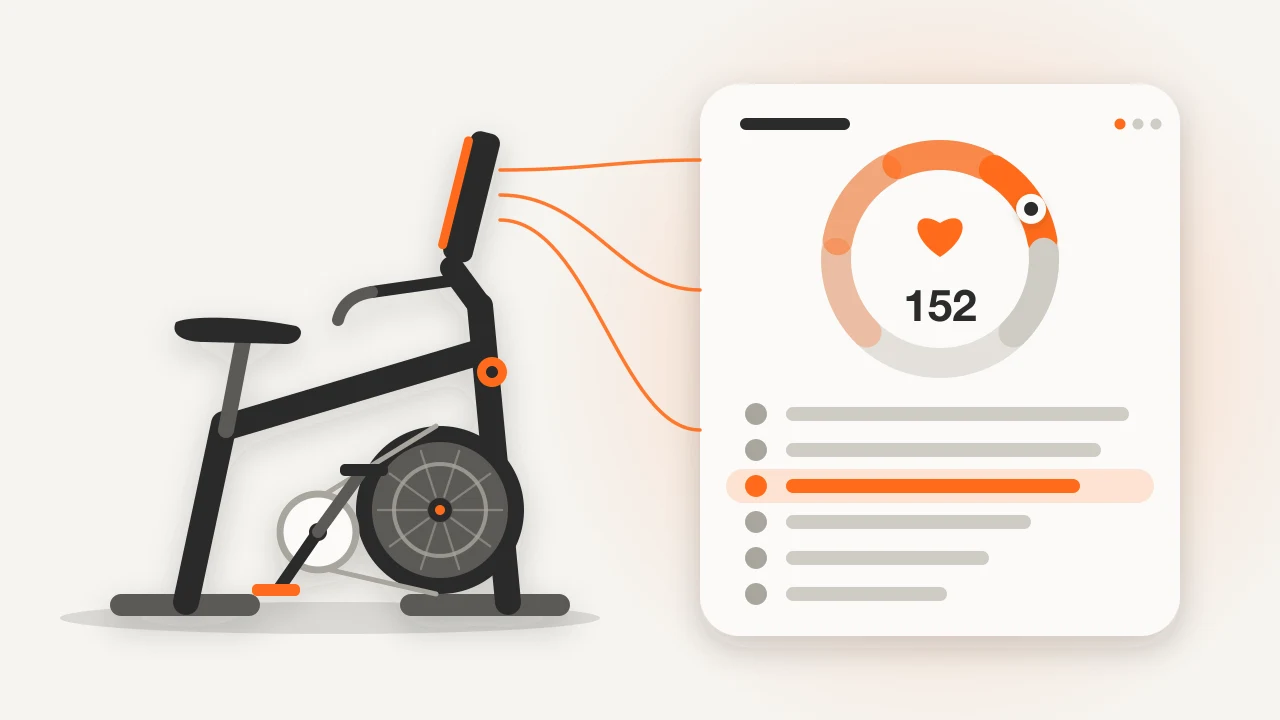
Key takeaways
- Total output is average watts times seconds, divided by 1,000, so 150 W for a 45-minute class gives 405 kJ, or about 405 kcal.
- The same resistance number means different watts on different bikes, and power is cadence times resistance, so compare output only with yourself on the same bike.
- Heart rate takes a minute or two to rise after a hard effort starts, so a one-minute sprint barely moves it; judge intervals by output and RPE.
- Most of a class belongs in zones 2–4, about 60–90 % of your maximum, and two to four classes a week suit most people, with hard classes 48 hours apart.
What the class screen shows
| Reading | What it is | Caveat |
|---|---|---|
| Cadence (rpm) | Pedal revolutions per minute | Reliable |
| Resistance | A knob or a scale such as 0–100 | Brand-specific: the same number means different watts on different bikes and at different cadences |
| Output (watts, total kJ) | Power now and total work done | Set by the bike's own calibration; best for comparing yourself on the same bike |
| Calories | An estimate | Built from output or heart rate plus your profile |
| Heart rate (bpm) | From a paired strap or watch | Lags effort; wrist sensors can slip or misread |
Power is cadence times resistance: the same resistance at a higher cadence is more watts. Many studio bikes have no power meter at all and show only cadence and resistance, so instructors cue by feel, turns of the knob and RPE.
Spin class calories: why kilojoules are the number to trust
Total output is work: average watts times seconds, divided by 1,000, gives kilojoules. Human cycling efficiency is roughly 20–25 % (Ettema and Lorås, 2009), and that happens to make kilojoules of work about equal to kilocalories burned. So the output counter is a usable calorie meter, with a caveat: it includes the part of the energy you would use at rest anyway.
| Average power | 45-minute class | 60-minute class |
|---|---|---|
| 100 W | 270 kJ (about 270 kcal) | 360 kJ (about 360 kcal) |
| 150 W | 405 kJ (about 405 kcal) | 540 kJ (about 540 kcal) |
| 200 W | 540 kJ (about 540 kcal) | 720 kJ (about 720 kcal) |
The screen, the class app and your watch each use a different estimate, so they rarely agree. Wrist devices have been found to estimate energy expenditure with large errors even when their heart rate is good (Shcherbina et al., 2017). Treat any single figure as a range, and see calories burned and the calories burned by activity hub for how wearables estimate energy.
Heart rate zones in a class
Use the five-zone model from heart rate zones. A typical class moves from zones 1–2 in the warm-up, to zones 3–4 on climbs and hard efforts, with brief zone 5 spikes and recoveries between. Three things to know:
- Heart rate lags. It takes a minute or two to rise after a hard effort starts and peaks as the effort ends, so a one-minute sprint barely moves it. Judge intervals by output and RPE, and the class overall by average heart rate and time in zone.
- Indoors runs hotter. Without a fan, heart rate at the same output is often higher than outdoors. Use a fan, and if heart rate climbs at steady output, that is cardiac drift.
- Wrist or strap. Gripping the bars and sweating can disturb a wrist sensor; a chest strap is generally steadier, as covered in wrist heart rate accuracy.
Peloton output vs FTP: what the bike number means
Output is what you produce, in watts right now or kilojoules in total. FTP is roughly the power you could hold for an hour, usually estimated as 95 % of a 20-minute test. Some platforms, such as Peloton's Power Zone classes, build seven zones from an FTP estimate, the same idea as cycling power zones.
Treat the numbers carefully. Different bikes are calibrated differently, so a gap of a few percent between your class bike, a home bike and a power meter is normal. Leaderboards usually rank raw output, which favours bigger riders; power-to-weight is the fairer comparison. Indoor FTP is often 5–10 % lower than outdoors because of heat and a fixed position; see indoor cycling and ERG mode.
How many classes a week
| Goal | Classes per week | Mix |
|---|---|---|
| Getting started | 2 | One easy, one moderate, 30–45 minutes each |
| General fitness | 3–4 | One hard interval class, one or two steady ones, one easy or long |
| Weight management | 3–5 plus daily walking | Consistency and food matter more than any single class |
For health, the WHO recommends 150–300 minutes of moderate or 75–150 minutes of vigorous activity a week, plus muscle strengthening on two or more days (Bull et al., 2020). Keep hard classes about 48 hours apart and make most of the rest easy, as in polarized training.
Indoor is not the same as outdoors: there is no coasting or wind, so 45 minutes in class is 45 minutes of pedalling, but there is also less handling, variety and cooling. Against an elliptical or running, energy use follows intensity and duration rather than the machine, so the best choice is the one you will keep doing.
Common mistakes
- Treating a calorie figure as a budget and eating it back when it may be well above what you burned.
- Chasing the leaderboard in every class and riding hard every day.
- Riding without a fan, water or a proper saddle height.
- Comparing output across different bikes or brands.
- Using wrist heart rate to judge short intervals.
In MoveVitals
MoveVitals does not read Peloton directly, because Peloton has no public API. Switch on sharing to Strava in Peloton and connect Strava, and class rides arrive via Strava with power, cadence and heart rate when they were recorded. Zwift and other indoor platforms relay the same way. Classes recorded on a Garmin, Polar, COROS, Suunto or WHOOP, or relayed by Strava, arrive as indoor rides when the source labels them as indoor cycling, kept separate from outdoor ones; if the same class comes from two sources, the two records are merged and the original device is labelled. A studio bike with no connected device has nothing to send, so wear a watch to record it.
Worked example
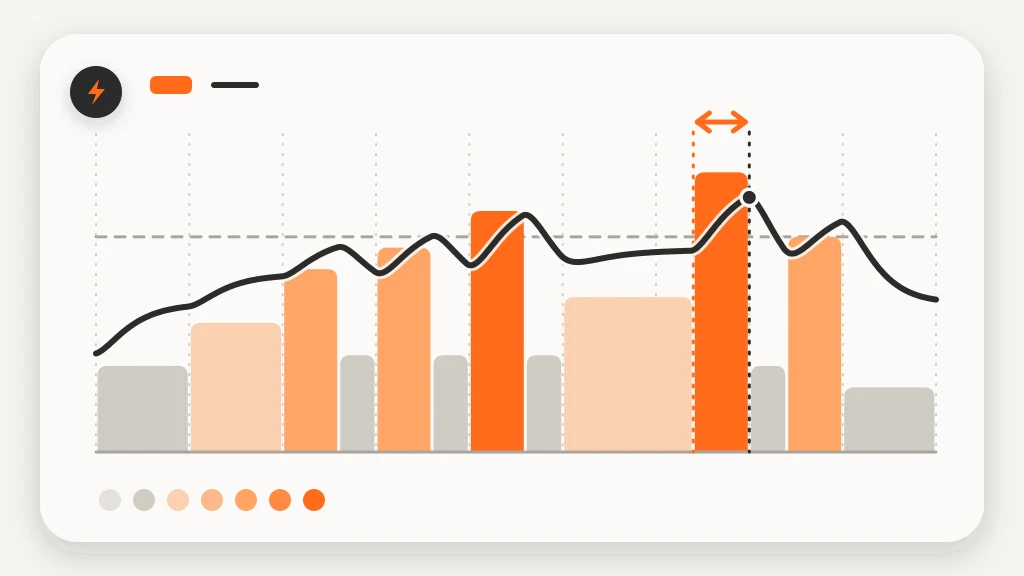
Illustrative scenario. Jin rides a 20-minute test averaging 211 W, so his FTP is about 200 W (95 %). His zone 2 is 56–75 %, or 112–150 W, and zone 4 is 91–105 %, or 182–210 W. In a 45-minute class he averages 145 W, which is 145 × 2,700 ÷ 1,000 ≈ 390 kJ, about 390 kcal. The class screen shows about 410 kcal and his watch 520 kcal. During three 4-minute efforts at 190–200 W his heart rate peaks near 168 bpm just as each effort ends, so he sets the effort by output and RPE and uses heart rate for the class overall. He rides three classes a week (one hard, two moderate), about 135 minutes in total, and adds a 30-minute walk and two strength sessions. Figures are illustrative.
Action steps
- Use total output (kJ) as your calorie guide, and treat screen and watch figures as a range.
- Do a 20-minute test or an FTP test on your usual bike to set zones, and re-test every 6–8 weeks on the same bike.
- Wear a chest strap if you can, put a fan on you, and judge intervals by output and RPE rather than heart rate.
- Start with two classes a week, add a third and fourth gradually, and keep hard classes 48 hours apart.
- Share your rides to Strava (or record them on a watch) so MoveVitals can see them, and compare classes on the same bike.
Related guides
- Calories burned: active, resting and total energy expenditure
- Heart rate zones explained: how to set and use them
- FTP (functional threshold power): what it is and how to test it
- Indoor cycling and ERG mode: getting the most from a smart trainer
- Calories burned by activity: MET values, per-hour tables and how wearables estimate them
FAQ
How many calories does a 45-minute spin class burn? Judged by work, an average of 100–200 W gives roughly 270–540 kJ, about 270–540 kcal. Screens and watches often show more. The figure includes some energy you would use at rest anyway.
What heart rate should I aim for in a spin class? Mostly zones 2–4, about 60–90 % of your maximum, with brief peaks higher during sprints. Heart rate lags effort by a minute or two, so use it for the class overall and use output and RPE for intervals.
How many times a week should I do spin classes? Two to four suit most people, with one or two hard ones and at least a day between them. Add strength training on two days and some daily walking.
Is spinning good for weight loss? It can help as part of a routine you keep up, because energy use follows intensity and duration, not the machine. Food intake and consistency matter more than any one class, and spinning is no better or worse than running or an elliptical.
Is Peloton output the same as FTP? No. Output is the work you do, in watts or total kilojoules; FTP is roughly the power you could hold for an hour. Some platforms estimate FTP from a 20-minute test, and bikes are calibrated differently, so compare yourself on the same bike.
References
- Ettema and Lorås (2009). Efficiency in cycling: a review. European Journal of Applied Physiology. https://doi.org/10.1007/s00421-009-1008-7
- Shcherbina et al. (2017). Accuracy in Wrist-Worn, Sensor-Based Measurements of Heart Rate and Energy Expenditure in a Diverse Cohort. Journal of Personalized Medicine. https://doi.org/10.3390/jpm7020003
- Bull et al. (2020). World Health Organization 2020 guidelines on physical activity and sedentary behaviour. British Journal of Sports Medicine. https://doi.org/10.1136/bjsports-2020-102955
For general information only. This is not medical advice — talk to a qualified professional about your health.
Keep reading
Devices & setup
Strava and MoveVitals: workouts, streams and devices that arrive via Strava
3 min read
Training science
Zone 2 training: the science and how to do it right
4 min read
Training science
Interval training and HIIT: designing sessions that work
4 min read
Sports
Walking for fitness and weight loss: pace, heart rate zones and how much is enough
9 min read
Training science
Polarized training (80/20): easy most of the time, hard some of the time
4 min read
Metrics explained
VO2 max: what it means and how to improve it
4 min read