

Sports
Surfing with a watch: wave counts, paddling load and heart rate
A surf session is mostly paddling and waiting, with only a few minutes spent riding waves. A watch can log wave counts, paddling time and surfing heart rate, but water, cold and constant arm movement make every number an estimate worth checking.
Written by MoveVitals Editorial Collective
Community-authored educational content. Individual clinical review is identified only when a named review is actually recorded.
Editorial standards & corrections
Key takeaways
- In a study of competitive heats, surfers paddled about 54 % of the time, sat still for 28 % and rode waves for about 8 %, so hours in the water are not hours of training.
- Surf modes infer a wave from a speed jump lasting several seconds, so they can count whitewater or split one long ride in two.
- Heart rate averages around two-thirds of maximum in competition heats, and cold, water and tight sleeves cause gaps in wrist readings.
- The Compendium lists about 3 METs for general surfing and 5 for competitive surfing, or about 200–350 kcal an hour for a 65–70 kg adult.
- Build the paddling engine with 30–60 minutes of easy aerobic work at zone 2, and surf within your ability with a leash and a plan someone knows.
A surf session can last one to three hours, but most of it is spent paddling out, paddling for waves or sitting still. That stop-start rhythm, plus salt water, cold and a wrist that is submerged half the time, is why surfing is hard for a watch to measure. This guide covers what a surf mode records, how far to trust it and which fitness work carries over.
What a surf session looks like
The pattern repeats: paddle out through the break, with duck dives under the whitewater; wait for a set with low heart rate and cooling skin; sprint-paddle to catch a wave; ride for seconds on legs and trunk; paddle back out. In a GPS and heart rate study of twelve nationally ranked surfers in competition, paddling took about 54 % of heat time, standing still 28 %, and wave riding only about 8 %. A later GPS and video study of 20-minute heats found about 44 % paddling and 42 % stationary. In the first study, average heart rate was around two-thirds of maximum, with peaks in the high 80s percent. Those were competitors in short heats; recreational sessions usually include even more waiting. Reviews of surf physiology agree that paddling, not riding, dominates the workload.
The lesson is that hours in the water are not hours of training. The hard minutes are the paddle bursts, and they are short and repeated, much like interval training.
What a surf mode records, and how far to trust it
Some watches, for example certain Garmin models, have a dedicated surfing activity that records wave count, ride distance and speed; many others offer only a general water or paddle profile. Check your model's manual. Apple Watch can log a workout too, and its water resistance is meant for shallow-water activity such as swimming, so read your maker's guidance on high-velocity water sports.
| Number | Where it comes from | Common errors |
|---|---|---|
| Wave count | Motion plus a sustained jump in GPS speed | Counts whitewater or a speed surge; splits one long ride in two; misses short rides |
| Ride distance, top speed | GPS | Signal drops when the wrist is underwater; smoothing hides short peaks; speed can spike |
| Paddling time | Arm motion and GPS | Not every model separates paddling from sitting; current can look like movement |
| Session duration | Activity start and stop | Includes paddle-out and long waits; forgetting to stop adds beach time |
| Heart rate | Wrist optical sensor | Cold, water film, tight sleeves and arm movement cause gaps and false readings |
Surf modes generally infer a wave from a speed jump that lasts several seconds together with a change in motion. That works for clean rides and fails at the edges. Two habits help: wear the watch in the same place every time and compare its count with your own memory for a few sessions to learn which way it errs, then use counts to compare sessions in similar conditions, not as an absolute score. Counts from different brands are not comparable. GPS cannot see through water, so let the watch find a fix on the beach before you paddle out.
Most sports watches are rated for at least 50 m of water pressure, which covers swimming and duck dives, but wipe-outs and leash tugs are another matter. Rinse the watch in fresh water after salt water.
Heart rate in cold water
Optical sensors need steady skin contact and blood flow under them. In the sea, water can slip between watch and skin, cold narrows the blood vessels at the wrist and wetsuit cuffs squeeze or cover the case. Expect gaps and odd numbers (wrist vs chest strap accuracy, swimming heart rate). Some options:
- Wear the watch snug on the wrist you use less, outside the cuff if it fits, a finger-width above the wrist bone.
- Radio signals travel poorly through water, so a strap paired to a watch can drop out whenever you are submerged. Some straps store a session in their own memory; check your model's manual.
- Or accept the gaps. Judge the session by how it felt and by the heart rate that was recorded, not by the missing minutes.
Cold water also changes how heart rate responds, so comparing a winter session with a summer one is shaky (cold water immersion). Leave the water if shivering will not stop, your hands cannot grip or you feel confused. A watch cannot tell you that; your body can. For wider safety in cold, open water see open-water swimming.
Calories per hour
The Compendium of Physical Activities lists about 3 METs for general surfing and 5 for competitive surfing, with paddling a surfboard on its own around 7. A 65 kg adult surfing for two hours at 3 METs uses roughly 390 kcal in total. A watch reports active energy, which excludes resting energy and so reads lower, and if heart rate dropped out it may be guessing from motion. A crowded line-up lowers the true average, because waiting is not hard work. For the method and a hub of values, see calories burned by activity.
Fitness that carries over
- Paddling engine. Easy aerobic work, such as 30–60 minutes at zone 2 in a pool or on a rowing machine, builds the base that lets heart rate settle between waves. Then copy the burst pattern: 8–10 efforts of 15–30 seconds hard with 40–60 seconds easy, once or twice a week.
- Shoulders and upper back. Rows, push-ups and rotator-cuff work build paddling endurance, and thoracic spine mobility helps you hold the chest-up paddling position and rotate.
- Pop-up, legs and trunk. Push-up-to-squat practice, single-leg balance and anti-rotation core work support the take-off and the ride.
- Breath control. Duck dives and hold-downs make breath holding part of surfing. Practise only dry: seated or lying on land, relaxed, with someone nearby. Never hyperventilate first, and never practise breath-holds in or near water alone, because shallow-water blackout can strike without warning. If you have a heart, lung or neurological condition, ask a clinician first.
Surf within your ability, wear a leash, tell someone your plan and expect cold early in the day. Raise paddling volume gradually and see a clinician for shoulder or back pain that persists.
In MoveVitals
Surf sessions arrive as ordinary workouts from whichever source recorded them: Garmin, Polar, COROS, Suunto or WHOOP through their direct connections, or Apple Watch sessions that reach your Strava account. MoveVitals has no separate surfing type, so a surf session arrives as other, with the duration, heart rate and calories the device supplied and, when the source provides a heart rate stream, time in heart rate zones. Wave counts, ride distance and top speed usually stay in your watch maker's app. If a watch and a chest strap both recorded the session, MoveVitals groups them as one (how MoveVitals handles multiple devices). Overnight heart rate, HRV and sleep come from your ring or watch through its own connection, so you can read the night after a cold dawn session beside it. Direct Apple Health sync is planned, not available.
Worked example
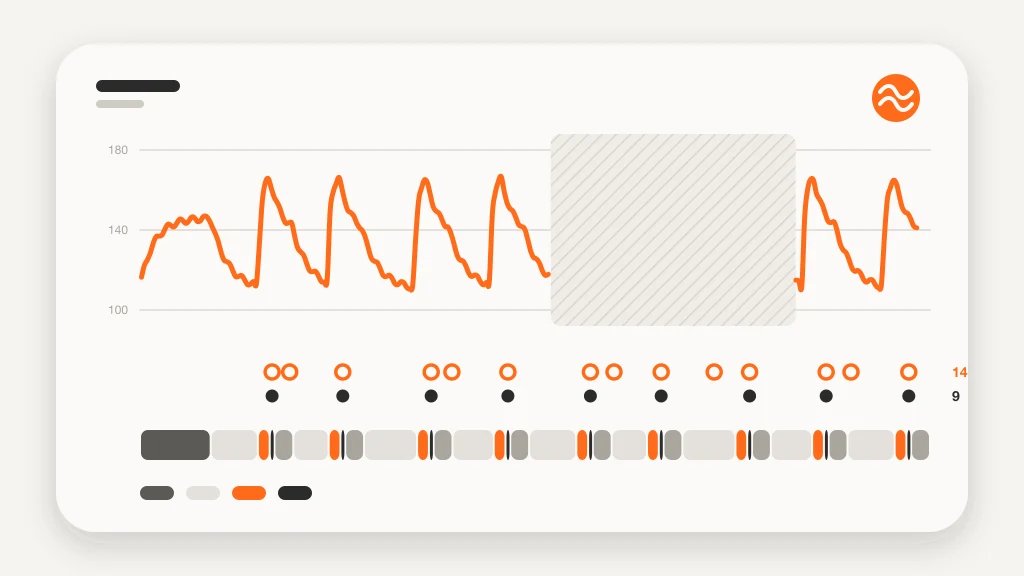
Illustrative scenario. Camille, 41 and 65 kg, surfs for two hours at dawn in 16 °C water in a 4/3 wetsuit. Her watch's surf mode reports 14 waves, but she remembers about 9 real rides: the rest were whitewater and rides that did not hold. It reports about 55 minutes of paddling (46 % of the session). The optical heart rate has gaps totalling about 38 minutes, mostly after the first hour when her hands were cold. The recorded part averages 118 bpm (about 64 % of her 185 bpm maximum) with peaks of 160–168 bpm on paddle-outs and wave sprints. The watch shows about 330 active kcal; a general-surfing estimate (3 METs, 65 kg, 2 h) gives about 390 kcal of total energy, so the two are in the same ballpark. That night her overnight heart rate averages 55 bpm against her usual 52, and she sleeps about 20 minutes less. She now treats the count as roughly 1.5 times her real rides, compares sessions in similar conditions, adds two pool interval sessions a week (8 × 20 seconds hard, 40 seconds easy) and a short thoracic mobility routine. Numbers are illustrative.
Action steps
- Choose your watch's surfing or paddle profile, let it get a GPS fix on the beach, and wear it in the same place each session.
- Compare the wave count with your own for a few sessions, then use it only to compare similar days.
- Expect heart rate gaps in cold water. Judge effort by how it felt and use the recorded heart rate as a sketch, not a total.
- Build paddling fitness with easy aerobic work plus short intervals, and train shoulders and thoracic mobility.
- Keep breath-hold practice dry and supervised, and leave the water at the first signs of cold trouble.
Related guides
- Heart rate zones explained: how to set and use them
- Interval training and HIIT: designing sessions that work
- Thoracic spine mobility: for cyclists, rowers and desk workers
- Cold water immersion and ice baths: what the evidence says
- Open-water swimming with a watch: GPS tracks, sighting, cold water and safety
FAQ
What heart rate is normal when surfing? Averages are typically moderate, around two-thirds of maximum in competition heats, with peaks much higher during paddling bursts. Cold and sensor problems make water readings less reliable.
How many calories does surfing burn per hour? About 200–350 kcal for a 65–70 kg adult, using general to competitive MET values, and less in a crowded line-up. Watches give estimates that can be well off.
Does Apple Watch work for surfing? It can record a workout, and its water resistance is designed for shallow-water activity such as swimming. Heart rate and GPS may drop out in the sea, so treat the data as approximate and check your maker's guidance for your model.
References
- Farley et al. (2012). Physiological demands of competitive surfing. Journal of Strength and Conditioning Research. https://doi.org/10.1519/jsc.0b013e3182392c4b
- Farley et al. (2018). Workloads of competitive surfing: work-to-relief ratios, surf-break demands, and updated analysis. Journal of Strength and Conditioning Research. https://doi.org/10.1519/jsc.0000000000002659
- Mendez-Villanueva and Bishop (2005). Physiological aspects of surfboard riding performance. Sports Medicine. https://doi.org/10.2165/00007256-200535010-00005
- Herrmann et al. (2024). 2024 Adult Compendium of Physical Activities: a third update of the energy costs of human activities. Journal of Sport and Health Science. https://doi.org/10.1016/j.jshs.2023.10.010
- Gillinov et al. (2017). Variable accuracy of wearable heart rate monitors during aerobic exercise. Medicine & Science in Sports & Exercise. https://doi.org/10.1249/mss.0000000000001284
For general information only. This is not medical advice — talk to a qualified professional about your health.
Keep reading
Sports
Walking for fitness and weight loss: pace, heart rate zones and how much is enough
9 min read
Metrics explained
Resting heart rate: normal ranges and what changes it
4 min read
Metrics explained
VO2 max: what it means and how to improve it
4 min read
Metrics explained
Heart rate zones explained: how to set and use them
4 min read
Devices & setup
How MoveVitals handles multiple devices: provenance, duplicates and conflicts
5 min read
Metrics explained
Normal heart rate variability (HRV) by age: RMSSD vs SDNN
6 min read