

Sports
Golf and your wearable: steps, heart rate, walking vs cart and swing tempo
Golf counts as exercise when you walk it: a round on foot is typically 12,000–17,000 steps at a gentle, jagged heart rate, while a cart cuts the load roughly in half. Here is what a golf watch or Apple Watch records, where it errs and how to read a round next to your recovery.
Written by MoveVitals Editorial Collective
Community-authored educational content. Individual clinical review is identified only when a named review is actually recorded.
Editorial standards & corrections
Key takeaways
- An 18-hole round on foot costs about 4.3–4.5 METs and roughly 600–900 kcal above rest for a 75 kg adult, against about 3.5 METs and 300–450 kcal in a cart.
- A cart cuts steps to roughly 5,000–7,000, and golf heart rate on foot averages often 55–65 % of max, higher on hills and in heat.
- Gripping the club, impact and sweat add noise to wrist heart rate, so judge a round by duration, steps and average heart rate rather than peaks or calorie totals.
- Warm up hips and trunk for 5–10 minutes before the first tee and raise range-session volume gradually, because a swing is a fast rotation repeated dozens of times a round.
An 18-hole round usually takes 3½ to 4½ hours, and much of that is walking, standing and waiting. That makes golf unusual: how you travel between shots matters more for your health than how you swing.
Does golf count as exercise?
Yes, if you walk. The Compendium of Physical Activities rates walking a course with clubs at about 4.3–4.5 METs, which is moderate intensity, and using a power cart at about 3.5 (calories burned by activity). Two walked rounds a week can cover most of the 150 minutes of moderate activity that WHO guidelines suggest, even though no single moment of the round feels hard.
| Walking (carrying or pulling clubs) | Riding a cart | |
|---|---|---|
| MET value | about 4.3–4.5 | about 3.5 |
| Steps over 18 holes | roughly 12,000–17,000 | roughly 5,000–7,000 |
| Average heart rate | often 55–65 % of max, creeping up late | lower and flatter |
| Energy above rest, 75 kg | roughly 600–900 kcal | roughly 300–450 kcal |
These are rules of thumb from small studies, not promises. In a controlled study of 16 young competitive golfers on a 6.6 km course, walking with a caddie averaged about 17,000 steps and 880 kcal of activity energy, against about 6,300 steps and 460 kcal in a cart; heart rate rose through the round on foot but fell in the cart. In a small study of older golfers (average age 68), a walked round took about 3½ hours and 13,400 steps, with an average heart rate of 110 bpm. Reviews of golf and health report benefits for blood pressure, blood lipids and balance, but the evidence is mixed and built on small, varied studies, and "golfers live longer" findings cannot separate the game from the kind of person who plays it.
What a golf watch records
- Steps and distance. A walked round produces plenty of step and GPS data. Wrist step counters tend to under-count while you push or pull a trolley, because your arm barely swings, and they cannot see the weight of a bag on your back. GPS distance can wander under trees and includes every detour into the rough.
- Heart rate. Wrist optical sensors usually follow a four-hour walk well enough to give a fair average, but gripping the club, impact and sweat add noise, so ignore single spikes. A chest strap is generally steadier if you want clean data (wrist vs chest strap accuracy).
- Walking or cart. If your golf profile asks, answer honestly. Riding while logging "walking" overstates the round.
- Swing tempo. Some golf-specific watches estimate tempo, the ratio of backswing to downswing time (often discussed as around 3:1 for good players), and some pair with club sensors to count shots.
Golf smartwatch vs GPS watch
A dedicated golf GPS watch, such as Garmin's Approach line, usually gives preloaded course maps, distances to the green and long battery life. A general smartwatch, Apple Watch included, usually needs a golf app, drains faster with GPS on and may need a top-up after one round. For picking by sport, see which wearable for your sport.
Golf heart rate, blood pressure and safety
Expect a low, saw-tooth trace. Heart rate climbs on hills and on brisk stretches, falls while you wait on the tee, and drifts upward late in a hot round, a bit like cardiac drift. Most of a round sits in zones 1–2 (heart rate zones).
One small crossover study found systolic blood pressure lower after an 18-hole round in healthy older golfers, and reviews report favourable blood-pressure effects, but that is not a treatment. If you have high blood pressure or take heart-rate-lowering medicines such as beta-blockers, which make percent-of-max zones misleading, ask your clinician how to gauge effort. Stop and seek care for chest pain or pressure, fainting, unusual breathlessness or palpitations with dizziness. See blood pressure for home measurement and hydration and electrolytes for hot rounds.
Back, shoulders and recovery
A swing is a fast rotation repeated dozens of times a round, plus practice swings and range sessions. Overuse problems in the low back, elbow, shoulder and wrist are commonly reported in amateurs, often after a sudden jump in practice volume or a cold first drive. Prevention is unglamorous: spend 5–10 minutes before the first tee on hips and trunk rotation (warm-up routine, hip mobility, thoracic mobility), raise range volume gradually, and see a clinician for pain that lasts or spreads.
Golf rarely stresses recovery by itself, so overnight heart rate and HRV usually look normal the next morning. What moves them is heat, a long day, a late finish and alcohol at the clubhouse (alcohol, HRV and sleep). Compare with your own baseline.
In MoveVitals
Golf rounds arrive as ordinary workouts from whichever source recorded them: Garmin, Polar, COROS, Suunto or WHOOP through their direct connections, or Apple Watch rounds that reach your Strava account. MoveVitals has golf as its own sport type. Duration, heart rate and calories are what the device supplied, and time in heart rate zones is calculated from the heart rate stream when the source provides one. If a watch and Strava both recorded the round, MoveVitals groups them as one session (how MoveVitals handles multiple devices). Daily steps come from Garmin, Polar, COROS, Oura or Withings through their own connections, so a walked round shows up as a high-step day, and Withings blood pressure readings can sit beside it. Direct Apple Health sync is planned, not available.
Worked example
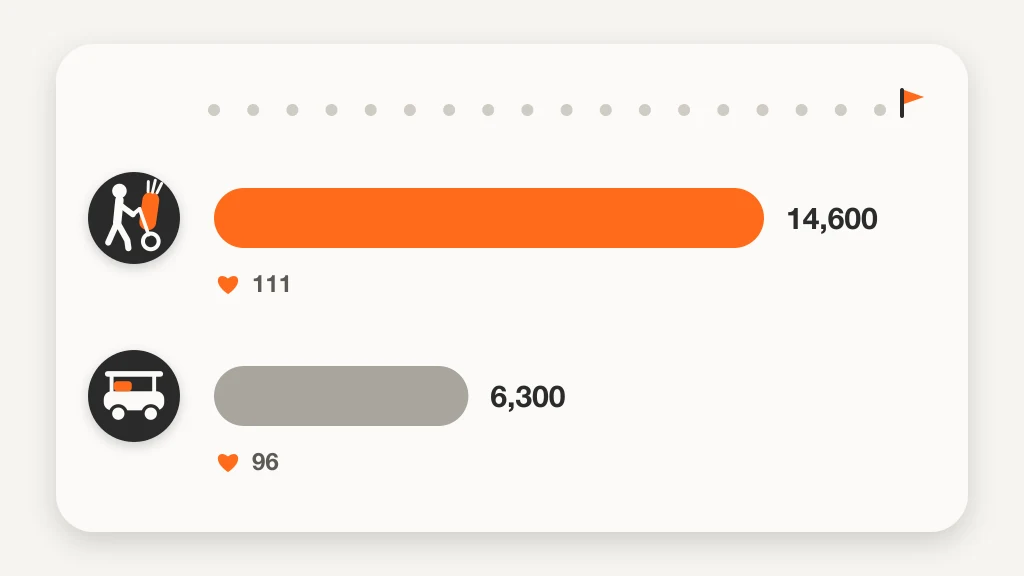
Illustrative scenario. Mark, 54, 80 kg, walks 18 holes with a push trolley: 4 h 05 min, 14,600 steps, an average heart rate of 111 bpm (about 67 % of his estimated maximum of 166) and a peak of 138 on the hilly back nine. His watch reports about 760 kcal of active energy; a MET table would say roughly 1,050 above rest, but it assumes non-stop walking, so he plans with a range of 700–1,000. The next weekend he rides a cart: 6,300 steps, an average heart rate of 96 bpm and about 380 kcal. The walked round adds roughly 7,000 steps to a normal day, lifting his daily average for the week by about 1,000. Numbers are illustrative.
Action steps
- Choose the golf profile (walking or cart, if offered), wear the watch snug and check that the battery covers five hours with GPS.
- Walk when you can, with a push trolley or a light bag, and keep a steady pace between shots; count a walked round as a moderate session.
- Judge a round by duration, steps and average heart rate, not by peaks or calorie totals.
- Warm up hips and trunk for 5–10 minutes before the first tee, and raise range-session volume gradually.
- Drink during the round, go easy on alcohol, and compare next-morning resting heart rate and sleep with your baseline.
Related guides
- Daily steps: is 10,000 really the target?
- Calories burned by activity: MET values, per-hour tables and how wearables estimate them
- Heart rate zones explained: how to set and use them
- Thoracic spine mobility: for cyclists, rowers and desk workers
- Blood pressure: categories, home measurement and what moves it
FAQ
Does golf count as exercise? Walking a round does: it is moderate-intensity activity with a lot of steps, though heart rate stays mostly in zones 1–2. Riding a cart still adds some activity, but roughly half as much.
How many steps and calories does walking golf give you? Roughly 12,000–17,000 steps and 600–900 kcal above rest for 18 holes for a 75 kg adult, depending on the course and how straight you hit. In a cart, about half the calories and 5,000–7,000 steps. Watch figures are estimates.
What heart rate is normal when playing golf? Averages of roughly 55–65 % of maximum, higher on hills and in heat. Your own measured maximum is a better anchor than "220 − age".
Is a golf GPS watch better than a smartwatch? A golf GPS watch usually wins on course maps and battery; a smartwatch can be better as an all-day health tracker. Check battery life for five hours with GPS on.
References
- Herrmann et al. (2024). 2024 Adult Compendium of Physical Activities: A third update of the energy costs of human activities. Journal of Sport and Health Science. https://doi.org/10.1016/j.jshs.2023.10.010
- Sorbie et al. (2022). Golf and Physical Health: A Systematic Review. Sports Medicine. https://doi.org/10.1007/s40279-022-01732-w
- Kettinen et al. (2023). Comparative effectiveness of playing golf to Nordic walking and walking on acute physiological effects on cardiometabolic markers in healthy older adults: a randomised cross-over study. BMJ Open Sport & Exercise Medicine. https://doi.org/10.1136/bmjsem-2022-001474
- O'Donnell et al. (2026). Riding a Golf Cart Versus Walking: A Study on the Physiological and Performance Differences in Tournament Golf. European Journal of Sport Science. https://doi.org/10.1002/ejsc.70099
- Bull et al. (2020). World Health Organization 2020 guidelines on physical activity and sedentary behaviour. British Journal of Sports Medicine. https://doi.org/10.1136/bjsports-2020-102955
For general information only. This is not medical advice — talk to a qualified professional about your health.
Keep reading
Devices & setup
How MoveVitals handles multiple devices: provenance, duplicates and conflicts
5 min read
Sports
Walking for fitness and weight loss: pace, heart rate zones and how much is enough
9 min read
Metrics explained
Resting heart rate: normal ranges and what changes it
4 min read
Metrics explained
VO2 max: what it means and how to improve it
4 min read
Metrics explained
Heart rate zones explained: how to set and use them
4 min read
Sports
Pickleball and your health data: heart rate zones, calories and joint load
6 min read