

Sports
Ice and inline skating: heart rate, calories and speed skating training
Ice and inline skating are smooth, low-impact endurance sports in which heart rate tells you far more than a step count or a calorie estimate. This guide covers ice skating and roller skating calories, how to read your heart rate on skates, speed skating training, and what a watch can and cannot record in the cold.
Written by MoveVitals Editorial Collective
Community-authored educational content. Individual clinical review is identified only when a named review is actually recorded.
Editorial standards & corrections
Key takeaways
- For a 70 kg person, recreational ice skating at 5–7 METs burns about 350–500 kcal an hour and fast ice or inline skating at 9–12 METs about 650–850, compared with 500–700 for jogging at 7–10 METs.
- Heart rate lags effort by about a minute on skates, so a 2–3 minute interval is nearly over before the number catches up.
- Sample skating sessions are 45–90 minutes easy, 3 × 10 minutes of tempo at about 75–90% of max heart rate and 6–8 × 2–3 minutes hard.
- Indoor rinks give no GPS signal and step counts from skating are unreliable, so use time and laps and press the lap button at each interval.
- Wear a helmet and wrist guards, and stop and get medical advice for chest pain, fainting or palpitations with dizziness.
Skating covers ice skating (recreational, figure, hockey, long-track and short-track speed skating) and inline or roller skating. A watch records heart rate well enough and, outdoors, speed and distance, but its algorithms assume running and cycling. For hockey and other stop-start sports, see team sports with a wearable.
What your watch records when you skate
| Metric | Outdoors (path, lake, oval) | Indoor rink | How far to trust it |
|---|---|---|---|
| Heart rate | Recorded | Recorded | Chest straps are generally steadier than wrist sensors, especially in the cold |
| Speed and distance | GPS, usually good on open ground | No GPS signal; distance may be missing | Use time and laps indoors |
| Steps and cadence | Often few or none, or miscounted | Same | Ignore step counts from skating |
| Calories | Estimated from heart rate, weight and age | Same | A rough estimate, see below |
Some sports watches offer an ice skating or inline skating profile; if yours does not, a generic cardio profile still records heart rate and calories. Use an outdoor GPS profile when you want speed, and press the lap button at each interval. When choosing a skating watch, look at battery life, chest strap support and a skating profile before the brand. Wrist optical sensors are generally less accurate during vigorous, rhythmic movement (Bent et al., 2020); see how accurate wrist heart rate is.
Calories: ice skating, inline skating, walking and running
Energy cost is roughly MET × body weight (kg) × hours, where one MET is about 1 kcal per kg per hour (resting energy included). Typical Compendium of Physical Activities values (Ainsworth et al., 2011), rounded:
| Activity | Typical METs | 70 kg person, 1 hour |
|---|---|---|
| Brisk walking (5–6 km/h) | 3.5–4.5 | 250–320 kcal |
| Recreational ice skating | 5–7 | 350–500 kcal |
| Recreational inline skating (about 14 km/h) | 7–8 | 500–550 kcal |
| Jogging | 7–10 | 500–700 kcal |
| Fast ice or inline skating (about 18–21 km/h or more) | 9–12 | 650–850 kcal |
| Competitive speed skating | 13 or more | 900 kcal or more |
The ranges are wide because real cost depends on technique, ice, wind and how much you glide. A skilled skater may use less energy than a beginner at the same speed, so heart-rate-based estimates usually track effort better than speed-based ones. For more sports see calories burned by activity; for active versus resting energy see calories burned.
Inline skating heart rate: what to expect on skates
Set zones from your maximum heart rate or a field test (heart rate zones), then expect three quirks:
- Beginners run hot. Balance, tension and the low crouch lift heart rate at slow speeds. Pace by heart rate, not by how fast you glide; the same speed feels easier within weeks.
- Heart rate lags effort by about a minute, so a 2–3 minute interval is nearly over before the number catches up. Use speed, laps and effort as well.
- Cold hands and wrists reduce blood flow at the skin and can make optical readings drop out. A chest strap and a proper warm-up fix most of it.
Speed skating training and inline skating workouts: how to structure the week
Speed skaters and fast inline skaters spend much of the year off the ice, with cycling, running, strength and jump work alongside inline skating. Recreational skaters can borrow the structure for an inline skating workout or a rink session.
| Session | Example | Intensity |
|---|---|---|
| Easy endurance | 45–90 min of relaxed skating | Zone 2, full sentences (zone 2) |
| Tempo | 3 × 10 min steady, 3 min easy between | Zones 3–4, about 75–90% of max HR |
| Intervals | 6–8 × 2–3 min hard, equal easy (interval training) | Zone 4, last reps near maximum |
| Technique | Single-leg glides, edges, crossovers, 20–30 min | Low; quality over effort |
| Off-ice strength | Single-leg squats, step-ups, lunges, hip and core (strength for endurance athletes) | 1–2 sessions a week |
A sensible week has two or three skating sessions (one long and easy, one quality), one or two strength sessions and one other cardio session (cross-training), with roughly 80% of the time easy (Seiler, 2010). Add 5–10% volume a week and take an easier week every fourth (deload weeks).
Cold, battery and safety
- Battery. Cold temporarily reduces battery capacity, so expect less GPS time than rated. Start fully charged, keep the watch under a sleeve and use GPS only when you need speed.
- Natural ice. A watch cannot tell you whether ice is safe. Check local ice reports and skate with someone.
- Protection and joints. Wear a helmet and, for inline skating, wrist guards, elbow pads and knee pads; in an analysis of in-line skating injuries, wrist guards were associated with fewer wrist injuries (Schieber et al., 1996). A stiff boot loads the ankles, hips and glutes, so build ankle mobility and single-leg strength.
- Warning signs. Chest pain, fainting or palpitations with dizziness mean stop and get medical advice; a watch cannot tell you why.
In MoveVitals
Skating workouts from Garmin, COROS, Suunto and Polar arrive with duration, heart rate and calories, plus distance and speed when recorded outdoors with GPS. Strava adds GPS and heart rate streams, and Apple Watch skating reaches MoveVitals through Strava. Sessions named ice, inline or roller skating are grouped as Skating; one recorded with a generic profile may show as Other, and you can fix the sport in Strava because sport edits sync. Time in zone comes from the heart rate stream, duplicates are merged (how MoveVitals handles multiple devices), and skating counts toward your training load next to runs and rides.
Worked example
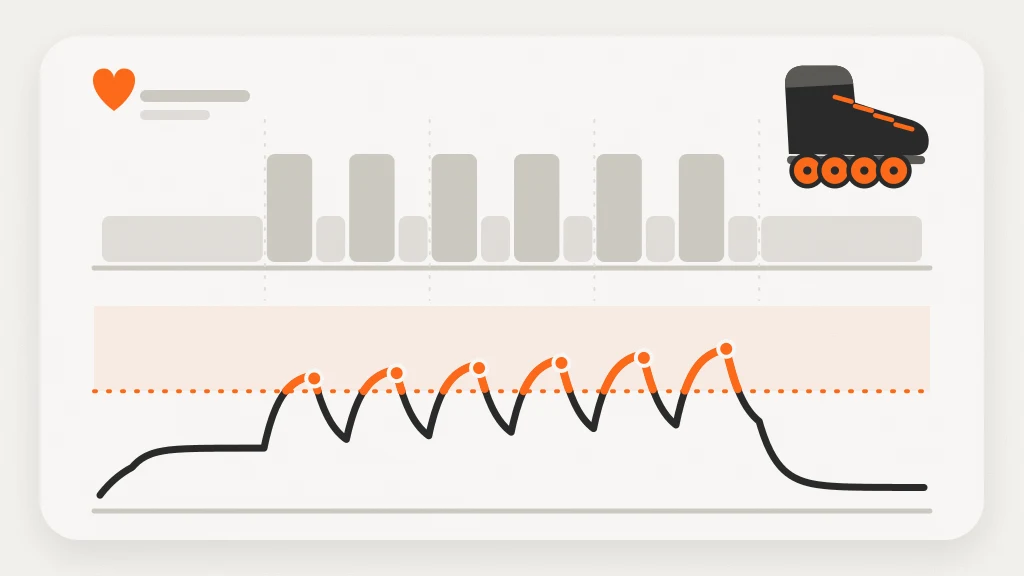
Illustrative scenario. Lena, 34 and 62 kg, has a maximum heart rate of about 190 bpm from a field test, so zone 2 is roughly 114–133 bpm and zone 4 about 152–171 bpm. On a smooth cycle path she skates 10 minutes easy, 6 × 3 minutes hard with 2 minutes easy between, then 10 minutes of cool-down: 50 minutes and about 15 km. The easy sections sit at 126–138 bpm, while the hard blocks climb from about 158 bpm in the first to 171 in the last. Because heart rate lags, she judges each block by speed (around 22 km/h). Her watch estimates about 430 kcal and a hand check with roughly 6 METs easy and 11 hard gives about 400, so she treats both as estimates; the near-zero step count she ignores. Eight weeks later the same 125 bpm easy skate runs at about 19 km/h instead of 17. Figures are illustrative.
Action steps
- Use an outdoor GPS profile outdoors and an indoor or generic one in a rink, and add a chest strap if you rely on zones.
- Set zones from a maximum heart rate or field test, and keep most skating easy enough to speak in full sentences.
- Add one interval or tempo session a week and press the lap button at each interval.
- Treat calories as estimates; compare weeks by time in zone and duration.
- Add two off-ice sessions: single-leg strength plus cycling or running, with ankle and hip mobility.
- Wear a helmet and wrist guards, check the ice, and keep the watch warm and charged.
Related guides
- Calories burned by activity: MET values, per-hour tables and how wearables estimate them
- Heart rate zones explained: how to set and use them
- Cross-training: building fitness while sparing your joints
- Ankle mobility: the knee-to-wall test and exercises that work
- How accurate is wrist heart rate? Optical sensors vs chest straps, by sport
FAQ
How many calories does ice skating burn? For a 70 kg person, recreational ice skating works out to roughly 350–500 kcal an hour, and more when faster. These are MET-based estimates; see calories burned by activity.
Is inline skating a good workout compared with running? At fitness pace its energy cost can match or exceed jogging, with less impact on the joints, though technique and falls matter more.
Does skating count steps on a watch? Not reliably. Step algorithms expect walking and running movement, so use time, heart rate and outdoor GPS distance instead.
Why is my heart rate so high when I start skating? Balance, tension and the crouch raise it, and starting too fast makes it worse; slow down and pace by heart rate. If it stays high at an easy effort or comes with chest pain or dizziness, read why heart rate is high during exercise and talk to a doctor.
References
- Ainsworth et al. (2011). 2011 Compendium of Physical Activities: a second update of codes and MET values. Medicine & Science in Sports & Exercise. https://doi.org/10.1249/MSS.0b013e31821ece12
- Bent et al. (2020). Investigating sources of inaccuracy in wearable optical heart rate sensors. npj Digital Medicine. https://doi.org/10.1038/s41746-020-0226-6
- Schieber et al. (1996). Risk factors for injuries from in-line skating and the effectiveness of safety gear. New England Journal of Medicine. https://doi.org/10.1056/nejm199611283352202
- Seiler (2010). What is Best Practice for Training Intensity and Duration Distribution in Endurance Athletes?. International Journal of Sports Physiology and Performance. https://doi.org/10.1123/ijspp.5.3.276
For general information only. This is not medical advice — talk to a qualified professional about your health.
Keep reading
Sports
Trail running with a watch: heart rate, climbs and pacing by effort
7 min read
Devices & setup
How MoveVitals handles multiple devices: provenance, duplicates and conflicts
5 min read
Training science
Zone 2 training: the science and how to do it right
4 min read
Sports
Walking for fitness and weight loss: pace, heart rate zones and how much is enough
9 min read
Devices & setup
Strava and MoveVitals: workouts, streams and devices that arrive via Strava
3 min read
Metrics explained
Resting heart rate: normal ranges and what changes it
4 min read