

Sports
Cross-country skiing and ski touring: training, heart rate and altitude
Cross-country skiing and ski touring are among the most demanding endurance sports, and the training behind them is mostly easy aerobic volume with a smaller share of hard intervals. This guide covers cross-country skiing heart rate zones, summer base training, ski touring fitness and skimo training, and how to read heart rate and SpO2 at altitude.
Written by MoveVitals Editorial Collective
Community-authored educational content. Individual clinical review is identified only when a named review is actually recorded.
Editorial standards & corrections
Key takeaways
- Cross-country skiing uses the same five zones as other sports, with easy at roughly 55–70% of max heart rate, steady at 70–80% and threshold at 80–90%, but ski effort does not map one-to-one onto running.
- Build the summer base with three to five sessions a week, roughly 80% easy, including roller skiing, poles uphill, one long session of 1.5–3 hours and one threshold session.
- On a long ski tour, cap heart rate at about 75–80% of max and plan on 300–400 vertical metres an hour on a skin track, slower in deep snow, with a heavy pack or at altitude.
- Tours often reach 2,000–3,500 m, so expect higher heart rate and lower SpO2, descend if symptoms worsen, and carry avalanche gear because a watch is not safety equipment.
Cross-country skiing means gliding on groomed tracks or open terrain with classic technique (diagonal stride and double poling) or skating technique. Ski touring means climbing on skis with skins and skiing down; ski mountaineering (skimo) is its racing form, which made its Olympic debut at the Milano Cortina 2026 Winter Games.
Starting out: how the disciplines differ
| Cross-country skiing | Ski touring | Skimo racing | |
|---|---|---|---|
| Terrain | Groomed tracks, flat to rolling | Backcountry, long climbs and descents | Marked courses, steep climbs |
| Main demand | Sustained whole-body aerobic work | Long steady climbing, cold, altitude | Fast climbing, transitions, short descents |
For cross-country skiing for beginners, start with classic technique on groomed tracks, rent gear and take a lesson. Heart rate runs high at first because of balance and technique, so keep sessions easy and short (30–60 minutes). Skating is faster and more demanding, so many people learn it second.
Cross-country skiing heart rate zones versus running
Skiing uses the arms, trunk and legs, so heart rate and perceived effort do not map one-to-one onto running. Set zones from a maximum heart rate or field test (heart rate zones, maximum heart rate) and confirm them with the talk test.
| Effort | % of max HR | Talk test | Ski example |
|---|---|---|---|
| Easy aerobic (zones 1–2) | 55–70% | Full sentences | Base skis, roller skis, flats on tour |
| Steady (zone 3) | 70–80% | Short sentences | Long steady climbs, loppet pace |
| Threshold (zone 4) | 80–90% | A few words | 4–10 minute climbs, tempo blocks |
| Hard (zone 5) | 90–100% | Not talking | 3–5 minute intervals, sprints |
Arm-dominant double poling and cold air can leave peak heart rate a little lower than on a treadmill, so do not rewrite your zones from one session. Elite endurance skiers do the large majority of their training at low intensity (Seiler and Kjerland, 2006; Sandbakk and Holmberg, 2017), which is why polarized training and zone 2 apply directly. In the cold, wrist optical sensors often misread because of cold skin, gloves and arm swing (Bent et al., 2020); a chest strap is steadier (wrist heart rate accuracy).
Cross-country skiing training: the summer base
The snow season is short, so most fitness is built beforehand (periodization). A weekly pattern for a committed recreational skier:
| Session | Purpose | How often |
|---|---|---|
| Roller skiing (classic and skate) | Technique and specific endurance | 1–2 a week; helmet, quiet roads, practise stopping |
| Running or walking uphill with poles (Nordic walking) | Aerobic base with arm work | 1–2 a week |
| Long easy session of 1.5–3 hours | Volume in zone 2 (bike, run or roller ski) | Once a week |
| Threshold or intervals, e.g. 4 × 4–8 min hard, equal rest | Raise threshold and VO2 max | Once a week |
| Strength: rows, triceps, core, single-leg work (strength for endurance athletes) | Poling power and durability | 1–2 a week |
A SkiErg is a handy dry-land tool for double poling (Concept2 and MoveVitals). Keep roughly 80% of the time easy and add volume gradually. For ski marathons, practise fuelling in training (carbohydrate fuelling).
Ski touring fitness and skimo training: the climbing engine
Touring fitness is mostly long, steady climbing. For a ski mountaineering training plan, build three things: an aerobic base (2–4 hour easy sessions on foot, bike or skis), climbing-specific work (hill repeats, 4 × 10 minutes just under threshold) and leg strength for the descent (squats, lunges, step-ups). The hiking guide has a similar structure (hiking heart rate and training). On the day:
- Set a cap. Around 75–80% of max HR suits a long day, lower at altitude or in the cold. Slow down before you can no longer speak in short sentences.
- Track vertical metres per hour. A common planning rule is 300–400 vertical metres an hour on a skin track, slower in deep snow, with a heavy pack or at altitude. Set a turnaround time and keep to it.
- Judge the descent by feel. Heart rate drops on descents even when your thighs burn, so it says little about effort or fatigue.
- Stay dry, eat and drink. Shed layers early, climb warm but not wet and put on a dry layer before the descent; sweat chills you quickly and cold suppresses thirst (hydration).
Altitude, cold and SpO2: reading the numbers
Tours often reach 2,000–3,500 m. Above roughly 2,500 m, heart rate runs higher at the same effort and SpO2 falls (altitude, SpO2), so a heart rate that looks too high may just be the altitude. On long climbs it also drifts up at a steady pace (cardiac drift). Wrist SpO2 is noisy with cold skin and movement, so take readings at rest and warm, and treat them as rough. Symptoms matter more than the number: headache, nausea or dizziness mean do not go higher, and descend if they worsen; severe headache, confusion or breathlessness at rest call for descent and medical help (Luks et al., 2019).
Cold shortens battery life, so start fully charged, keep the watch under a cuff and choose a GPS mode that outlasts your longest day. A barometric altimeter gives steadier ascent than GPS height. See skiing and snowboarding with a wearable. A watch is not avalanche safety equipment: read the avalanche bulletin, carry a transceiver, shovel and probe, and go with trained partners.
In MoveVitals
Ski workouts from Garmin, COROS, Suunto and Polar arrive with duration, heart rate and calories. Suunto adds ascent and altitude, and Strava brings elevation and altitude streams, GPS and laps; COROS second-by-second streams arrive through Strava if you connect it too, and Apple Watch ski workouts come through Strava. Sessions named skiing, whether cross-country, backcountry or roller ski, are grouped as the Ski sport type, and Concept2 SkiErg sessions sync from the Logbook. Time in zone is calculated from the heart rate stream and duplicates are merged (how MoveVitals handles multiple devices).
Worked example
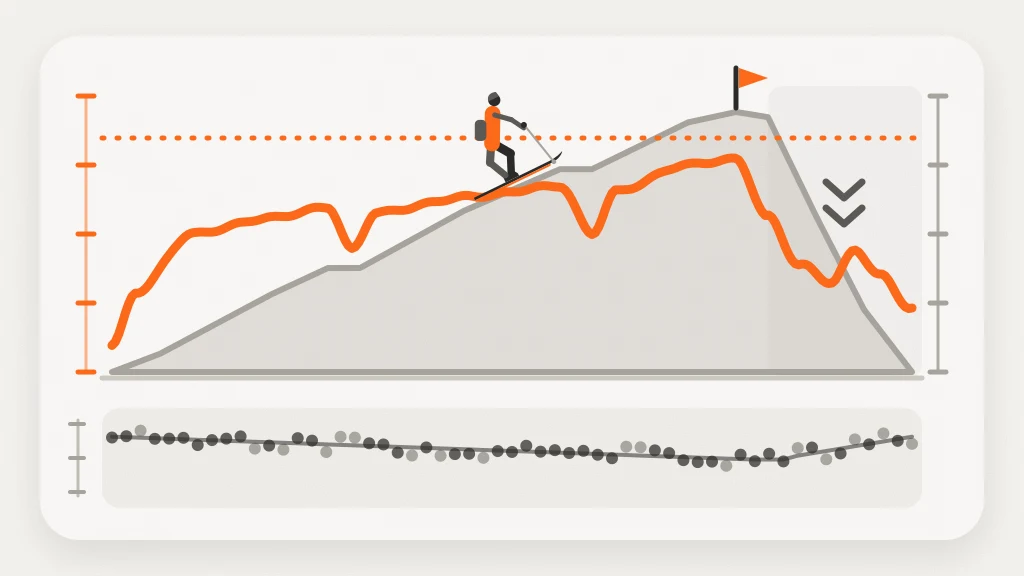
Illustrative scenario. Julia, 38, plans a day tour of 1,200 m of ascent from 1,700 m to a 2,900 m summit. With a planning rule of 300–400 vertical metres an hour she expects 3–4 hours up and sets a turnaround time. Her maximum heart rate is about 188 bpm from a hard uphill effort, so her easy range is 113–132 bpm (60–70%) and her climbing cap is 150 bpm (80%). To avoid starting too fast, she keeps the first hour at 135–145 bpm, speaking in short sentences. She tops out after 3 hours 25 minutes: 1,200 ÷ 3.4 ≈ 350 vertical metres an hour, at an average of 146 bpm (78%) with a drift from about 140 to 150 bpm in the last hour. Her wrist SpO2 reads 91–93% near the summit; she feels well, so she treats it as normal at that altitude, but would stop climbing and descend if headache or nausea appeared. On the 25-minute descent her heart rate sits at 115–135 bpm although her thighs burn, so she judges it by feel. Her autumn training was one easy 2–3 hour session, one threshold session and two strength sessions a week. Figures are illustrative.
Action steps
- Find your maximum heart rate in the sport, or from a hard uphill effort, and set zones; confirm them with the talk test and use a chest strap in the cold.
- Build a base through the summer: three to five sessions a week, roughly 80% easy, with roller skiing, running or walking with poles, cycling, one threshold session and one or two strength sessions (pulling, triceps, trunk, single-leg work).
- On tours, set a heart rate cap (about 75–80% of max for a long day) and a turnaround time, and climb by effort rather than the group's pace.
- Manage the cold: layer to avoid sweating, keep the watch warm and charge it before you leave.
- Expect higher heart rate and lower SpO2 at altitude, descend if symptoms worsen, and carry avalanche gear and know how to use it.
Related guides
- Zone 2 training: the science and how to do it right
- Polarized training (80/20): easy most of the time, hard some of the time
- Altitude: acclimatisation, training camps and your wearable data
- Blood oxygen (SpO2): what wearables measure and when to worry
- Cardiac drift (decoupling): why heart rate rises at the same pace
FAQ
What heart rate zones should I use for cross-country skiing? The same five zones as in other sports, set from your maximum heart rate or a field test: easy is roughly 55–70% of max, steady 70–80% and threshold 80–90%. Check them with the talk test, because skiing, roller skiing and running can give slightly different peaks.
How do I train for ski touring? Build a base of long easy sessions, add one weekly threshold session on climbs, strengthen legs and trunk, and practise with your pack, in the cold and on skins before a big tour.
Why is my SpO2 low on a ski tour? SpO2 normally falls with altitude, and wrist readings are noisy in the cold. Symptoms matter more than the number: headache, nausea, dizziness or breathlessness at rest mean stop climbing, and descend if they worsen.
References
- Seiler and Kjerland (2006). Quantifying training intensity distribution in elite endurance athletes: is there evidence for an "optimal" distribution?. Scandinavian Journal of Medicine & Science in Sports. https://doi.org/10.1111/j.1600-0838.2004.00418.x
- Sandbakk and Holmberg (2017). Physiological capacity and training routines of elite cross-country skiers: approaching the upper limits of human endurance. International Journal of Sports Physiology and Performance. https://doi.org/10.1123/ijspp.2016-0749
- Luks et al. (2019). Wilderness Medical Society clinical practice guidelines for the prevention and treatment of acute altitude illness: 2019 update. Wilderness & Environmental Medicine. https://doi.org/10.1016/j.wem.2019.04.006
- Bent et al. (2020). Investigating sources of inaccuracy in wearable optical heart rate sensors. npj Digital Medicine. https://doi.org/10.1038/s41746-020-0226-6
For general information only. This is not medical advice — talk to a qualified professional about your health.
Keep reading
Sports
Hiking and trekking: heart rate on climbs, pacing and how to train for it
8 min read
Training science
Zone 2 training: the science and how to do it right
4 min read
Metrics explained
Resting heart rate: normal ranges and what changes it
4 min read
Sports
Japanese interval walking: the 3-minute fast / 3-minute slow method, step by step
8 min read
Training science
Polarized training (80/20): easy most of the time, hard some of the time
4 min read
Training science
Interval training and HIIT: designing sessions that work
4 min read