

Sports
Tennis with a wearable: heart rate between points, load and recovery
Tennis is a stop-start sport: points last seconds, and you rest 20–25 seconds between them. A wearable turns that rhythm into a readable tennis heart rate, calories-per-hour estimate and training load, so you can judge a match day and recover from it properly.
Written by MoveVitals Editorial Collective
Community-authored educational content. Individual clinical review is identified only when a named review is actually recorded.
Editorial standards & corrections
Key takeaways
- Average heart rate runs about 55–70 % of maximum in rallying or drills, 60–75 % in doubles and 70–85 % in club singles.
- Estimated energy for a 70 kg adult is about 300–400 kcal an hour in rallying, 400–450 in doubles and 500–600 in club singles.
- Most club points end within about 10 seconds, and short peaks close to your maximum are normal for a healthy player in a hard rally.
- Grip pressure and the shock of each hit add noise on the racket arm, so wear the watch on the other wrist or use a chest strap, and ignore GPS on a court about 24 m long.
- If heart rate no longer falls at changeovers, slow down, drink and rest in the shade, and stop and seek medical care for chest pain, fainting, unusual breathlessness or palpitations with dizziness.
A tennis match has no fixed length: a club singles match can run 60 to 120 minutes and a three-set match well beyond that. The Rules of Tennis allow 20 seconds between points (25 seconds in some professional events) and 90 seconds at changeovers; recreational players are usually looser.
What tennis looks like on a heart rate trace
Most points at club level end within about 10 seconds, with the occasional rally of 15–25 seconds between patient baseliners, especially on slow courts. Heart rate follows with a lag: it climbs during the rally, peaks a few seconds after the point ends, and falls during the rest, though usually not all the way back. Over a long match the low points of the trace creep upward, a bit like cardiac drift, and faster in heat. Studies of match play generally find that players spend much of the time well below maximum heart rate, with short peaks near it (heart rate zones).
| Format | Typical effort | Average heart rate (% of max) | Estimated energy, 70 kg adult |
|---|---|---|---|
| Rallying or drills (cooperative) | Light to moderate | ~55–70 % | ~300–400 kcal/h |
| Doubles | Moderate | ~60–75 % | ~400–450 kcal/h |
| Singles, club level | Moderate to vigorous | ~70–85 % | ~500–600 kcal/h |
These are rule-of-thumb ranges, not measurements: level, age, court surface and opponent change them a lot. The energy column is roughly MET × body weight (kg) × hours, using Compendium of Physical Activities values of about 5 for hitting balls, 6 for doubles and 8 for singles. Watches report active energy, which leaves out resting energy and therefore reads lower. Either way it is an estimate that can be well off (calories burned, calories burned by activity).
The same stop-start logic applies in padel, pickleball, badminton and table tennis. Tennis singles usually sits at the harder end, because the court is large and you cover it alone.
Is 180 bpm too high for tennis?
Short peaks close to your maximum are normal for a healthy player in a hard rally. What matters is whether your maximum is the number you think it is: "220 − age" can be off by 10 bpm or more, so a measured value is a better anchor (maximum heart rate). Some reasons for tennis heart rate to run higher than expected:
- Heat and dehydration. The same effort costs more heartbeats on a hot court.
- Sleep, illness and caffeine. A poor night, a cold or a large coffee can all lift heart rate for the same effort.
- Sensor error. Optical sensors can lock onto the rhythm of swings or read double. If a number looks impossible, compare it with a chest strap.
If heart rate stays high between points and no longer falls at changeovers, slow down, drink and rest in the shade. Stop and seek medical care for chest pain or pressure, fainting, unusual breathlessness, or palpitations with dizziness. A watch cannot rule a heart problem in or out, and some heart medicines such as beta-blockers lower heart rate and make percent-of-max zones misleading; ask your clinician how to gauge effort. See high heart rate during exercise.
Wearing a watch on court
- Heart rate. Grip pressure and the shock of each hit add motion noise, and the racket-arm wrist is usually the worst place. Wear the watch snug on the other wrist, a finger-width above the wrist bone. Chest straps are generally more accurate than wrist sensors in stop-start exercise, and optical readings often lag, so peaks look smaller and later than they were (wrist vs chest strap accuracy, Polar H10).
- Sport profile. Many Garmin, Polar, COROS, Suunto and Apple Watch models list tennis, and some add match scoring; check your model. If yours does not, use another racket profile. Calorie estimates differ by profile.
- GPS. A court is about 24 m long, so distance and pace tell you little, and indoor courts have no GPS at all. Use duration, heart rate and active energy.
For picking a device by sport, see which wearable for your sport.
Tennis conditioning: build the engine, then sharpen it
A match is repeated short efforts on top of an aerobic base, so conditioning has two halves. Easy aerobic work, such as 30–60 minutes at zone 2, helps you recover between points and keeps late-set heart rate lower. Short intervals then copy the rally-to-rest pattern, for example 8–12 efforts of 15–20 seconds hard with 25 seconds easy, once or twice a week (interval training). Add one or two strength sessions for the shoulders, trunk and legs, and keep hard days apart from match days.
Match load, heat and long days
Because a tennis match can last two or three hours, load builds without feeling dramatic. A simple way to track it is minutes × effort rating: 90 minutes at an RPE of 7 is 630 arbitrary units, comparable week to week (RPE, training load).
In warm weather, start hydrated and drink at changeovers (hydration and electrolytes). Early warning signs of heat trouble include headache, dizziness, nausea, confusion or cramping; stop, cool down and get help if they do not pass. Overuse problems in the elbow, shoulder and wrist are common in racket sports and tend to follow sudden jumps in hitting volume, so raise it gradually and see a clinician for pain that persists.
Recovery after a match day
Heart rate settles within minutes of finishing (heart rate recovery); the night after is more telling. Floodlights, adrenaline and a late finish can push sleep later, and overnight heart rate is often higher and HRV lower after a hard match, usually back to normal within a day or two. Compare with your own baseline, not other people's (personal baseline, sleep duration). Eat and drink after playing, walk for 5–10 minutes, and leave a day or two between hard singles matches when you can.
In MoveVitals
Tennis sessions arrive as ordinary workouts from whichever source recorded them: Garmin, Polar, COROS, Suunto or WHOOP through their direct connections, or Apple Watch sessions that reach your Strava account. MoveVitals maps tennis to a shared racket sport type, alongside padel, badminton, pickleball and table tennis. Duration, heart rate and calories are what the device supplied, and time in heart rate zones is calculated from the heart rate stream when the source provides one. If a watch and a chest strap both recorded the match, MoveVitals groups them as one session (how MoveVitals handles multiple devices). Overnight heart rate and HRV come from your ring or watch through its own connection, so you can read the night after next to the match. Direct Apple Health sync is planned, not available.
Worked example
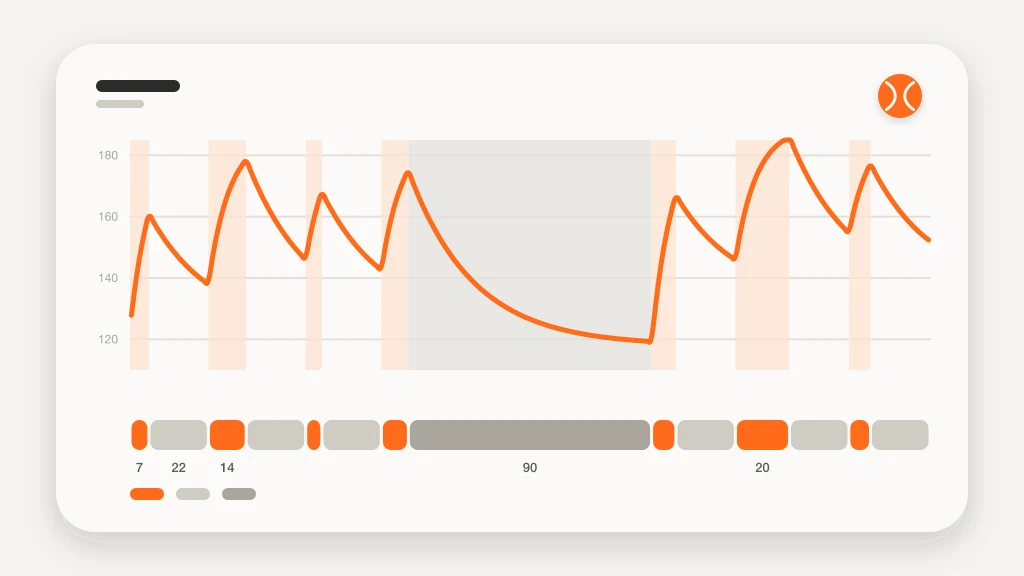
Illustrative scenario. Amira, 38, plays 90 minutes of club singles on a warm Saturday morning (about 28 °C). Her measured maximum is about 182 bpm. A chest strap shows an average of 138 bpm (76 %), rally peaks of 172–178 bpm and about 18 % of the time above 155 bpm (85 %). Between points her heart rate falls by roughly 20–30 bpm. At the first changeover it drops to about 125 bpm, but by the last set the changeover low is about 140 bpm, a sign that heat and fluid loss are catching up. Her watch reports about 640 active kcal; an 8 MET estimate for 70 kg gives about 840 kcal of total energy, so the two are not in conflict. That night her overnight heart rate averages 57 bpm against her usual 53, and she sleeps about 40 minutes less. She swaps Sunday's hard session for an easy walk and now drinks at every changeover. Numbers are illustrative.
Action steps
- Choose the tennis profile (or another racket profile) and wear the watch snug on the non-racket wrist, or use a chest strap.
- Judge a match by average heart rate, time per zone and how far heart rate falls at changeovers, not by single peaks or calorie totals.
- Drink at every changeover, and treat heart rate that no longer falls between points as a cue to slow down.
- Log effort as minutes × RPE to see your weekly load, and raise hitting volume gradually.
- After a hard or late match, compare overnight heart rate and sleep with your own baseline, and space hard singles days.
Related guides
- Heart rate zones explained: how to set and use them
- Heart rate recovery: how fast your heart rate drops after exercise
- Training load explained: TRIMP, TSS, strain and relative effort
- Hydration and electrolytes: drinking smart for training and racing
- Padel with a wearable: heart rate, calories and recovery between matches
- Table tennis: heart rate, calories and reaction training
FAQ
What is a normal heart rate when playing tennis? Averages of roughly 55–85 % of maximum depending on format and level, with brief peaks near maximum. Individual variation is large, so use your own zones.
How many calories does tennis burn per hour? Roughly 400–600 kcal for a 70 kg adult, more in singles than doubles, based on MET values. A watch usually reports active energy, which reads lower, and both are estimates.
Which watch is best for tennis? One with a tennis or racket profile, good battery life and a secure strap, worn on the non-racket wrist. A chest strap gives steadier heart rate during rallies.
How long does recovery take after a tennis match? After a moderate match most people feel normal the next day. After a long, hot or late match, overnight heart rate and sleep can take a day or two to settle.
References
- Ainsworth et al. (2011). 2011 Compendium of Physical Activities: a second update of codes and MET values. Medicine & Science in Sports & Exercise. https://doi.org/10.1249/MSS.0b013e31821ece12
- Kovacs (2007). Tennis physiology: training the competitive athlete. Sports Medicine. https://doi.org/10.2165/00007256-200737030-00001
- Fernandez-Fernandez et al. (2009). A review of the activity profile and physiological demands of tennis match play. Strength & Conditioning Journal. https://doi.org/10.1519/SSC.0b013e3181ada1cb
- Shcherbina et al. (2017). Accuracy in wrist-worn, sensor-based measurements of heart rate and energy expenditure in a diverse cohort. Journal of Personalized Medicine. https://doi.org/10.3390/jpm7020003
For general information only. This is not medical advice — talk to a qualified professional about your health.
Keep reading
Sports
Walking for fitness and weight loss: pace, heart rate zones and how much is enough
9 min read
Metrics explained
Resting heart rate: normal ranges and what changes it
4 min read
Metrics explained
VO2 max: what it means and how to improve it
4 min read
Metrics explained
Heart rate zones explained: how to set and use them
4 min read
Devices & setup
How MoveVitals handles multiple devices: provenance, duplicates and conflicts
5 min read
Metrics explained
Normal heart rate variability (HRV) by age: RMSSD vs SDNN
6 min read