

Training science
Hitting the wall: why marathoners bonk and how to avoid it
Hitting the wall in a marathon is a sharp late-race slowdown, usually after about 30 km (mile 20), most often caused by low glycogen and made worse by starting too fast, heat or too little fuel. Your watch data shows it coming, and pacing, carbohydrate and long-run rehearsal can prevent it.
Written by MoveVitals Editorial Collective
Community-authored educational content. Individual clinical review is identified only when a named review is actually recorded.
Editorial standards & corrections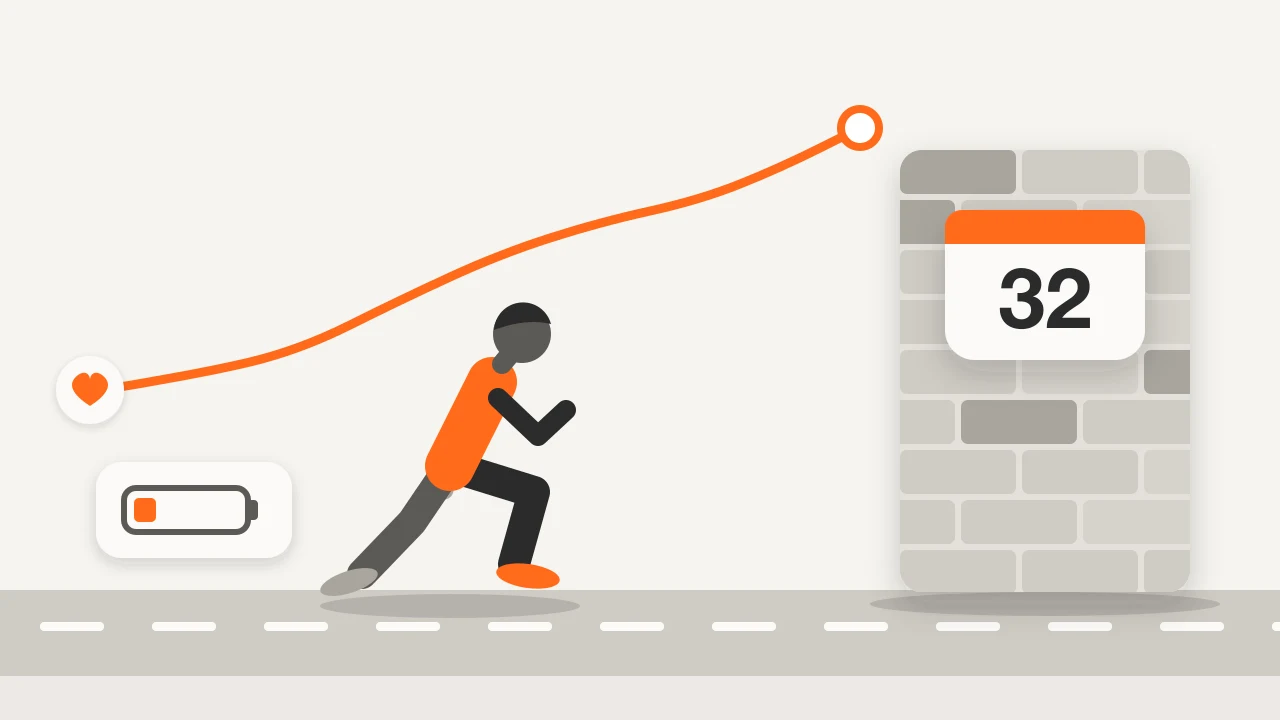
Key takeaways
- Glycogen stores hold roughly 1,500–2,500 kcal while a marathon costs about 2,500–3,500 kcal, about 1 kcal per kg of body weight per km, so fat and race-day carbohydrate must cover the gap.
- In your watch data, the classic signature is a steady pace until about km 30–35, then a 5 km block more than about 10% slower while effort feels higher.
- Prevent the wall with 8–12 g of carbohydrate per kg a day for 1–2 days before the race and 60–90 g an hour from the first 30–45 minutes.
- Rehearse fuelling on at least three long runs of 25–32 km, because gut tolerance trains.
- Stop and get medical help for confusion, fainting, repeated vomiting, chest pain or being unable to stand.
What the wall actually is
Your body stores carbohydrate as glycogen in muscle and liver. At marathon effort, carbohydrate supplies most of the energy and fat covers the rest. Running at that effort can drain glycogen in roughly two to three hours, so a runner who is still going after that, or who started too fast, can hit a point where the legs turn heavy, pace collapses and the same effort suddenly feels far harder. A metabolic model of marathon running (Rapoport, 2010) supports glycogen depletion as a main driver.
| Store or cost | Approx. energy | Note |
|---|---|---|
| Muscle and liver glycogen | 1,500–2,500 kcal | Varies with body size, training and carb-loading |
| Marathon energy cost | 2,500–3,500 kcal | About 1 kcal per kg of body weight per km |
| Fat stores | Tens of thousands of kcal | Plentiful, but burned too slowly to supply full marathon pace on their own |
| Carbohydrate during the race | 60–90 g an hour = 240–360 kcal | Tops up blood glucose and spares glycogen; does not replace everything you burn |
The wall is common. In an analysis of more than 4 million recreational race records, using a pacing-based definition of a sustained late-race slowdown, about 28% of men and 17% of women hit it, and the slowdowns lasted around 10 km on average (Smyth, 2021).
It is rarely just glycogen
Marathoners use "the wall" and "bonking" (bonking while running means running out of fuel) for any late collapse, but several causes overlap:
| Contributor | What you feel and see | Main fix |
|---|---|---|
| Glycogen running low | Sudden heavy legs, pace collapse, brain fog, cold sweats; heart rate may not follow the effort | Carb-load, 60–90 g an hour from early, long-run rehearsal |
| Starting too fast | Fast first 10 km, then a steady fade; positive splits | Even pacing: race pacing |
| Heat and dehydration | Heart rate drifts up at the same pace; thirst, dizziness | Slow down for heat; plan fluids and sodium (hydration and electrolytes) |
| Muscle fatigue | Sore quads, falling cadence, form breaking down while energy feels fine | Long runs, strength work, a proper taper (strength training for endurance) |
Spot it in your data
- Pace by 5 km. A steady pace until about km 30–35, then a block more than about 10% slower while effort feels higher, is the classic signature. Treat 10% as a rule of thumb, not a diagnosis.
- Heart rate. Some runners see heart rate climbing as pace falls (heat, dehydration, cardiac drift); others see it flat or lower than the effort would suggest. Neither pattern is diagnostic.
- Pace per heartbeat. Compare the first and second halves like aerobic decoupling. A few percent is normal late in a marathon; a drop of 10% or more says something ran out: fuel, fluids or pacing.
- Running dynamics. If your watch records them, falling cadence and longer ground contact time often show up with fatigue (running dynamics).
- In training. The same signature on a 30 km long run tells you to fuel earlier or start slower, long before race day.
How to avoid hitting the wall
- Pace. Start at or a few seconds per km slower than goal pace for the first 5–10 km, then settle. Time banked early is paid back with interest; see race pacing. Set the goal from a recent race and adjust for heat.
- Load up. Sports-nutrition guidelines suggest about 8–12 g of carbohydrate per kg of body weight a day for 1–2 days before a long event (Burke et al., 2011), plus a carbohydrate breakfast 1–4 hours before the start at 1–4 g/kg (carbohydrate fuelling).
- Fuel early and often. Aim for 60–90 g of carbohydrate an hour, starting in the first 30–45 minutes instead of waiting for hunger. A typical gel holds about 20–25 g, so 60 g an hour is roughly 2–3 gels once you count sports drink at aid stations. Above about 60 g an hour, glucose-plus-fructose mixes are absorbed better (Jeukendrup, 2014). See the race-day nutrition plan.
- Practise. Rehearse the plan on at least three long runs of 25–32 km, since gut tolerance trains. Easy aerobic volume (zone 2) improves fat use, and marathon-pace segments in long runs teach the pace.
- Manage heat and taper. Slow down on warm days and taper properly so glycogen stores start full; see tapering and running in the heat.
If it starts mid-race
- Take carbohydrate now: a gel or sports drink with water. It can take several minutes to help, so do not expect instant relief.
- Slow to a pace you can hold and use walk breaks. Easing early costs less time than stopping later.
- Keep fuelling little and often rather than in one big dose.
- Stop and get medical help for confusion, fainting, repeated vomiting, chest pain or being unable to stand. Those are not "just the wall".
In MoveVitals
Race and long-run activities from Garmin, COROS, Polar, Suunto, Strava or Apple Health come together as one activity stream with pace, heart rate and, if recorded, cadence, so you can review where a race faded and compare it with earlier long runs. If you wear a Dexcom CGM, glucose can sit next to pace on long runs, though it needs careful interpretation during exercise (blood glucose and CGMs). MoveVitals does not log gels or prescribe fuelling plans.
Worked example
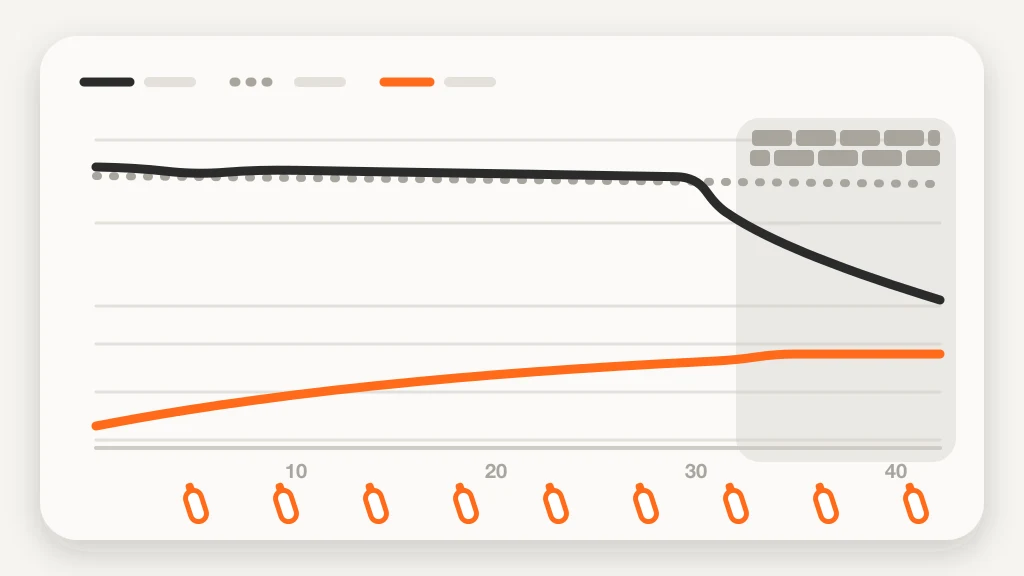
Illustrative scenario. Marta, 41, runs a 3:58:03 marathon: the first half in 1:47:57 (5:07/km, about 8:15/mile), the second in 2:10:06. Her watch shows pace holding until about km 30, then falling to roughly 6:40/km (10:44/mile) by km 32 while heart rate sits near 165 bpm, against about 158 bpm at 5:07/km early on. Her speed per heartbeat has dropped by about a quarter, and she had taken only two gels. Next time her goal is 3:50 (5:27/km, 8:46/mile). She plans 5:28/km for the first 30 km, carb-loads at about 8 g/kg for two days and rehearses 60 g an hour on three long runs of 28–32 km. On race day she takes a gel about every 25 minutes from minute 20, plus sports drink at aid stations. She eases to 5:34/km over the last 12 km and finishes in 3:51:53, with halves of 1:55:20 and 1:56:33 (about 1% slower) and speed per heartbeat down only about 5%. Figures are illustrative.
Action steps
- Set a realistic goal from a recent race, and plan the first 5–10 km at or slightly slower than goal pace, adjusting for heat.
- Rehearse fuelling on at least three long runs of 25–32 km, building toward 60–90 g of carbohydrate an hour and starting in the first 30–45 minutes.
- Carb-load for 1–2 days before the race (about 8–12 g/kg a day), eat a carbohydrate-rich breakfast and taper so glycogen is full.
- After each race or long run, check your 5 km splits and pace per heartbeat in the second half to see where and why you faded.
- Agree a mid-race plan in advance: take carbohydrate, ease the pace, walk if needed, and get medical help for confusion, fainting, repeated vomiting or chest pain.
Related guides
- Marathon training: building a plan that gets you to the finish
- Race pacing: why even splits usually win
- Carbohydrate fuelling for training and racing
- Cardiac drift (decoupling): why heart rate rises at the same pace
- Race-day nutrition for the half and full marathon: what to eat, when, and how many gels
FAQ
At what distance does the marathon wall hit: mile 20? Typically after about 30–35 km (miles 19–22), often called "mile 20", but it depends on pace, fuel, heat and fitness. Starting too fast brings it forward.
What does hitting the wall feel like? Suddenly heavy legs, a pace collapse, mental fog, irritability, dizziness, cold sweats or nausea, with effort feeling far higher than your pace suggests.
Is hitting the wall the same as bonking? The terms are used interchangeably. "Bonking" describes running out of fuel in any endurance sport; the marathon wall often combines low glycogen with pacing, heat and muscle fatigue.
Can I hit the wall in a half marathon? It is much less likely, because glycogen stores usually last that long. A very fast start, heat or little pre-race food can still cause a late fade.
How many gels do I need? About 60–90 g of carbohydrate an hour from all sources. A typical gel holds 20–25 g, and sports drink counts too. Practise the plan in training; see the race-day nutrition plan.
References
- Rapoport (2010). Metabolic Factors Limiting Performance in Marathon Runners. PLoS Computational Biology. https://doi.org/10.1371/journal.pcbi.1000960
- Smyth (2021). How recreational marathon runners hit the wall: A large-scale data analysis of late-race pacing collapse in the marathon. PLOS ONE. https://doi.org/10.1371/journal.pone.0251513
- Burke et al. (2011). Carbohydrates for training and competition. Journal of Sports Sciences. https://doi.org/10.1080/02640414.2011.585473
- Jeukendrup (2014). A Step Towards Personalized Sports Nutrition: Carbohydrate Intake During Exercise. Sports Medicine. https://doi.org/10.1007/s40279-014-0148-z
For general information only. This is not medical advice — talk to a qualified professional about your health.
Keep reading
Training science
Zone 2 training: the science and how to do it right
4 min read
Devices & setup
Strava and MoveVitals: workouts, streams and devices that arrive via Strava
3 min read
Training science
Polarized training (80/20): easy most of the time, hard some of the time
4 min read
Training science
Interval training and HIIT: designing sessions that work
4 min read
Metrics explained
VO2 max: what it means and how to improve it
4 min read
Metrics explained
Heart rate zones explained: how to set and use them
4 min read