

Devices & setup
Garmin vs Apple Watch for training and health: what each measures best
In a Garmin vs Apple Watch comparison, Garmin's sports watches lead with a training layer and multi-day battery, while the Apple Watch is an iPhone-centred smartwatch with health sensors built for daily wear. Which one measures your running, sleep and recovery better depends on the model, the metric and how you use it.
Written by MoveVitals Editorial Collective
Community-authored educational content. Individual clinical review is identified only when a named review is actually recorded.
Editorial standards & corrections
Key takeaways
- Apple Watch needs an iPhone, current models needing iPhone 11 or later, while Garmin watches work with iPhone or Android through the Garmin Connect app.
- A Forerunner 970 is rated at up to 15 days in smartwatch mode and up to 26 hours GPS-only, which suits long events and sleep tracking without nightly charging.
- Wrist heart rate on both brands is good at rest and steady effort and weaker in intervals, strength work and cold, so use a chest strap for hard sessions on either.
- Neither brand has been shown to be consistently better for sleep stages, and both are reasonable for sleep versus wake.
- Garmin's Training Readiness runs from 1 to 100 and Apple's Readiness app exists only on Series 12 and Ultra 4; they are different models, so numbers do not transfer between brands.
At a glance
Specs checked against Garmin and Apple pages in November 2026. Models change every year, so confirm yours.
| Garmin sports watches (Forerunner, fēnix) | Apple Watch (Series 12, Ultra 4, SE 3) | |
|---|---|---|
| Phone | iPhone or Android, via the Garmin Connect app | iPhone only (current models need iPhone 11 or later) |
| Battery (maker rating) | Forerunner 970: up to 15 days in smartwatch mode, up to 26 hours GPS-only; larger fēnix models higher | Series 12: up to 24 hours (38 in Low Power Mode); Ultra 4: up to 50 hours (84); SE 3: up to 18 hours |
| Training layer | Training Status, Training Load, Training Readiness, HRV Status, Body Battery (varies by model) | Training Load, effort rating, Cardio Fitness; Readiness app on Series 12 and Ultra 4 only |
| Night and recovery | Sleep Score, overnight HRV status, Body Battery | Vitals (overnight heart rate, respiratory rate, wrist temperature, blood oxygen; HRV on Series 12 and Ultra 4), Sleep Score |
| Heart and health features | ECG app on selected models and regions | ECG app (not on SE) and irregular rhythm notifications; sleep apnea and hypertension notifications; availability varies by country |
| Sports and outdoors | Many sport profiles; maps on many models; multi-band GNSS on higher-end models | Workout app plus third-party apps; Ultra adds dual-frequency GPS and long-battery workout modes |
| Smart features | Notifications and music; a smaller app store | Calls, apps, payments and tight iPhone integration |
| Subscription | Core features free; optional Garmin Connect+ | No subscription for core watch features |
Training metrics: what each brand offers
Garmin's layer comes from Firstbeat Analytics models. Training Status compares recent load with your fitness trend, Training Readiness (1–100) combines sleep, recovery time, HRV status, acute load and recent sleep and stress, and HRV Status compares a seven-night average with your baseline. Body Battery is a separate energy estimate. See Garmin Training Status and Training Readiness and Body Battery.
Apple builds from simpler blocks: Training Load compares your recent workouts with the previous weeks using effort ratings, Vitals compares overnight metrics with your typical range, and Sleep Score rates last night. Readiness, a daily 0–10 score, exists only on Series 12 and Ultra 4. See Apple Watch recovery and readiness.
Each is a different model, so numbers do not transfer between brands. Neither measures VO2 max in a lab; both estimate it, and the estimates shift with heat, hills and sensor noise (see VO2 max).
Accuracy: heart rate, GPS, sleep and HRV
- Heart rate. Optical wrist sensors on both brands are generally good at rest and during steady running or cycling, and weaker in intervals, strength training, cold or with a loose fit. Heart-rate-based load, zones and recovery inherit that error. A chest strap is generally more accurate for hard sessions; see wearable heart rate accuracy.
- GPS. Both offer multi-band or dual-frequency GNSS on selected models, which helps in cities and under trees. Distances from two devices usually differ by a small percentage, so compare paces from the same device. See running pace.
- Sleep. Both separate sleep from wake reasonably well and estimate stages less well compared with lab tests. Each brand's sleep score weighs inputs differently, so do not compare them; see sleep scores compared.
- HRV. Garmin reports an overnight average and a status against your baseline; Apple Health has historically stored SDNN. Different statistics, different windows: compare trends within one device (HRV guide).
Which suits which use
| If you... | Often fits |
|---|---|
| Run or ride long events and want multi-day battery | Garmin |
| Want training status, readiness and load metrics built for structured plans | Garmin |
| Want one watch for calls, apps and payments, and own an iPhone | Apple Watch |
| Use an Android phone | Garmin (Apple Watch needs an iPhone) |
| Want ECG or rhythm notifications | Both on selected models; check your country |
For running specifically, a good watch is one whose battery, screen and metrics you will actually use. Many runners train happily on either; ultra and trail runners lean toward Garmin's battery.
Wearing both
Give each watch one job: the Garmin for workouts and structured training, the Apple Watch for daily wear, or the reverse. Avoid recording the same session on both if you upload both to Strava, because you will see two activities.
In MoveVitals
- Garmin connects through the Garmin Connect Developer Program on the hosted version only (the adapter is not in the open-source export). It brings activities (heart rate, pace, power, cadence, GPS), daily summaries, Body Battery, sleep, overnight HRV and Garmin scale data. Training Status and Training Readiness stay in Garmin's apps; MoveVitals calculates its own load from all your activities. See the Garmin guide.
- Apple Watch workouts that are already in Strava can arrive through the Strava connection. Apple sleep, HRV and resting heart rate need direct Apple Health access through a MoveVitals iOS app that is still in development, and Apple's Readiness, Training Load and Sleep Score are not imported. See the Apple Health guide.
- Together: records from different providers (Garmin directly and Strava) are grouped into one workout when sports are compatible and times overlap; two records both arriving via Strava are not grouped automatically. Apple's SDNN is stored as its own metric and never mixed with other HRV. See how MoveVitals handles multiple devices.
Worked example
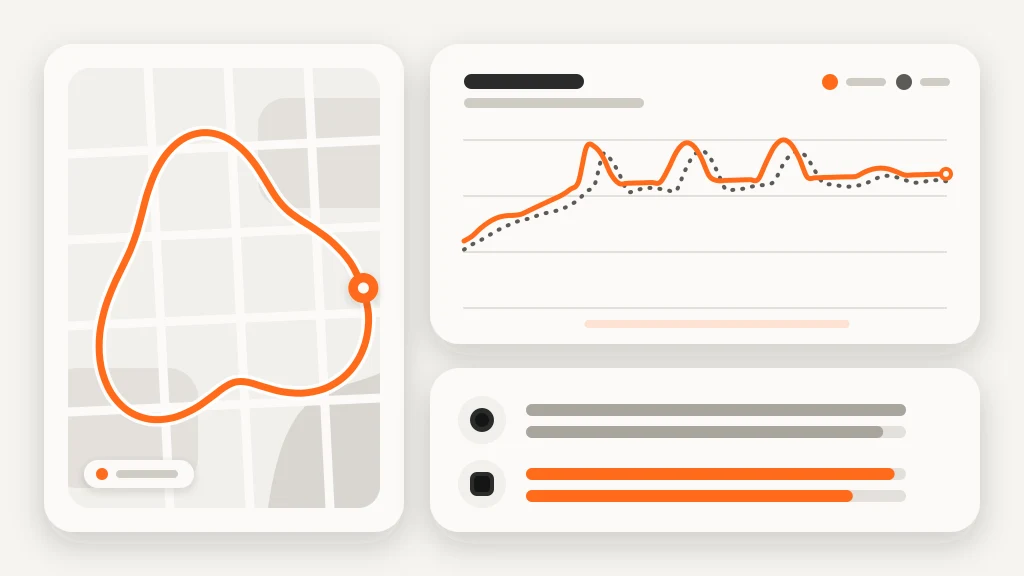
Illustrative scenario. Dani wears a Garmin on one wrist and an Apple Watch on the other for a 10 km interval run. The Garmin records 10.02 km, average heart rate 152 bpm and 640 kcal; the Apple Watch records 9.97 km (0.5% less), 149 bpm and 590 kcal (about 8% less). Overnight, the Garmin shows 7 h 05 min of sleep with 52 minutes of deep sleep, the Apple Watch 6 h 58 min with a different stage split. Dani concludes that distance and heart rate agree within a few percent, calories and stages are estimates, and sleep scores are not comparable. The Garmin run arrives directly and the Apple Watch run through Strava; MoveVitals groups them into one workout, keeps both records and uses Dani's priorities for each field. For threshold sessions Dani adds a chest strap. Numbers are illustrative.
Action steps
- Decide the main job: structured training, everyday smartwatch or health alerts, and check your phone (Apple Watch needs an iPhone).
- Match battery to your routine: nightly charging is easy for daily wear, awkward for multi-day events and sleep tracking.
- Use a chest strap for intervals and strength work, whichever brand you wear.
- Wear the watch to bed for a few weeks so recovery features build a baseline, and compare trends within one device.
- If you use both, assign each a job and rank sources per metric in MoveVitals; record each session on one watch.
Related guides
- Garmin Training Status and Training Readiness: what the labels mean and when to trust them
- Apple Watch recovery and readiness: Vitals, Training Load, Sleep Score and the Readiness app
- Garmin Body Battery: charging, draining and what it tells you
- How accurate is wrist heart rate? Optical sensors vs chest straps, by sport
- How MoveVitals handles multiple devices: provenance, duplicates and conflicts
FAQ
Which is more accurate, Garmin or Apple Watch? There is no single winner. Accuracy depends on the model, fit, activity and metric, and independent tests rarely cover both brands under the same conditions. Use a chest strap when heart rate precision matters.
Is Garmin or Apple Watch better for sleep tracking? Neither has been shown to be consistently better for sleep stages; both are reasonable for sleep versus wake. Pick by comfort and battery, and follow one device's trend.
Does Garmin have something like the Apple Watch Readiness score? Garmin's closest equivalents are Training Readiness (1–100) and Body Battery, but they are different models with different inputs.
Do I need a subscription for either? Not for the core features. Garmin sells an optional Connect+ tier; check both makers for current terms.
References
- Bent et al. (2020). Investigating sources of inaccuracy in wearable optical heart rate sensors. npj Digital Medicine. https://doi.org/10.1038/s41746-020-0226-6
- Chinoy et al. (2021). Performance of seven consumer sleep-tracking devices compared with polysomnography. Sleep. https://doi.org/10.1093/sleep/zsaa291
- Miller et al. (2022). A Validation of Six Wearable Devices for Estimating Sleep, Heart Rate and Heart Rate Variability in Healthy Adults. Sensors. https://doi.org/10.3390/s22166317
- Apple. Compare Apple Watch models. https://www.apple.com/watch/compare/
- Garmin. Forerunner 970 Owner's Manual: Battery Life Information. https://www8.garmin.com/manuals/webhelp/GUID-025D75CF-3445-49E1-8D81-1AA74AB4E00F/EN-US/GUID-1933DAC3-8171-4995-A1F0-CD298E1F5A33.html
- Garmin. Forerunner 970 Owner's Manual: Training Readiness. https://www8.garmin.com/manuals/webhelp/GUID-025D75CF-3445-49E1-8D81-1AA74AB4E00F/EN-US/GUID-C21BE0C8-A08E-4DA1-B6C6-2E0E2DDDB372.html
For general information only. This is not medical advice — talk to a qualified professional about your health.
Keep reading
Metrics explained
VO2 max: what it means and how to improve it
4 min read
Devices & setup
How MoveVitals handles multiple devices: provenance, duplicates and conflicts
5 min read
Metrics explained
Normal heart rate variability (HRV) by age: RMSSD vs SDNN
6 min read
Metrics explained
Resting heart rate: normal ranges and what changes it
4 min read
Training science
Interval training and HIIT: designing sessions that work
4 min read
Sports
Trail running with a watch: heart rate, climbs and pacing by effort
7 min read