

Metrics explained
Garmin Body Battery: charging, draining and what it tells you
Body Battery is Garmin's 5–100 estimate of your energy reserves. It charges during rest and sleep and drains with activity and stress.
Written by MoveVitals Editorial Collective
Community-authored educational content. Individual clinical review is identified only when a named review is actually recorded.
Editorial standards & corrections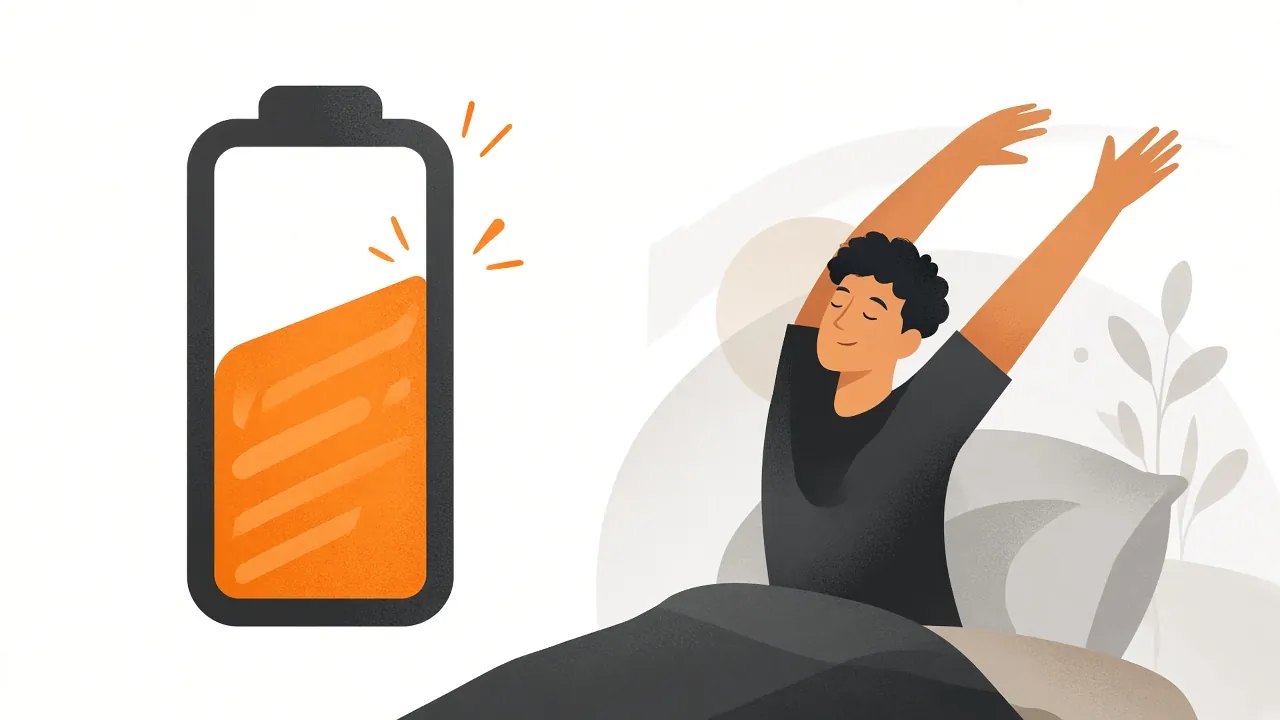
Key takeaways
- A typical healthy Body Battery pattern is waking at 70–100, drifting down through the day and charging back overnight, though many healthy people top out at 80–95.
- A morning Body Battery below about 50 after a full night suggests poor-quality sleep, illness, alcohol or accumulated fatigue.
- The overnight charge tells you more than the absolute number: a +60 night is very restorative and a +15 night is not.
- If morning Body Battery is 20 or more points below your two-week baseline, swap hard training for an easy session.
- Body Battery and WHOOP or Oura recovery scores use different proprietary models, so their values are not directly comparable.
Body Battery combines HRV, stress, sleep quality and activity into a running energy level from 5 to 100. It is built on Firstbeat Analytics' physiological models.

How it moves
| Charges | Drains |
|---|---|
| Quality sleep (main source) | Exercise |
| Calm rest, naps | Stress, including mental load |
| Relaxation and breathing exercises | Illness, alcohol, late meals |
A typical healthy pattern: wake up at 70–100, drift down through the day, and charge back overnight.
Reading it
- Low morning value (below ~50) after a full night suggests poor-quality sleep, illness, alcohol or accumulated fatigue.
- Fast drain while sitting usually reflects stress or digestion.
- Charge during sleep tells you more than the absolute number: a +60 night is very restorative; +15 is not.
How to use it
- Plan hard sessions on days you start high.
- On low days, choose easy movement — gentle activity rarely hurts.
- Use the overnight charge as feedback on evening habits (late screens, alcohol, late training).
In MoveVitals
Body Battery is synced from Garmin daily and stored as its own metric. It isn't merged with WHOOP recovery or Oura readiness, but you can compare them on the same chart.
Worked example
Illustrative scenario. Wei wakes on Monday with a Body Battery of 85 after 7.5 hours of sleep. A 60-minute tempo run drains about 25 points, a stressful afternoon of meetings another 20, and by 10 pm he is at 30. On Thursday, after a late dinner and two beers, he wakes at only 45 even though he was in bed for 8 hours — overnight stress stayed elevated and HRV was low. Instead of the planned intervals he does an easy 40-minute ride, goes to bed 45 minutes earlier and is back at 80 on Friday. The numbers are an estimate built on HRV and activity models, so he treats a single low reading as a prompt to check sleep, alcohol and stress, not as a diagnosis.
Action steps
- Note your typical wake-up value over two weeks to learn your own baseline.
- If morning Body Battery is 20+ points below baseline, swap hard training for an easy session.
- Look at the overnight charge curve: a flat curve points to alcohol, late meals or illness.
- Add a 10-minute breathing or relaxation break on high-stress days and watch the drain slow.
- Compare Body Battery with HRV and resting heart rate before changing a training plan.
Related guides
- Normal heart rate variability (HRV) by age: RMSSD vs SDNN
- Stress scores on wearables: what they really measure
- WHOOP Recovery score: what drives it and how to act on it
- Garmin Connect and MoveVitals: activities, health and Body Battery
FAQ
Can Body Battery reach 100 every day? Not necessarily; many healthy people top out at 80–95.
Why did it drain during a relaxing evening? Late meals, alcohol or a stimulating environment can keep arousal high.
Why is my Body Battery low after a full night's sleep? Sleep duration alone does not charge it; elevated overnight heart rate, low HRV, alcohol, late meals or the start of an illness can all limit recharge.
Does wearing the watch loosely affect Body Battery? Yes. Body Battery depends on optical heart rate and HRV, so a loose fit or gaps in wear reduce accuracy.
Is Body Battery the same as a WHOOP or Oura recovery score? They are similar ideas but use different proprietary models, so values are not directly comparable across brands.
References
- Shaffer et al. (2017). An Overview of Heart Rate Variability Metrics and Norms. Frontiers in Public Health. https://doi.org/10.3389/fpubh.2017.00258
- Plews et al. (2013). Training Adaptation and Heart Rate Variability in Elite Endurance Athletes: Opening the Door to Effective Monitoring. Sports Medicine. https://doi.org/10.1007/s40279-013-0071-8
- Halson (2014). Monitoring Training Load to Understand Fatigue in Athletes. Sports Medicine. https://doi.org/10.1007/s40279-014-0253-z
- Pietilä et al. (2018). Acute Effect of Alcohol Intake on Cardiovascular Autonomic Regulation During the First Hours of Sleep in a Large Real-World Sample of Finnish Employees: Observational Study. JMIR Mental Health. https://doi.org/10.2196/mental.9519
For general information only. This is not medical advice — talk to a qualified professional about your health.
Keep reading
Devices & setup
How MoveVitals handles multiple devices: provenance, duplicates and conflicts
5 min read
Recovery & sleep
Your personal baseline: why "normal for you" beats population averages
4 min read
Metrics explained
Normal heart rate variability (HRV) by age: RMSSD vs SDNN
6 min read
Recovery & sleep
Sleep hygiene: evidence-based habits for better sleep
4 min read
Devices & setup
WHOOP and MoveVitals: what syncs and how to get the most from it
3 min read
Recovery & sleep
Overreaching and overtraining: warning signs and what to do
4 min read