

Devices & setup
WHOOP vs Oura vs a sports watch: which data you get and how to combine them
WHOOP vs Oura comes down to where you want a sensor and what you want it to tell you: WHOOP is a screenless band built around strain and recovery, Oura a ring built around sleep, readiness and temperature trends. Neither replaces a sports watch, and the three work best combined rather than ranked.
Written by MoveVitals Editorial Collective
Community-authored educational content. Individual clinical review is identified only when a named review is actually recorded.
Editorial standards & corrections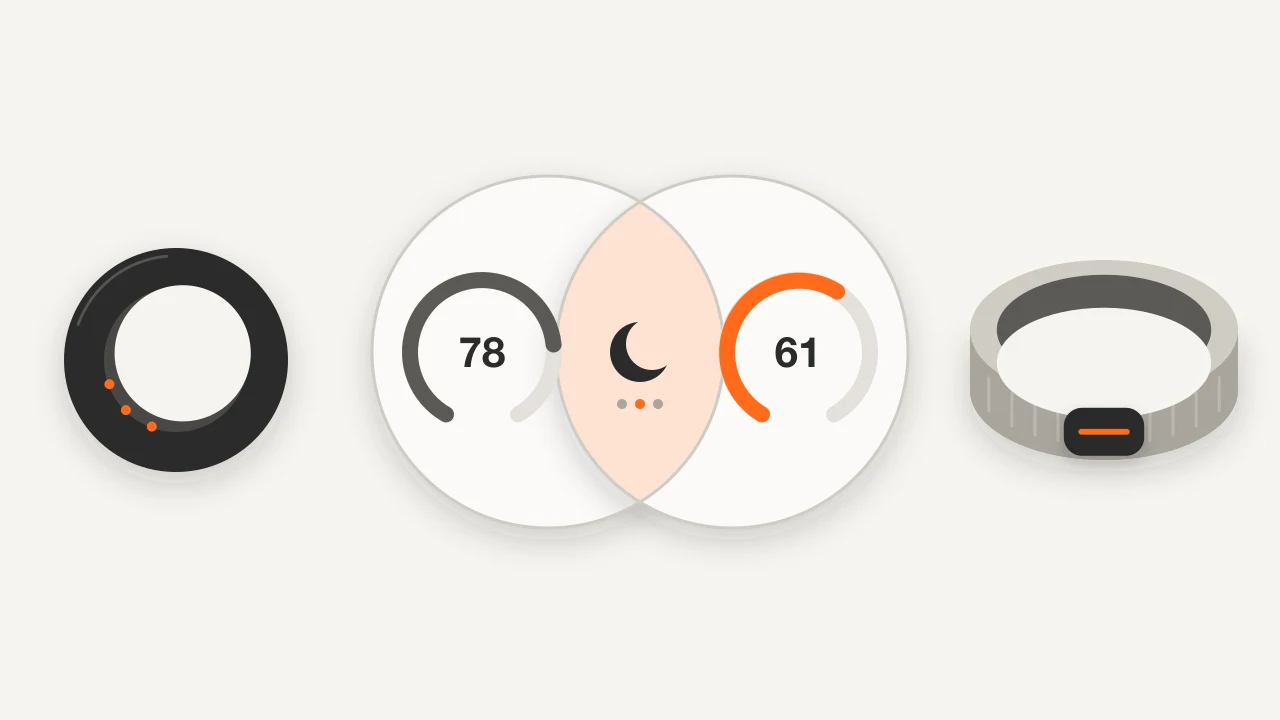
Key takeaways
- WHOOP Recovery (0–100 %) is built from overnight HRV, resting heart rate, sleep performance and respiratory rate, while Oura Readiness (0–100) also blends temperature, sleep balance and activity.
- HRV is the largest driver of WHOOP Recovery while Oura spreads the weight over nine contributors, so the two can disagree on the same morning without either being wrong.
- Vendor battery ratings are 14+ days for WHOOP and about 5–8 days for Oura Ring 4 or 6–9 days for Ring 5.
- As checked in November 2026, WHOOP membership includes the band at about US$199, 239 or 359 a year, while an Oura ring costs from about US$349 plus US$69.99 a year.
- Neither band nor ring records a GPS track on the device, so pace, route and power still need a sports watch or bike computer.
At a glance
Specs checked against vendor and press pages in November 2026. Models, prices and regions change often, so confirm before buying.
| WHOOP 5.0 / MG | Oura Ring 4 / Ring 5 | Sports watch (e.g. Garmin) | |
|---|---|---|---|
| Form | Screenless strap, worn on the wrist or upper arm | Ring on a finger | Wrist watch with screen and GPS |
| Battery (vendor rating) | 14+ days | About 5–8 days (Ring 4), 6–9 days (Ring 5) | Roughly a week to several weeks in smartwatch mode, far fewer hours with GPS |
| Daily scores | Recovery 0–100%, Strain 0–21, Sleep performance | Readiness 0–100, Sleep score, Activity score | Brand-specific, such as Training Readiness and Body Battery |
| Cost model | Membership includes the band: about US$199, 239 or 359 a year (One, Peak, Life) | Ring from about US$349 (Ring 4) or US$399 (Ring 5), plus membership at US$5.99 a month or US$69.99 a year | One-off purchase; some brands add optional paid tiers |
| Extras | Peak adds Healthspan; Life uses the MG band with ECG (US) and Blood Pressure Insights | Newer rings add features such as Health Radar (limited regions) | ECG and others on selected models |
How each builds its daily score
WHOOP Recovery (0–100%) is built from overnight HRV, resting heart rate, sleep performance and respiratory rate, with SpO2 and skin temperature as context on newer bands. Green is 67–100, yellow 34–66, red 0–33. Strain (0–21, logarithmic) measures the cardiovascular load of the whole day, and WHOOP suggests a target strain from your recovery. See WHOOP Recovery and WHOOP Strain.
Oura Readiness (0–100) blends contributors: resting heart rate, HRV balance against a longer-term baseline, body temperature, recovery index, sleep, sleep balance, sleep regularity, previous-day activity and activity balance. Oura calls 85 and above optimal, 70–84 good and below 70 a sign to take it easier. See Oura Readiness.
The design difference: WHOOP centres on a loop of strain against recovery, while Oura is sleep-led, with activity as one contributor. Both judge you against your own baseline, so give each a few weeks before trusting its scores.
Where they disagree and why
- Wear location. Finger versus wrist or upper arm. Optical signal quality depends on fit, movement, temperature and skin, and a chest strap is generally more reliable than either during workouts.
- Time windows. Both report HRV as RMSSD but sample different parts of the night, so compare trends within one device, not numbers across them.
- Weighting. HRV is the largest driver of WHOOP Recovery; Oura spreads the weight over nine contributors, including activity balance. After a hard block WHOOP can read red while Oura says Good, because sleep and temperature look fine. Neither is wrong.
- Sleep stages. Estimates differ by tens of minutes. Validation studies against lab sleep tests find good sleep-versus-wake detection and moderate stage agreement. See sleep scores compared and sleep tracker accuracy.
Which question each answers
| Your question | What many people reach for |
|---|---|
| How hard was my day for my heart, and am I ready for more? | WHOOP's strain and recovery loop (heart-rate based, so it undercounts heavy lifting) |
| How are my sleep, HRV and temperature trending over months? | Oura's sleep-led scores |
| What were my pace, route or power? | A sports watch or bike computer; neither band nor ring records a GPS track on the device |
| What is easiest to wear all night? | A matter of comfort: try a ring and a strap if you can |
Using a ring, a band and a sports watch together
Give each device one job: one source for night-time recovery, and the watch (or a chest strap for intervals) for workouts. Wearing a ring and a band at night produces two scores that will differ, and two memberships; choose a primary and follow its trend. If your watch already offers recovery metrics (see Garmin Training Status and Training Readiness), the ring or band mostly adds a second opinion at night. For the watch side, read Garmin vs Apple Watch.
In MoveVitals
- WHOOP syncs recovery, HRV, resting heart rate, sleep stages, strain and workouts; Oura syncs readiness, sleep, HRV, resting heart rate, temperature deviation, SpO2, steps and workouts. Both use official read-only APIs and update by webhook. Some Oura data needs an active membership. See the WHOOP and Oura guides.
- Scores stay separate. Recovery and Readiness are stored as their own metrics and never averaged or converted; you can chart them side by side.
- You choose the winner for shared metrics such as HRV and sleep in the source-priority settings, and a conflict flag appears when the gap exceeds the metric's tolerance (10% for HRV). Both sources stay inspectable.
- Workouts from WHOOP and a GPS watch are merged into one activity. Garmin connects on the hosted version only. See how MoveVitals handles multiple devices.
Worked example
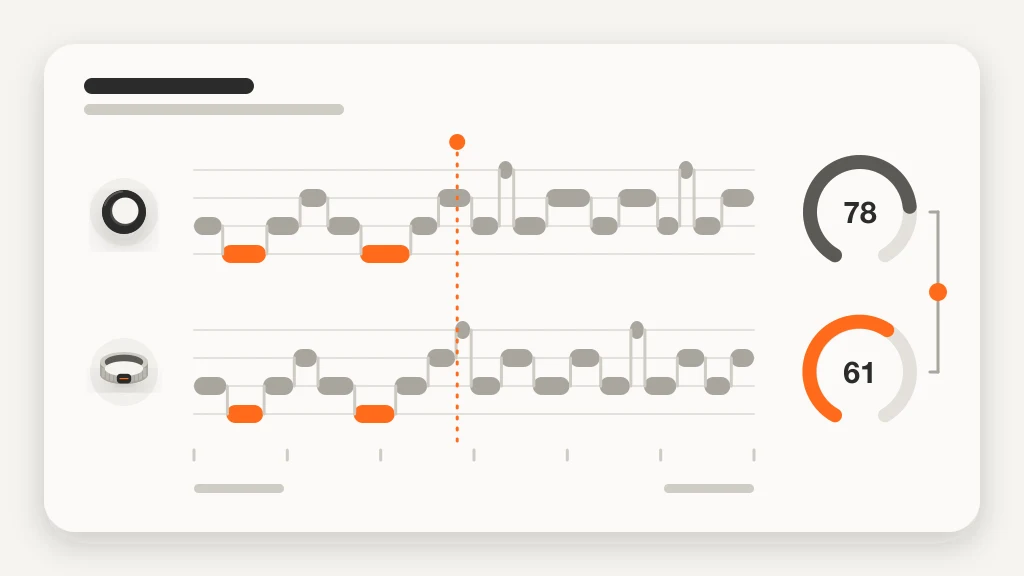
Illustrative scenario. Kenji, training for a half marathon, wears an Oura ring and a WHOOP band for four weeks to decide which to keep. After a hard Saturday long run, WHOOP shows Recovery 36% (red), HRV 44 ms, resting heart rate 56 bpm and 6 h 10 min of sleep. Oura shows Readiness 74 (Good), HRV 52 ms, resting heart rate 55 bpm and 6 h 25 min. MoveVitals keeps both and flags the HRV gap: (52 − 44) ÷ 52 ≈ 15%, above the 10% tolerance. Kenji opens the contributors: WHOOP's red is driven by HRV and short sleep, while Oura rates sleep balance acceptable. He swaps the tempo run for 45 easy minutes. Over the month the two scores move in the same direction on most days even when the numbers differ, so he keeps one source for night recovery and a chest strap for intervals. Numbers are illustrative.
Action steps
- Decide what you want most: night-time sleep trends, a strain-and-recovery loop or GPS workouts, and match the device to the job.
- Add up the full cost: hardware plus membership, and what happens to features if you stop paying.
- Wear it consistently (same finger or arm position, snug fit) and allow two to four weeks to build your baseline.
- Read the drivers behind each score and compare weekly trends, not a single morning.
- If you use both, rank one source per metric in MoveVitals and keep the other as a second opinion.
Related guides
- WHOOP Recovery score: what drives it and how to act on it
- Oura Readiness score: the contributors and how to use them
- WHOOP Strain: how the 0–21 scale works
- Sleep scores compared: Oura, Garmin, Polar, Withings and WHOOP
- How MoveVitals handles multiple devices: provenance, duplicates and conflicts
FAQ
Is WHOOP or Oura better for sleep? There is no proven winner. Validation studies test one device at a time, models change, and results for sleep stages are moderate for consumer devices in general. Choose by comfort and by how you will use the data.
Which is better for athletes? It depends on the question. WHOOP's strain gauge targets daily load; Oura's strength is sleep and trend tracking. Neither replaces a sports watch or chest strap for workouts, and many athletes combine them.
Can I wear both? Yes, but the scores will differ. Pick one as your primary source and follow its trend.
Do WHOOP and Oura need a subscription? Yes. WHOOP's band comes with a membership, and Oura charges a monthly membership on top of the ring, with some data requiring it. Prices and tiers change, so check the vendors.
References
- Miller et al. (2022). A Validation of Six Wearable Devices for Estimating Sleep, Heart Rate and Heart Rate Variability in Healthy Adults. Sensors. https://doi.org/10.3390/s22166317
- Chinoy et al. (2021). Performance of seven consumer sleep-tracking devices compared with polysomnography. Sleep. https://doi.org/10.1093/sleep/zsaa291
- Altini et al. (2021). The Promise of Sleep: A Multi-Sensor Approach for Accurate Sleep Stage Detection Using the Oura Ring. Sensors. https://doi.org/10.3390/s21134302
- Oura. Oura Membership: pricing and what is included. https://ouraring.com/membership
- WHOOP Community. WHOOP 5.0 One, Peak and Life tiers overview. https://www.community.whoop.com/t/can-you-give-me-a-quick-overview-of-the-whoop-5-0-one-peak-life-tiers/566
For general information only. This is not medical advice — talk to a qualified professional about your health.
Keep reading
Metrics explained
Normal heart rate variability (HRV) by age: RMSSD vs SDNN
6 min read
Metrics explained
Resting heart rate: normal ranges and what changes it
4 min read
Recovery & sleep
Alcohol, HRV and sleep: what your wearable shows the night after
3 min read
Devices & setup
How MoveVitals handles multiple devices: provenance, duplicates and conflicts
5 min read
Devices & setup
WHOOP and MoveVitals: what syncs and how to get the most from it
3 min read
Recovery & sleep
Sleep hygiene: evidence-based habits for better sleep
4 min read