

Metrics explained
DEXA scans: the most accurate way to measure body fat — and calibrate your scale
A DEXA scan measures fat, lean mass and bone, region by region, in about ten minutes. One scan a year turns your smart scale's daily estimates into numbers you can trust.
Written by MoveVitals Editorial Collective
Community-authored educational content. Individual clinical review is identified only when a named review is actually recorded.
Editorial standards & corrections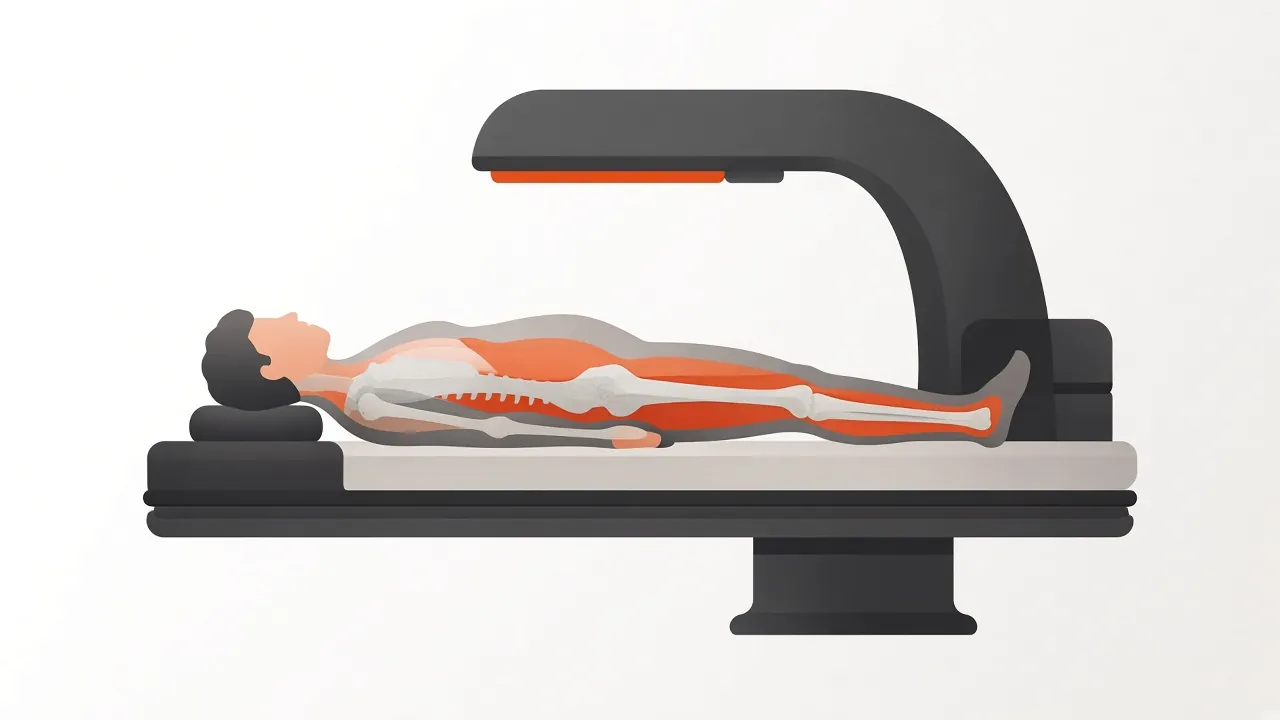
Key takeaways
- DEXA reports body fat % and fat mass by region, lean mass, visceral fat and bone mineral density, at a radiation dose comparable to a day or less of natural background radiation.
- The athletic body-fat range is 6–13 % for men and 14–20 % for women, and the healthy range at age 20–39 is 8–20 % and 21–33 %.
- Smart scales estimate fat from electrical resistance, which shifts with hydration, food, time of day and skin temperature, so a DEXA scan gives them a calibration point.
- For repeat scans use the same machine in the morning, fasted, wait at least 3–6 months between scans, and discuss any low bone density result with your doctor.
What DEXA measures
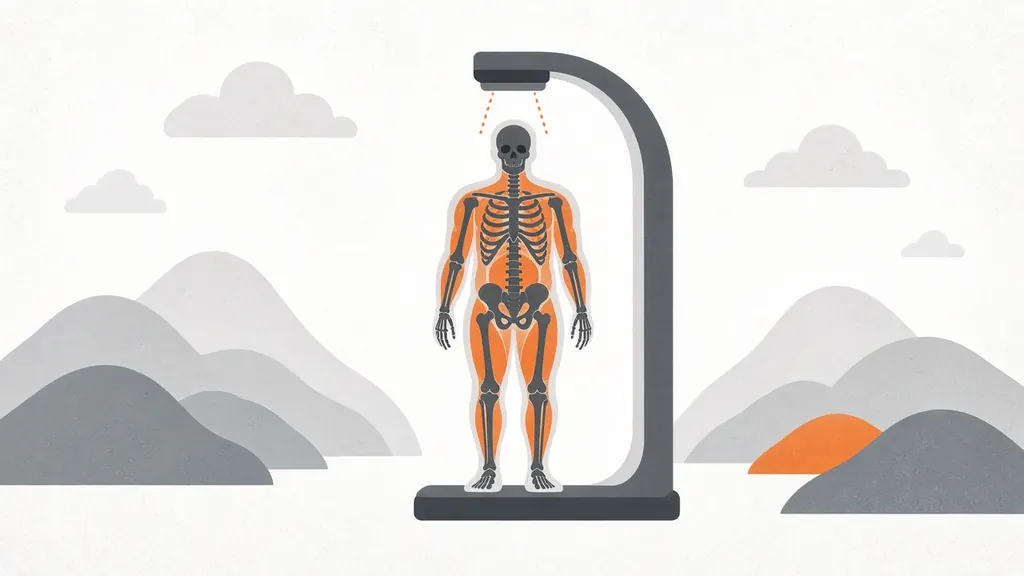
Dual-energy X-ray absorptiometry passes two low-energy X-ray beams through the body. It reports:
- Body fat % and fat mass by region (arms, legs, trunk).
- Lean mass, a good proxy for muscle.
- Visceral fat — the fat around organs most linked to metabolic risk.
- Bone mineral density.
The radiation dose is very low (comparable to a day or less of natural background radiation).
Typical body-fat ranges
| Men | Women | |
|---|---|---|
| Athletic | 6–13 % | 14–20 % |
| Healthy range (age 20–39, Gallagher et al.) | 8–20 % | 21–33 % |
Ranges rise slightly with age. DEXA tends to read a few points higher than many smart scales.
Why calibrate your smart scale
Bioimpedance scales estimate fat from electrical resistance, which shifts with hydration, food, time of day and skin temperature. Their trend is useful; their absolute value can be off by several percentage points. Compare a DEXA result with your scale reading taken the same morning, and you know your personal offset.
Getting a reliable scan
Morning, fasted, normally hydrated, no training beforehand, similar clothing — and the same machine for repeat scans. Repeat every 6–12 months when tracking a body-composition goal.
In MoveVitals
Add your DEXA body fat in Body Lab (Body composition). If you weigh yourself on a connected scale such as Withings, the Lab shows the scale's reading from the nearest day and how far it is from DEXA. See also body fat percentage and muscle mass.
Worked example
Illustrative scenario. Grace, 52, has a DEXA scan: 68 kg total, 24.5 kg fat (36%), 41 kg lean mass, visceral fat area of 95 cm², and a spine T-score of −1.4, in the low-bone-mass range. After 6 months of heavy strength training twice a week and more protein, a repeat scan on the same machine shows lean mass +1.2 kg and fat −2.0 kg. The bone result she discusses with her doctor, since DEXA is the standard tool for diagnosing osteoporosis. Small changes may be within measurement error.
Action steps
- Book repeat scans on the same machine, ideally at the same clinic.
- Scan in the morning, fasted and before exercise, with similar hydration.
- Compare lean mass, fat mass and visceral fat — not just body-fat %.
- Wait at least 3–6 months between scans for meaningful change.
- Discuss any low bone density result with your doctor.
Related guides
- Body fat percentage: healthy ranges and how smart scales measure it
- Visceral fat: the fat you can't see and why it matters most
- Body weight: why daily numbers jump and how to read the trend
- Strength training for endurance athletes
FAQ
Where can I get one? Sports-medicine clinics, university labs, some gyms and imaging centres; bone-density scans in hospitals use the same machine.
Is BMI good enough? BMI ignores where weight comes from; DEXA separates fat from muscle.
How much radiation does a DEXA scan use? Very little — typically far less than a chest X-ray.
Why do DEXA and a smart scale disagree? They use different methods; smart scales estimate from electrical impedance and are more affected by hydration.
References
- Cruz-Jentoft et al. (2019). Sarcopenia: revised European consensus on definition and diagnosis. Age and Ageing. https://doi.org/10.1093/ageing/afy169
- Neeland et al. (2019). Visceral and ectopic fat, atherosclerosis, and cardiometabolic disease: a position statement. The Lancet Diabetes & Endocrinology. https://doi.org/10.1016/s2213-8587%2819%2930084-1
For general information only. This is not medical advice — talk to a qualified professional about your health.
Keep reading
Devices & setup
Withings and MoveVitals: scales, blood pressure and sleep
3 min read
Recovery & sleep
Protein for recovery: how much, when and from what
3 min read
Recovery & sleep
Your personal baseline: why "normal for you" beats population averages
4 min read
Devices & setup
How MoveVitals handles multiple devices: provenance, duplicates and conflicts
5 min read
Metrics explained
Resting heart rate: normal ranges and what changes it
4 min read
Metrics explained
Blood oxygen (SpO2): what wearables measure and when to worry
4 min read