

Metrics explained
Testosterone: what the number means for training and recovery
Testosterone supports muscle, bone, red blood cells, mood and libido — in men and women. It also responds to how you sleep, eat and train, which makes it a useful check when recovery stalls.
Written by MoveVitals Editorial Collective
Community-authored educational content. Individual clinical review is identified only when a named review is actually recorded.
Editorial standards & corrections
Key takeaways
- The typical adult total testosterone range is 264–916 ng/dL (9.2–31.8 nmol/L) for men and about 15–70 ng/dL (0.5–2.4 nmol/L) for women.
- Draw blood between 7 and 10 am, because levels peak in the morning and fall by up to 30 % by evening, and always repeat one low result before drawing conclusions.
- A week of 5-hour nights lowers testosterone measurably, and heavy training on low energy intake can reduce it too.
- Discuss symptoms and results with a doctor and do not self-prescribe testosterone or boosters, which have little evidence over the counter.
Ranges
| Group | Total testosterone (typical adult range) |
|---|---|
| Men | 264–916 ng/dL (9.2–31.8 nmol/L) |
| Women | about 15–70 ng/dL (0.5–2.4 nmol/L) |
Ranges follow CDC-standardised assays; labs vary. In men, a value below about 300 ng/dL on two morning tests, together with symptoms, is the usual threshold for further assessment (American Urological Association).
Getting an accurate value
- Draw blood between 7 and 10 am — levels peak in the morning and fall by up to 30 % by evening.
- Avoid testing after a sleepless night, during illness or in a very heavy training block.
- One low result should always be repeated before conclusions.
What lowers it
Short sleep (a week of 5-hour nights lowers it measurably), low energy availability and large deficits, prolonged heavy endurance training without recovery, excess body fat, alcohol, and some medications. In women, very low energy availability shows up instead as cycle disruption.
Reading it with your data
If testosterone is low, look at your sleep duration, training load and HRV trend. A drop that coincides with a big training block and falling HRV points to overreaching rather than a hormonal disorder.
In MoveVitals
Add total testosterone in ng/dL or nmol/L in Body Lab under Hormones. If you set your sex in Settings, the Lab uses the matching reference range.
Worked example
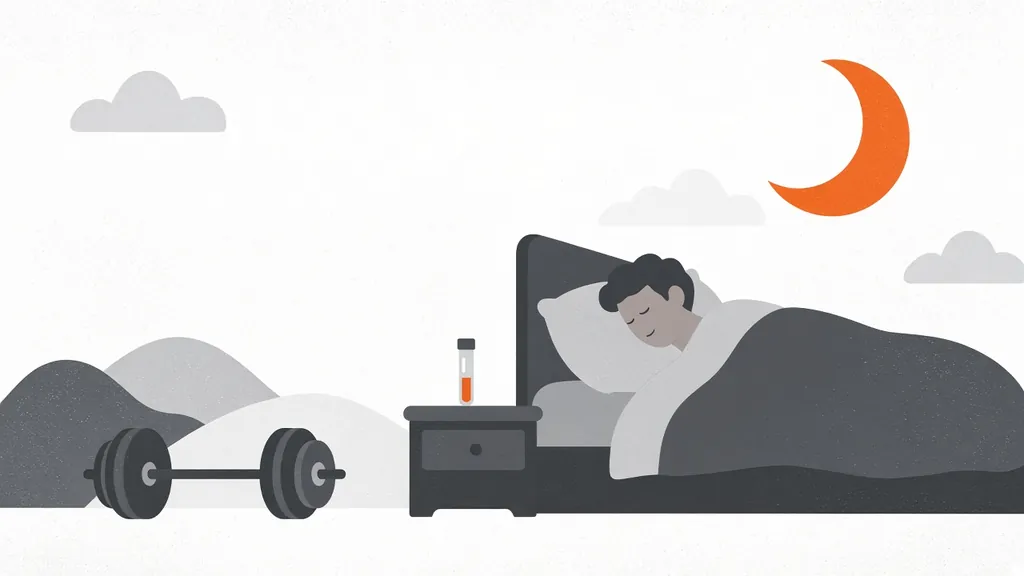
Illustrative scenario. Marco, 34, is training for an ultra while sleeping about 6 hours and eating in a large calorie deficit. He feels flat, his libido is down and an afternoon blood test shows total testosterone of 9.8 nmol/L (≈283 ng/dL). Following the Endocrine Society guideline, his doctor repeats the test on a morning sample after fasting: 11.5 nmol/L — borderline. Rather than starting therapy, they address the likely causes: he raises intake to roughly match his training load, prioritises 7.5–8 hours of sleep and cuts weekly volume by 20% for a month. The repeat test eight weeks later is within the normal range and he feels better.
Action steps
- Test total testosterone on a fasting morning sample (roughly 7–10 am).
- Confirm any low result with a repeat test before drawing conclusions.
- Check energy availability: chronic under-eating with heavy training suppresses hormones.
- Protect sleep; short sleep is linked to lower testosterone.
- Discuss symptoms and results with a doctor; do not self-prescribe testosterone or boosters.
Related guides
- Which blood tests are worth doing — a practical panel for active adults
- Overreaching and overtraining: warning signs and what to do
- How much sleep do you need? Sleep duration and sleep debt
- Strength training for endurance athletes
FAQ
Should I take boosters? Over-the-counter "boosters" have little evidence. Fix sleep, energy intake and load first; discuss persistent low values with a doctor.
Is free testosterone better? It adds detail when SHBG is unusual; your doctor can calculate it from total testosterone, SHBG and albumin.
Does heavy endurance training lower testosterone? High volumes combined with low energy intake can reduce it; restoring fuel and recovery usually helps.
Should I test free testosterone too? Your doctor may add free testosterone or SHBG when total testosterone is borderline or SHBG is likely abnormal.
Do women need testosterone testing? Sometimes, for specific symptoms such as irregular cycles; the reference ranges are very different from men's.
References
- Bhasin et al. (2018). Testosterone Therapy in Men With Hypogonadism: An Endocrine Society* Clinical Practice Guideline. The Journal of Clinical Endocrinology & Metabolism. https://doi.org/10.1210/jc.2018-00229
- Leproult et al. (2010). Role of Sleep and Sleep Loss in Hormonal Release and Metabolism. Endocrine Development. https://doi.org/10.1159/000262524
- Meeusen et al. (2013). Prevention, diagnosis and treatment of the overtraining syndrome: Joint consensus statement of the European College of Sport Science (ECSS) and the American College of Sports Medicine (ACSM). European Journal of Sport Science. https://doi.org/10.1080/17461391.2012.730061
For general information only. This is not medical advice — talk to a qualified professional about your health.
Keep reading
Recovery & sleep
Your personal baseline: why "normal for you" beats population averages
4 min read
Devices & setup
How MoveVitals handles multiple devices: provenance, duplicates and conflicts
5 min read
Recovery & sleep
Sleep hygiene: evidence-based habits for better sleep
4 min read
Devices & setup
WHOOP and MoveVitals: what syncs and how to get the most from it
3 min read
Recovery & sleep
Overreaching and overtraining: warning signs and what to do
4 min read
Devices & setup
Polar watches and MoveVitals: Polar Flow sync explained
3 min read