

Metrics explained
TSH and free T4: checking your thyroid
The thyroid sets the pace of your metabolism. Too slow and you feel tired, cold and heavy; too fast and your heart races. Two blood tests answer most questions.
Written by MoveVitals Editorial Collective
Community-authored educational content. Individual clinical review is identified only when a named review is actually recorded.
Editorial standards & corrections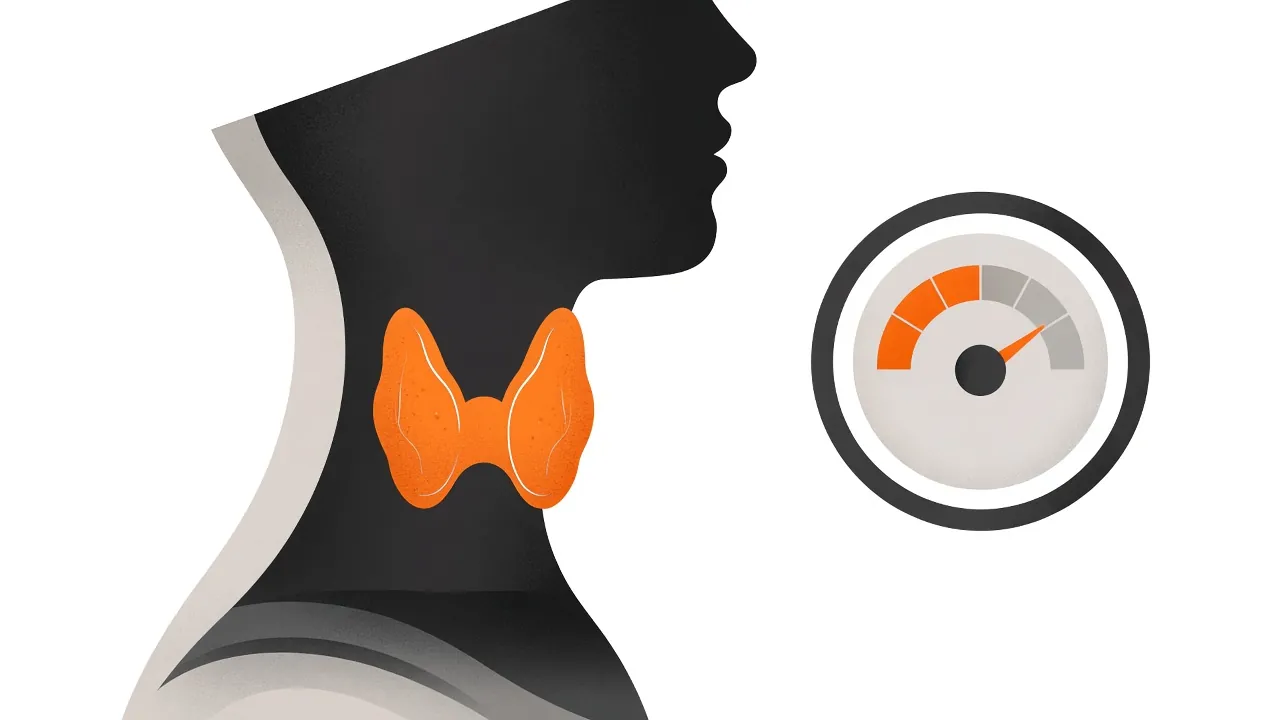
Key takeaways
- A typical adult TSH is 0.4–4.0 mIU/L and free T4 is 0.8–1.8 ng/dL; high TSH with low free T4 usually suggests hypothyroidism, and low TSH with high free T4 hyperthyroidism.
- High TSH with normal free T4 is subclinical hypothyroidism and is often monitored, so repeat an abnormal result after 6–12 weeks before acting on it.
- Biotin supplements interfere with many assays, so avoid them for 2–3 days before testing if your doctor agrees.
- An overactive thyroid often raises resting heart rate and lowers HRV, but a wearable cannot detect thyroid problems, and thyroid medication dosing is set by your doctor.
The tests
| Test | Typical adult range | Meaning |
|---|---|---|
| TSH | 0.4–4.0 mIU/L | Pituitary signal to the thyroid — high when the thyroid is underactive |
| Free T4 | 0.8–1.8 ng/dL (≈ 10–23 pmol/L) | Active thyroid hormone in circulation |
Labs differ slightly; use the range printed on your report.
| Pattern | Usually suggests |
|---|---|
| TSH high, free T4 low | Hypothyroidism |
| TSH high, free T4 normal | Subclinical hypothyroidism — often monitored |
| TSH low, free T4 high | Hyperthyroidism |
Symptoms worth testing for
Persistent fatigue, feeling cold, unexplained weight gain, constipation, dry skin (underactive); palpitations, heat intolerance, weight loss, tremor, anxiety (overactive).
What your wearables may show
An overactive thyroid often raises resting heart rate and lowers HRV; an underactive one can lower resting heart rate and slow weight loss despite training. These are clues, not diagnoses.
Testing tips
Test in the morning; avoid biotin supplements for 2–3 days beforehand (they interfere with many assays). Severe calorie restriction and very heavy training can temporarily lower T3 and T4.
In MoveVitals
Add TSH and free T4 in Body Lab under Hormones. Free T4 entered in pmol/L is converted to ng/dL.
Worked example

Illustrative scenario. Hannah notices her resting heart rate has drifted from 58 to 52 bpm over three months, she feels cold and tired, and her easy runs feel harder. A blood test shows TSH 7.2 mIU/L (above a typical reference of about 0.4–4.0) with free T4 at the low end of normal — a pattern often called subclinical hypothyroidism. Her doctor repeats the test six weeks later and checks thyroid antibodies before deciding on treatment, following the approach described in the American Thyroid Association guideline. Meanwhile she notes that her biotin supplement could distort some assays and stops it for several days before the retest, as advised.
Action steps
- Test TSH first; add free T4 (and antibodies if advised) when TSH is abnormal.
- Pause high-dose biotin for a few days before testing if your doctor agrees, as it can skew results.
- Repeat an abnormal result after 6–12 weeks before acting on it.
- Track resting heart rate, temperature and energy alongside lab values.
- Never adjust thyroid medication on your own; dosing is set by your doctor.
Related guides
- Which blood tests are worth doing — a practical panel for active adults
- Resting heart rate: normal ranges and what changes it
- Skin temperature and temperature deviation: how to read them
- Overreaching and overtraining: warning signs and what to do
FAQ
How often? Every one to two years, or when symptoms appear; more often if you're treated.
Do I need T3 or antibodies? Your doctor will add them if TSH or free T4 is abnormal.
Can hard training change thyroid tests? Severe energy deficit and illness can lower thyroid hormones; ordinary training usually has little effect on TSH.
What time of day should I test? TSH varies through the day, so testing at a similar morning time each time makes results more comparable.
Does my wearable detect thyroid problems? No. Changes in resting heart rate or temperature can be a hint, but only a blood test can assess thyroid function.
References
- Jonklaas et al. (2014). Guidelines for the Treatment of Hypothyroidism: Prepared by the American Thyroid Association Task Force on Thyroid Hormone Replacement. Thyroid®. https://doi.org/10.1089/thy.2014.0028
- Thomas et al. (2016). Position of the Academy of Nutrition and Dietetics, Dietitians of Canada, and the American College of Sports Medicine: Nutrition and Athletic Performance. Journal of the Academy of Nutrition and Dietetics. https://doi.org/10.1016/j.jand.2015.12.006
For general information only. This is not medical advice — talk to a qualified professional about your health.
Keep reading
Recovery & sleep
Your personal baseline: why "normal for you" beats population averages
4 min read
Devices & setup
How MoveVitals handles multiple devices: provenance, duplicates and conflicts
5 min read
Metrics explained
Normal heart rate variability (HRV) by age: RMSSD vs SDNN
6 min read
Devices & setup
WHOOP and MoveVitals: what syncs and how to get the most from it
3 min read
Metrics explained
Resting heart rate: normal ranges and what changes it
4 min read
Recovery & sleep
Overreaching and overtraining: warning signs and what to do
4 min read