

Metrics explained
BMI: how it's calculated, what it means and where it fails
Body mass index compares weight with height. It is a quick population screening tool, but it cannot tell muscle from fat.
Written by MoveVitals Editorial Collective
Community-authored educational content. Individual clinical review is identified only when a named review is actually recorded.
Editorial standards & corrections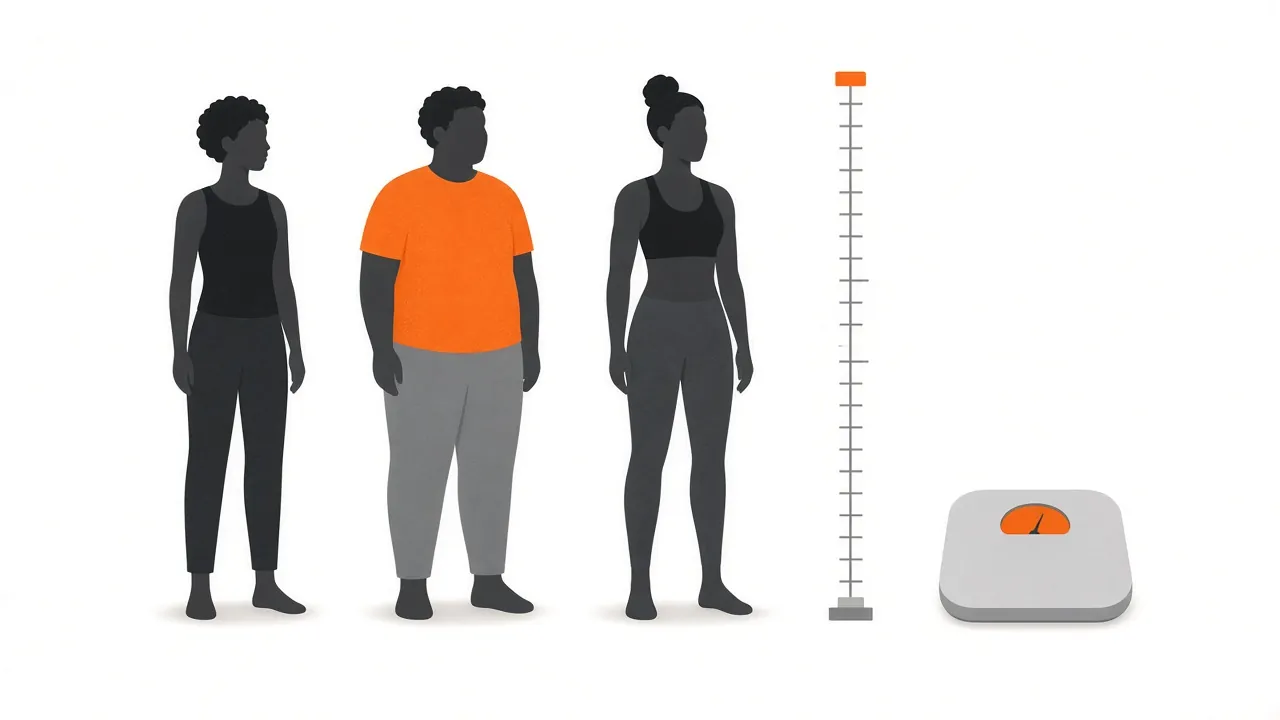
BMI calculator
BMI = kg ÷ (cm / 100)²
Educational adult estimate, calculated in your browser; inputs are not saved or sent to MoveVitals. BMI is not a body-fat measurement. Resting energy is not total daily expenditure or a calorie target; this equation is not intended for pregnancy or children.
Key takeaways
- BMI is weight in kg divided by height in metres squared, so 70 kg at 1.75 m gives about 22.9.
- WHO adult categories are underweight below 18.5, normal 18.5–24.9, overweight 25.0–29.9 and obesity from 30, while many Asian populations use lower cut-offs such as China's 24 and 28.
- A muscular athlete can count as overweight with low body fat, so pair BMI with waist size: risk rises above about 94 cm for men and 80 cm for women.
- Keeping your waist under half your height, a waist-to-height ratio below 0.5, is a simple companion target to BMI.
Body mass index (BMI) = weight (kg) ÷ height (m)². A person weighing 70 kg at 1.75 m has a BMI of 70 ÷ 3.06 ≈ 22.9.
Categories (adults)
| BMI | WHO category |
|---|---|
| < 18.5 | Underweight |
| 18.5–24.9 | Normal weight |
| 25.0–29.9 | Overweight |
| ≥ 30 | Obesity |
For many Asian populations, health risks rise at lower BMI, so lower cut-offs (e.g. ≥ 23 overweight, ≥ 27.5 obesity, or China's ≥ 24 and ≥ 28) are often used.
Where BMI falls short
- Muscle vs fat: a muscular athlete can be "overweight" with low body fat.
- Fat distribution: abdominal (visceral) fat matters more than total weight.
- Age, sex and ethnicity change what a given BMI means.
- Children and pregnancy need different references.
Better companions to BMI
- Waist circumference: risk rises above about 94 cm for men and 80 cm for women (lower thresholds in Asia).
- Waist-to-height ratio: keep your waist under half your height.
- Body fat percentage and visceral fat from a smart scale.
- Fitness markers such as VO2 max.
In MoveVitals
The calculator above uses the weight and height you enter, in kilograms and centimetres. It runs locally and does not read or save your account profile. Keep a consistent weight source when following changes.
Worked example
Worked calculation. A person who is 1.80 m and 92 kg has BMI = 92 ÷ 1.80² ≈ 28.4, which is "overweight" by WHO cut-offs. If a DEXA scan shows 14% body fat and a waist of 84 cm, that BMI mostly reflects muscle. Another person at 1.65 m and 68 kg (BMI 25.0) with a waist of 98 cm may carry more metabolic risk despite the lower BMI. Note that WHO suggests lower action points for many Asian populations.
Action steps
- Calculate BMI as weight (kg) ÷ height (m)².
- Measure waist circumference at the navel level, relaxed.
- Use waist-to-height ratio: aim for under 0.5.
- If BMI and waist disagree, consider a body-composition measure.
- Track trends monthly, not daily.
Related guides
- Body fat percentage: healthy ranges and how smart scales measure it
- Visceral fat: the fat you can't see and why it matters most
- DEXA scans: the most accurate way to measure body fat — and calibrate your scale
- Body weight: why daily numbers jump and how to read the trend
FAQ
Is BMI useless? No — it's a cheap, useful screening number. Just don't use it alone.
What BMI is best for health? In large studies the lowest risk is usually around 20–25, but fitness and waist size matter as much.
Is BMI accurate for muscular athletes? Often not; muscle raises weight, so BMI can overestimate fatness in muscular people.
Are BMI cut-offs the same for everyone? No; some health bodies use lower cut-offs for people of Asian descent because risk rises at lower BMI.
References
- Neeland et al. (2019). Visceral and ectopic fat, atherosclerosis, and cardiometabolic disease: a position statement. The Lancet Diabetes & Endocrinology. https://doi.org/10.1016/s2213-8587%2819%2930084-1
- Cruz-Jentoft et al. (2019). Sarcopenia: revised European consensus on definition and diagnosis. Age and Ageing. https://doi.org/10.1093/ageing/afy169
For general information only. This is not medical advice — talk to a qualified professional about your health.
Keep reading
Devices & setup
How MoveVitals handles multiple devices: provenance, duplicates and conflicts
5 min read
Metrics explained
Resting heart rate: normal ranges and what changes it
4 min read
Devices & setup
Withings and MoveVitals: scales, blood pressure and sleep
3 min read
Metrics explained
Normal heart rate variability (HRV) by age: RMSSD vs SDNN
6 min read
Metrics explained
VO2 max: what it means and how to improve it
4 min read
Metrics explained
Heart rate zones explained: how to set and use them
4 min read