

Key takeaway
Pooling 16 prospective cohort studies of adults, people who did muscle-strengthening activity had a 15% lower risk of all-cause mortality (RR 0.85, 95% CI 0.79 to 0.93) and a 17% lower risk of both cardiovascular disease and diabetes (RR 0.83 for each) than people who did none. The pooled mortality curve was lowest at about 40 min/week (RR 0.83), but whether larger amounts help or hurt is unclear. All of this is observational, from mostly US self-reported data, and the authors rated the certainty of evidence as very low for most outcomes.
Study design
Observational meta-analysis
Reading basis
Full text
Reading focus
Design & applicability
The research question
Several national and international guidelines, including the recent WHO guidelines, advise adults to do muscle-strengthening activity on at least 2 days a week, largely because of its benefits for the musculoskeletal system. Muscle strength is known to be linked to a lower risk of death and of non-communicable diseases such as cardiovascular disease and cancer, so strengthening exercise might help prevent premature death, but it has been studied far less than aerobic exercise. The first meta-analysis (11 studies) found lower all-cause mortality but no clear link with cardiovascular or cancer mortality, a later one found lower kidney cancer incidence, and neither measured how much activity is needed. With countries such as Japan revising their guidelines and debating whether to include strengthening exercise, the authors set out to update the evidence: to compare any versus no muscle-strengthening activity independent of aerobic activity, to quantify the dose–response curve, and to see what the combination with aerobic activity adds.
Who and how
This was a systematic review and meta-analysis of prospective cohort studies, registered in advance in the PROSPERO database and reported under the MOOSE and PRISMA 2020 guidelines. The authors searched MEDLINE and Embase from their inception to 25 October 2020 (updated in June 2021), screened 1252 records after removing duplicates, read 47 in full and included 16 studies, published between 2012 and 2020. Eligible studies followed adults aged 18 or older, free of severe conditions such as cancer or disability at baseline, for at least 2 years and examined muscle-strengthening activity independent of and in combination with aerobic activity. Most studies were from the USA, with the others from England and Scotland, Australia and Japan; sample sizes ranged from 3809 to 479,856 participants and ages from 18 to 97.8 years, with a maximum follow-up duration of 25.2 years (median). Thirteen studies measured muscle-strengthening activity by self-report and three by interview, and all focused on resistance, strength or weight training and callisthenics rather than carrying heavy loads or heavy gardening. The comparison was no muscle-strengthening activity.
The outcomes were all-cause mortality, cardiovascular disease (mostly deaths, with some studies also counting non-fatal events), total cancer (mostly deaths, with one study of incidence), diabetes incidence and five site-specific cancers. Two authors screened studies independently and three extracted data with cross-checking, taking the most adjusted estimates; most studies adjusted for age, body mass index, alcohol intake and smoking. Hazard ratios were treated as relative risks (RR), as was the one study that reported odds ratios, and study quality was scored on a modified Newcastle–Ottawa Scale (4 to 7 stars out of a possible 8). Any-versus-none comparisons used a DerSimonian and Laird random-effects model. The dose–response meta-analysis used the Greenland–Longnecker and Orsini method with restricted cubic splines (three knots at the 10th, 50th and 90th percentiles of exposure time) and a Wald test for non-linearity, and a joint analysis compared combined muscle-strengthening and aerobic activity with neither. Heterogeneity was measured by I², leave-one-out and subgroup analyses were run where enough studies existed, and certainty of evidence was graded with GRADE. Tests for publication bias were not done because there were too few studies.
What it found
- 1People who did any muscle-strengthening activity had a lower risk of death from any cause. In seven studies with 42,133 deaths among 263,058 participants, the pooled relative risk was 0.85 (95% CI 0.79 to 0.93, p<0.001), a 15% lower risk. Heterogeneity was high (I²=83.0%, p<0.001), but every study pointed the same way, and excluding the study that reported odds ratios gave RR 0.84 (95% CI 0.76 to 0.92).
- 2The association extended to several diseases, but not all cancers. Muscle-strengthening activity was linked to a 17% lower risk of cardiovascular disease (RR 0.83, 95% CI 0.73 to 0.93, p=0.002; 7 studies), a 12% lower risk of total cancer (RR 0.88, 95% CI 0.80 to 0.97, p=0.008; 6 studies), a 17% lower incidence of diabetes (RR 0.83, 95% CI 0.77 to 0.89, p<0.001; 5 studies) and a 10% lower incidence of lung cancer (RR 0.90, 95% CI 0.83 to 0.98, p=0.01; 2 studies). No clear association appeared for colon (RR 0.96, 95% CI 0.91 to 1.01), kidney (RR 0.88, 95% CI 0.76 to 1.02), bladder (RR 0.94, 95% CI 0.84 to 1.05) or pancreatic cancer (RR 1.12, 95% CI 0.98 to 1.28).
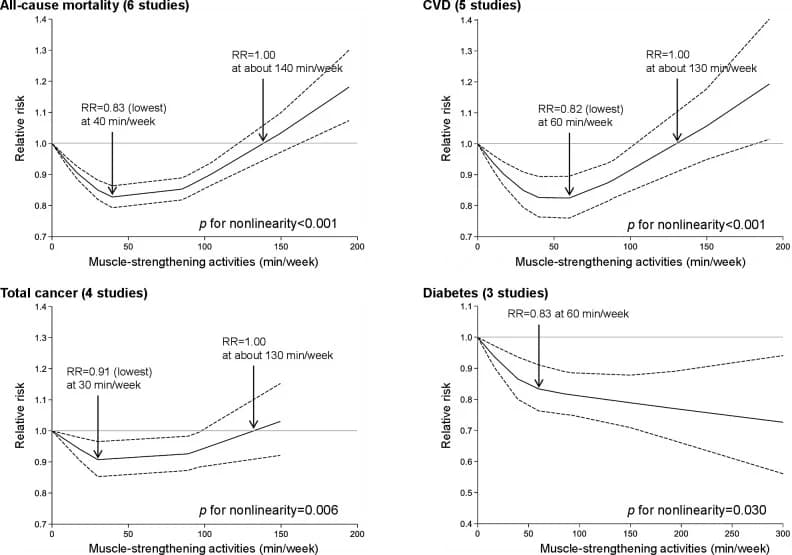
- 3More is not clearly better: for deaths, heart disease and cancer the curves were J-shaped, bottoming out at about 30 to 60 minutes a week. The lowest relative risk was 0.83 (95% CI 0.79 to 0.86) at 40 min/week for all-cause mortality, 0.82 (95% CI 0.76 to 0.90) at 60 min/week for cardiovascular disease and 0.91 (95% CI 0.85 to 0.97) at 30 min/week for total cancer, with estimates still below 1.00 up to roughly 130 to 140 min/week. A straight-line trend per 10 extra min/week was not clear (all-cause mortality RR 0.99, 95% CI 0.98 to 1.00, p=0.05), and the authors say the effect of a higher volume is unclear.
- 4For diabetes the curve was L-shaped, with most of the benefit coming early. Each extra 10 min/week of muscle-strengthening activity was linked to a lower diabetes risk (RR 0.98, 95% CI 0.97 to 0.99, p=0.003; 3 studies, 7511 cases among 167,072 participants), and the risk fell markedly up to 60 min/week before declining gradually.
- 5Combining muscle-strengthening with aerobic activity was linked to the lowest risks. Compared with doing neither, the combination was associated with a 40% lower risk of all-cause mortality (RR 0.60, 95% CI 0.54 to 0.67; 3 studies, 68,637 cases among 581,194 participants), a 46% lower risk of cardiovascular disease death (RR 0.54, 95% CI 0.41 to 0.70) and a 28% lower risk of total cancer death (RR 0.72, 95% CI 0.53 to 0.98). Because the reference group differs, these figures are not directly comparable with the strengthening-only estimates above.
- 6The results were fairly stable but the evidence is graded weak. Leaving out any single study did not substantially change the all-cause mortality or total cancer results, and heterogeneity for cardiovascular disease fell from I²=72.9% to 0.0% when one study (Liu et al) was excluded. Certainty of evidence was graded very low for all outcomes except diabetes (low), mainly because most studies came from the USA.
Limits & uncertainty
- 1The authors note that the main limitation is the small number of studies (5 to 7 per main outcome and only 2 per site-specific cancer). This prevented most subgroup analyses and tests for publication bias, so the pooled estimates might be overestimated, and the lung cancer finding rests on only two studies.
- 2The authors note that muscle-strengthening activity was measured by self-report questionnaire or interview, which may add to the heterogeneity seen, and that most studies were done in the USA, which limits generalisability and was the main reason the evidence was downgraded.
- 3The authors note that these are observational studies, so residual, unknown and unmeasured confounding may remain, and that only two databases were searched, so relevant studies may have been missed.
- 4Our observation: the dose–response curves rest on only 3 to 6 studies each, with exposure minutes assigned from category midpoints and open-ended categories, so the dip at 30 to 60 min/week and the apparent upturn at higher volumes are imprecise. The authors also could not examine how often people trained directly.
- 5Our observation: outcomes were not uniform across studies (for example cardiovascular disease and total cancer were mostly deaths, one study counted total cancer incidence, and heterogeneity was I²=72.9% to 83.0% for all-cause mortality, cardiovascular disease and total cancer). People who lift weights regularly may also differ in health habits and baseline health in ways that adjustment cannot fully remove.
What to take from it
These data are consistent with guidelines that suggest adults do muscle-strengthening activity at least twice a week: across the studies, even a modest weekly amount (the risk dipped around 30 to 60 minutes a week) was associated with lower rates of death, cardiovascular disease, cancer and diabetes. The combination of strength and aerobic activity was linked to the lowest risks, so strength work is best seen as an addition to aerobic activity, not a replacement for it.
This does not show that strength training itself lowers these risks, because people who train may differ in other ways. It also does not show that more than about an hour a week is harmful; estimates stayed below 1.00 up to roughly 130 to 140 min/week, and the authors call the effect of higher volumes unclear. The evidence was graded very low for most outcomes (low for diabetes), so treat it as supportive, not decisive. Anyone with a health condition should check with a clinician before changing their training.
Reading your own data
Log each strength session and the weekly minutes of strength work, using your watch's strength-training workout type with the same settings from week to week. Watch-recorded minutes include rests between sets, so they will not match the questionnaire minutes in these studies; compare your own weeks with each other rather than with the 30 to 60 minute figures. Missing workout data does not mean no activity occurred, so remember to start the workout, and track aerobic activity alongside because the combination was linked to the lowest risks.
How to read this evidence
Pooling observational studies does not remove their confounding. Check overlapping cohorts and whether relative effects are being confused with absolute benefits.
Sources & attribution
Muscle-strengthening activities are associated with lower risk and mortality in major non-communicable diseases: a systematic review and meta-analysis of cohort studies
British Journal of Sports Medicine · 2022-07
DOI: 10.1136/bjsports-2021-105061 ↗PubMed · 35228201 ↗MoveVitals editorial interpretation · educational content · no individual clinical review recorded
Sources checked 2026-11-01
Practical guides
Read in context
ACSM review of 137 reviews: resistance training works, and few programme details matter
The American College of Sports Medicine pooled 137 systematic reviews (over 30,000 healthy adults) and concluded that resistance training beats no exercise for strength, muscle size, power, endurance and several function tests. Few programme details changed results consistently: heavier loads (80% or more of one-repetition maximum) and 2 to 3 sets favoured strength, and at least 10 sets a week favoured muscle size, while training to failure, exercise type and periodization did not. It summarises reviews rather than new trials, gives no pooled effect sizes, and drew mostly on untrained adults and overlapping source trials.
Medicine & Science in Sports & Exercise
Nearly every resistance training plan beat no exercise; heavy loads led for strength
In a network meta-analysis of randomised trials in healthy adults (178 studies and 5097 people for strength, 119 studies and 3364 people for muscle size), nearly all resistance training prescriptions beat no exercise. Higher-load, multiset, thrice-weekly training ranked best for strength (standardised mean difference 1.60, 95% credible interval 1.38 to 1.82) and higher-load, multiset, twice-weekly training for muscle size (0.66, 0.47 to 0.85). Most prescriptions could not be statistically separated from each other (the 95% interval contained zero in 91% of the comparisons between them) and risk of bias was moderate to high, so the rankings are tentative.
British Journal of Sports Medicine
Protein supplements and weight training: small extra gains, smaller in older adults
Pooling 49 randomised trials with 1,863 healthy adults who did resistance training for at least 6 weeks, protein supplements added 0.30 kg of fat-free mass (95% CI 0.09 to 0.52) and 2.49 kg of one-repetition-maximum strength (0.64 to 4.33) on top of training alone. These gains were small next to the effect of training itself, were weaker with older age, and the suggested plateau near 1.6 g/kg/day was not statistically significant (p=0.079). One author has received funding from the US National Dairy Council, which supported trials in the analysis.
British Journal of Sports Medicine
Weight loss in frail older adults: aerobic plus strength training improved function most
In a 6-month trial of 160 obese, mildly to moderately frail adults aged 65 or older, a weight-loss programme plus combined aerobic and resistance exercise raised the Physical Performance Test score by 5.5 points, against 3.9 points for either exercise type alone and 1.0 for controls. Every exercise group still lost lean mass, and all but the resistance group lost hip bone density, so the combined programme softened these losses rather than preventing them. The volunteers were screened, trained under supervision and were mostly white, well-educated women.
The New England Journal of Medicine