

Key takeaway
In a meta-analysis of 52 randomised trials, cold-water immersion after high-intensity exercise was followed 24 hours later by lower soreness (SMD −0.89), higher perceived recovery (0.66) and better muscular power (0.22), with no effect on strength. Participants could not be blinded, most were men, and many pooled results rest on few studies with high heterogeneity.
Study design
Evidence review
Reading basis
Full text
Reading focus
Design & applicability
The research question
Cold-water immersion is a cheap, widely used recovery method, yet trials of it have given mixed results. Earlier meta-analyses pooled different cooling methods, exercise types, study designs and recovery times, which inflated heterogeneity, and the one attempt to find an optimum protocol (11–15 °C for 11–15 minutes) rested on fewer than 4 studies per analysis. This review asked whether cold-water immersion beats passive recovery after a single bout of strenuous exercise in physically active adults. It looked separately at eccentric and high-intensity exercise, at each time point after exercise, and at whether water temperature or immersion time changes the benefit.
Who and how
This is a systematic review with meta-analysis and meta-regression, registered in advance with the Open Science Framework and reported to PRISMA standards. The authors searched seven databases (Medline, SPORTDiscus, Scopus, Web of Science, Cochrane Library, EmCare and Embase) up to 20 September 2021. From 4849 records plus 6 found through reference lists, 52 randomised controlled trials were included. Participants were adults over 18 who exercised regularly or played sport. Immersion had to start within 15 minutes after a single strenuous bout, and the comparator was passive recovery with no intervention; trials that combined immersion with other treatments such as compression garments or active recovery were excluded. Studies were split into eccentric exercise (muscle-lengthening efforts such as drop jumps) and high-intensity exercise (such as intermittent running or match simulations). Quality was rated with the SIGN checklist: 11 studies were high quality, 37 acceptable and 4 low quality.
Outcomes were muscular power (jumps, sprints and anaerobic efforts under 10 seconds), strength (mostly isometric tests), endurance and flexibility performance, delayed onset muscle soreness (DOMS), perceived recovery and blood creatine kinase (CK, a marker of muscle damage), measured from 1 hour up to 168 hours after exercise. Results are standardised mean differences (SMD, with Hedges' correction) from random-effects models, with 95% confidence intervals; the authors call 0.20–0.60 small, 0.61–1.20 moderate and 1.21–2.00 large. Parallel and crossover trials were combined with a published method for crossover data, heterogeneity was summarised with I², and certainty was graded with GRADE, which downgrades for fewer than 100 participants, high heterogeneity or more than half the studies being low quality. Meta-regression tested water temperature and immersion duration as continuous moderators.
What it found
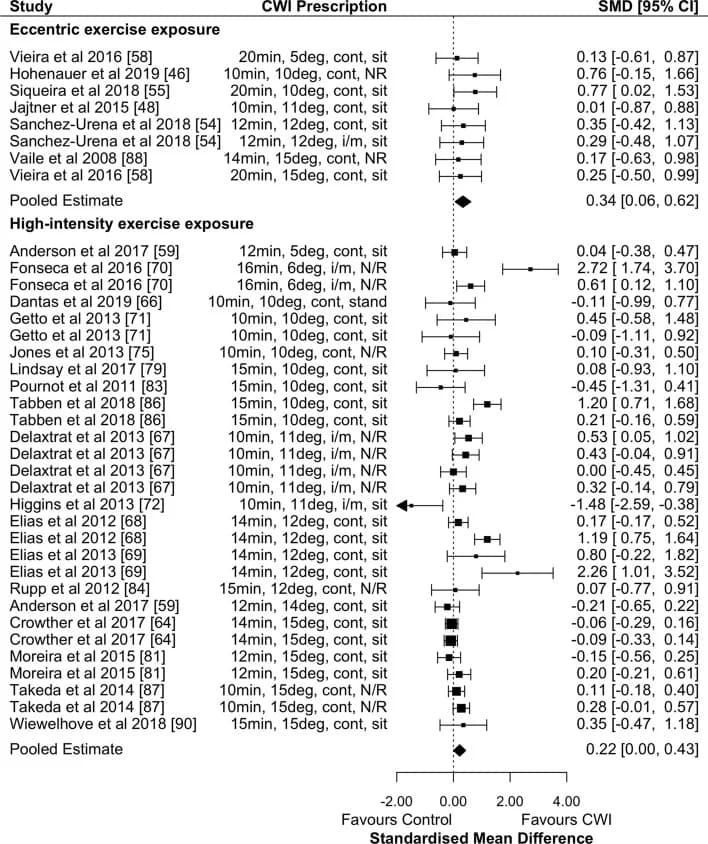
- 1After high-intensity exercise such as running and team-sport simulations, cold-water immersion beat passive recovery on four outcomes 24 hours later: muscular power (SMD 0.22, 95% CI 0.004–0.43, p = 0.046), muscle soreness (SMD −0.89, 95% CI −1.48 to −0.29, p = 0.003), perceived recovery (SMD 0.66, 95% CI 0.29–1.03, p = 0.001) and serum CK (SMD −0.85, 95% CI −1.61 to −0.08, p = 0.030). Certainty was moderate, and heterogeneity was high for power and soreness (I² 74.6% and 77.4%).
- 2After eccentric exercise the pattern differed: power recovered better at 24 hours (SMD 0.34, 95% CI 0.06–0.62, p = 0.018, high certainty, I² 0%), and the gap was still there at 48 hours (SMD 0.47, 95% CI 0.22–0.73) and 72 hours (SMD 0.62, 95% CI 0.27–0.98). Soreness was not clearly lower at 24 hours (SMD −0.51, 95% CI −1.10 to 0.09, p = 0.094) but was at 48, 72 and 96 hours (SMD −0.48, −0.55 and −0.41), and CK was unchanged at 24 hours (SMD 0.12, 95% CI −0.31 to 0.54).
- 3Strength showed no benefit after either type of exercise: SMD 0.74 (95% CI −0.78 to 2.26) at 24 hours after eccentric exercise and 0.12 (95% CI −0.38 to 0.62) after high-intensity exercise. Endurance performance after high-intensity exercise also did not improve (SMD −0.14, 95% CI −0.40 to 0.13, very low certainty), and flexibility showed no significant change at any time point.
- 4The benefits after high-intensity exercise were short-lived. Power was unchanged at 48 hours (SMD −0.02, 95% CI −0.12 to 0.07), perceived recovery was unchanged at 48 hours (SMD −0.02, 95% CI −0.38 to 0.34) and soreness was no longer lower at 72 hours (SMD 0.09, 95% CI −0.40 to 0.59), although soreness was lower at 1 hour (SMD −1.10) and 48 hours (SMD −0.82).
- 5Shorter and colder immersion looked better after high-intensity exercise, but only for some outcomes. For CK, the effect size decreased by 0.28 for each extra minute of immersion at 24 hours (95% CI −0.09 to −0.47; p = 0.004) and by 0.51 for each extra minute and each 1 °C rise in temperature at 48 hours (95% CI −0.25 to −0.77; p < 0.001); for endurance at 24 hours it decreased by 0.15 per minute (95% CI −0.06 to −0.24; p = 0.001). Temperature and duration did not significantly moderate other outcomes.
Limits & uncertainty
- 1The authors note that participants and researchers cannot be blinded to cold-water immersion, so expectation and placebo effects could inflate soreness and perceived recovery. Randomisation was also poorly reported: only 11 studies described it adequately and only 4 concealed treatment groups from the research team.
- 2The authors note that the evidence is mostly in men (4 female-only studies against 44 male-only), that most strength tests were isometric, and that very few studies examined endurance or flexibility, so those null results are weak.
- 3Our observation: many analyses rest on only 2 to 5 studies, several headline results are borderline (the lower bound of the power result after high-intensity exercise is 0.004, with I² 74.6%), and the methods describe no adjustment for the dozens of outcome-by-time tests. Isolated findings, such as the CK result at 168 hours after eccentric exercise from 2 studies, deserve caution.
- 4Our observation: the dose–response results come from comparing studies that differ in many other ways, and for endurance all but one study used 15 °C, so temperature could not be tested there. They should be read as a lead, not a protocol.
- 5Our observation: the review covers one immersion after one hard session, with follow-up up to 168 hours, and excluded training programmes with more than one session. It says nothing about regular use across a training block or about long-term adaptation.
What to take from it
If you already use cold-water immersion, this evidence supports a narrow role: after hard intermittent or high-intensity sessions it may leave you less sore and feeling more recovered the next day, and may help jump or sprint power at 24 hours. It did not improve strength recovery, and the evidence for endurance and flexibility is thin. The review hints that shorter, colder immersions may work better after high-intensity exercise, but that rests on a few studies and does not justify a specific protocol.
Do not conclude that cold-water immersion speeds long-term training gains, protects against injury or is needed for ordinary training. The review covered single sessions, mostly in men, and feeling better can partly reflect expectation. Certainty was moderate for most headline results and high for eccentric power at 24 hours, but many other estimates are imprecise.
Reading your own data
Wearable metrics such as HRV, resting heart rate and sleep were not outcomes in these trials, so the review cannot say whether a cold dip changes them. A fair self-test is to use the same jump or sprint test and a 0–10 soreness rating at the same time of day, 24 hours after similar sessions with and without immersion, and to log water temperature and minutes. Keep soreness ratings separate from performance because they can move in different directions, and compare several sessions of the same type rather than one.
How to read this evidence
Check which designs were included, how searches and bias assessment were conducted, and the last search date. Publication date alone does not make the underlying evidence current.
Authors’ structured abstract English
The attributed English abstract is reproduced under the recorded open licence. It is source material, not a MoveVitals interpretation. The prepared analysis above separates the authors’ findings from our interpretation.
Background
Studies investigating the effects of cold-water immersion (CWI) on the recovery of athletic performance, perceptual measures and creatine kinase (CK) have reported mixed results in physically active populations.
Objectives
The purpose of this systematic review was to investigate the effects of CWI on recovery of athletic performance, perceptual measures and CK following an acute bout of exercise in physically active populations.
Study design
Systematic review with meta-analysis and meta-regression.
Methods
A systematic search was conducted in September 2021 using Medline, SPORTDiscus, Scopus, Web of Science, Cochrane Library, EmCare and Embase databases. Studies were included if they were peer reviewed and published in English, included participants who were involved in sport or deemed physically active, compared CWI with passive recovery methods following an acute bout of strenuous exercise and included athletic performance, athlete perception and CK outcome measures. Studies were divided into two strenuous exercise subgroups: eccentric exercise and high-intensity exercise. Random effects meta-analyses were used to determine standardised mean differences (SMD) with 95% confidence intervals. Meta-regression analyses were completed with water temperature and exposure durations as continuous moderator variables.
Results
Fifty-two studies were included in the meta-analyses. CWI improved the recovery of muscular power 24 h after eccentric exercise (SMD 0.34 [95% CI 0.06-0.62]) and after high-intensity exercise (SMD 0.22 [95% CI 0.004-0.43]), and reduced serum CK (SMD - 0.85 [95% CI - 1.61 to - 0.08]) 24 h after high-intensity exercise. CWI also improved muscle soreness (SMD - 0.89 [95% CI - 1.48 to - 0.29]) and perceived feelings of recovery (SMD 0.66 [95% CI 0.29-1.03]) 24 h after high-intensity exercise. There was no significant influence on the recovery of strength performance following either eccentric or high-intensity exercise. Meta-regression indicated that shorter time and lower temperatures were related to the largest beneficial effects on serum CK (duration and temperature dose effects) and endurance performance (duration dose effects only) after high-intensity exercise.
Conclusion
CWI was an effective recovery tool after high-intensity exercise, with positive outcomes occurring for muscular power, muscle soreness, CK, and perceived recovery 24 h after exercise. However, after eccentric exercise, CWI was only effective for positively influencing muscular power 24 h after exercise. Dose-response relationships emerged for positively influencing endurance performance and reducing serum CK, indicating that shorter durations and lower temperatures may improve the efficacy of CWI if used after high-intensity exercise.
Funding
Emma Moore is supported by a Research Training Program (Domestic) Scholarship from the Australian Commonwealth Department of Education and Training.
Protocol registration
Open Science Framework: 10.17605/OSF.IO/SRB9D.
Sources & attribution
Impact of Cold-Water Immersion Compared with Passive Recovery Following a Single Bout of Strenuous Exercise on Athletic Performance in Physically Active Participants: A Systematic Review with Meta-analysis and Meta-regression
Moore E, Fuller JT, Buckley JD, Saunders S, Halson SL, Broatch JR, Bellenger CR.
Sports Medicine · 2022-07
DOI: 10.1007/s40279-022-01644-9 ↗PubMed · 35157264 ↗Europe PMC · Recorded licence: cc by ↗Abstract © the original authors, reproduced under the recorded open licence. Translations support reading; use the English record to check terminology and numerical results. Our methodological interpretation is separate from the authors’ conclusions.
MoveVitals editorial interpretation · educational content · no individual clinical review recorded
Sources checked 2026-11-01
Practical guides
Read in context
Cold-water immersion: no strength gain, briefly weaker jumps, soreness relief uncertain
Across 22 randomised trials (375 participants, mostly men), one cold-water immersion after exercise did not change maximal isometric strength (g 0.08, 95% CI −0.11 to 0.26) and was followed by weaker jumping straight afterwards (g −0.68), gone by 24–48 hours. Lower soreness and creatine kinase looked favourable but weakened in sensitivity checks, and certainty was low to very low.
PeerJ
Short-term HRV was higher during slow breathing in 962 military men, injured or not
In 962 military men (median age 37.6 years), every short-term heart rate variability (HRV) measure was higher during slow breathing at six breaths a minute than during spontaneous breathing, injured or not; in fast resting breathers RMSSD rose from 15.57 to 21.89 ms. It was one session in a fixed order, so it shows an immediate effect, not lasting benefit.
European Journal of Applied Physiology
Acute:chronic workload ratio: no evidence it can reduce injury risk, authors argue
The authors argue there is no evidence for using the acute:chronic workload ratio (ACWR) in training-load management or to reduce injury risk: no study has properly estimated a causal effect, and the ratio is statistically inaccurate and ambiguous. This is a methodological critique, not a new data analysis, so it does not show that training load is unrelated to injury.
International Journal of Sports Physiology and Performance
Heart rate variability: 24-hour, 5-minute and ultra-short readings are not interchangeable
An expert overview of heart rate variability (HRV) concludes that 24-hour, 5-minute and ultra-short readings measure different things, so norms for one cannot be applied to another; pooled 5-minute norms from 21,438 healthy adults averaged 50 ms for SDNN and 42 ms for RMSSD. It is a narrative review, not a trial, and it tests no consumer wearable.
Frontiers in Public Health