

Key takeaway
Among 25,241 UK Biobank adults who reported no leisure-time exercise, a median of 3 vigorous bouts of 1 or 2 minutes a day, picked up by a wrist accelerometer, was associated with a 38% to 40% lower risk of all-cause and cancer death and a 48% to 49% lower risk of cardiovascular death than no such bouts, over an average of 6.9 years and 852 deaths. This is an observational study using one week of wrist data and an algorithm to define vigorous effort, so it cannot show that adding such bursts causes the lower risk.
Study design
Cohort study
Reading basis
Full text
Reading focus
Association & confounding
The research question
Current guidelines say that all activity counts, whatever the length of each bout, replacing earlier advice that gave no credit to bouts under 10 minutes; but the evidence behind both versions came mostly from questionnaires, which capture longer bouts and leisure-time exercise such as gym sessions, running and sports. Vigorous activity gives more benefit per minute, yet structured vigorous exercise is neither feasible nor appealing for most middle-aged adults. The authors focused on vigorous intermittent lifestyle physical activity (VILPA): brief, sporadic bursts of vigorous effort within daily life, such as very fast walking while commuting or climbing stairs, which wearables can detect and questionnaires cannot. No cohort study had examined VILPA and mortality, so they tested how much daily VILPA, in minutes and in number of bouts, is associated with all-cause, cardiovascular disease and cancer mortality in people who reported no exercise, and compared it with vigorous activity in people who did exercise.
Who and how
This was a prospective cohort analysis in the UK Biobank, which enrolled adults aged 40 to 69 between 2006 and 2010. Between 2013 and 2015, a median of 5.5 years after baseline, 103,684 participants wore a wrist accelerometer for 7 days. Participants needed at least 3 valid days (more than 16 hours of wear, with at least one weekend day), and people who could not walk were excluded. The core sample was 25,241 nonexercisers: people who had reported, on a baseline touchscreen questionnaire, no leisure-time exercise and no more than one recreational walk a week (mean age 61.8 years, SD 7.6; 14,178 women and 11,063 men). VILPA was identified by a random forest classifier that labelled 10-second windows of wrist acceleration, counting walking at 400 milli-gravity or more as vigorous; a bout of up to 2 minutes needed 12 consecutive vigorous windows, and the classifier was checked in independent samples of 98 and 151 adults. Bouts of up to 1 and up to 2 minutes were studied because, in an unpublished laboratory study of 58 adults, reaching vigorous intensity took on average 73.5 seconds (SD 26.2). The exposures were the average daily minutes of VILPA and the daily number of length-standardised bouts (each counted as 1 or 2 minutes); the comparison was no VILPA, which applied to 11.2% of the sample. The same analyses were repeated for vigorous activity in 62,344 exercisers (35,290 women and 27,054 men).
The outcomes were all-cause, cardiovascular disease (CVD) and cancer mortality, obtained by linkage to NHS Digital, the NHS Central Register and National Records of Scotland up to 31 October 2021: 852 deaths (266 CVD and 511 cancer) over a mean follow-up of 6.9 years (SD 0.8; 175,528 person-years). Cox models were used for all-cause mortality and Fine-Gray models, which account for competing causes of death, for CVD and cancer. Dose-response curves used splines with knots at the 10th, 50th and 90th percentiles, VILPA values were capped at the 97.5th percentile, and deaths in the first 2 years were excluded. Models adjusted for age, sex, light and moderate activity, longer vigorous bouts, smoking, alcohol, sleep, fruit and vegetable intake, education, parental history of CVD and cancer, medication use, and prevalent CVD and cancer. The authors report a minimal dose (the amount linked to 50% of the optimal risk reduction) and hazard ratios at the median and maximum VILPA. Sensitivity analyses added body mass index, excluded 1,223 people with poor self-rated health, restricted the sample to 10,230 stricter nonexercisers, and calculated E-values for unmeasured confounding.
What it found
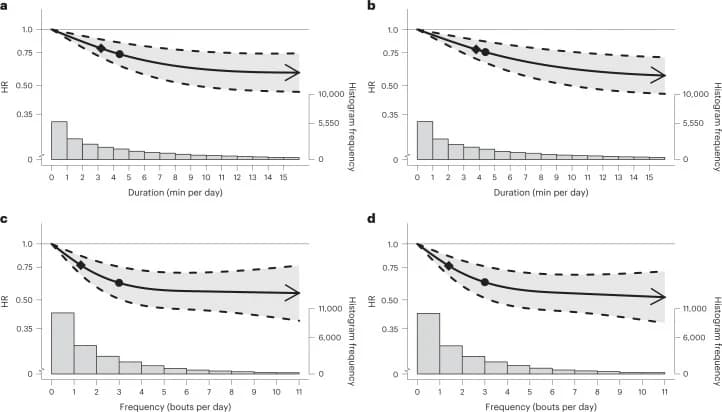
- 1More VILPA went with lower mortality in a near-linear way. Compared with no VILPA, the sample median of 3 length-standardised bouts a day (1 or 2 minutes each) was associated with 38% to 40% lower all-cause and cancer mortality and 48% to 49% lower CVD mortality. The median daily duration of 4.4 minutes was associated with 26% to 30% lower all-cause and cancer mortality and 32% to 34% lower CVD mortality.
- 2For all-cause mortality (bouts up to 1 minute), the minimal dose of 1.5 bouts a day had a hazard ratio of 0.75 (95% CI 0.66 to 0.85), the median frequency 0.61 (0.50 to 0.74) and the maximum 0.52 (0.37 to 0.72). By duration, 3.4 minutes a day gave 0.78 (0.70 to 0.86), the median 0.73 (0.63 to 0.85) and the maximum 0.59 (0.46 to 0.74). The drop was steepest at the low end, with gains continuing at higher amounts, and bouts up to 2 minutes gave similar results.
- 3CVD mortality showed the strongest associations. The minimal dose of 1.4 bouts a day had a hazard ratio of 0.67 (0.52 to 0.86), the median frequency 0.51 (0.35 to 0.74) and the maximum 0.35 (0.15 to 0.81). By duration, 3.4 minutes a day gave 0.73 (0.58 to 0.91), the median 0.66 (0.50 to 0.88) and the maximum 0.45 (0.29 to 0.72).
- 4Cancer mortality followed the all-cause pattern. The minimal dose of 1.5 bouts a day had a hazard ratio of 0.75 (0.63 to 0.88); by duration, 3.4 minutes a day gave 0.76 (0.66 to 0.87), the median 0.70 (0.59 to 0.84) and the maximum 0.51 (0.38 to 0.69).
- 5Vigorous activity in exercisers looked almost the same. Their dose-response curves overlapped almost completely with those of the nonexercisers, with only a modest difference in the minimal dose for all-cause mortality (4.8 versus 3.4 minutes a day).
- 6Checks did not change the picture. Excluding people with poor self-rated health (n=1,223), adding body mass index, and using the stricter nonexerciser definition (n=10,230) gave consistent results. For the all-cause estimates to be null, an unmeasured confounder would need a hazard ratio of 1.87 (lower CI 1.54) to 3.26 (2.12) with both VILPA and mortality.
Limits & uncertainty
- 1The authors note that they cannot entirely rule out reverse causation, where illness limits both bursts of effort and survival, although the results held after excluding early deaths and people in poor health. In our reading, the group with no VILPA was older (mean age 64.7 years against 59.7 in the group with the most bouts) and heavier (mean BMI 29.6 against 26.3), so some differences may remain after adjustment.
- 2The authors note that wrist-worn accelerometers may not capture some VILPA, such as carrying heavy shopping bags, and that signal and alignment uncertainties may persist; vigorous effort here is the output of an algorithm, not a measurement of heart rate or oxygen use. Activity was recorded for only one week.
- 3The authors note that nonexerciser status came from a questionnaire answered an average of 5.5 years before the accelerometer, and that it is subject to self-report error; 82% of a subsample of 2,407 reported the same status at both time points.
- 4The authors note that the UK Biobank response rate was 5.5% and that the cohort is not representative, though they cite work suggesting this does not materially affect activity-mortality associations. In our reading, 96.2% of the sample was White, so the findings may not carry over to other groups.
- 5In our reading, the estimates at the highest VILPA amounts are imprecise (for example a CVD hazard ratio of 0.35, 95% CI 0.15 to 0.81), because only 266 deaths were from CVD and VILPA values were capped at the 97.5th percentile.
What to take from it
For people who do not exercise formally, these results suggest that very short, hard efforts built into the day, such as fast walking for a minute or two or taking stairs briskly, may be worth adding. In this cohort even 1.5 bouts or 3.4 minutes a day was associated with a hazard ratio of 0.75 or 0.78 for all-cause mortality, and the authors note that the median of 4.4 minutes a day is just under 31 minutes of vigorous activity a week. Exercisers showed a very similar curve, so the effort level seems to matter whether or not you also train.
The findings do not show that three bursts a day will lower your own risk by 38% to 40%: they compare groups who differ in age and health, from one week of wrist data. Nor do they show that bursts can replace advice from your clinician. What counts as vigorous depends on fitness, and anyone with a heart condition or symptoms should talk to their clinician before adding hard efforts. Confidence is moderate: the pattern was consistent across three causes of death and several checks, but it remains observational.
Reading your own data
The study counted VILPA from wrist acceleration with its own algorithm, not from heart rate, so a watch's vigorous minutes or high heart-rate zone minutes use different rules and will not match. A practical approach is to tally, over 2 to 4 weeks, how many times a day you push hard for 1 or 2 minutes, such as fast stairs or hurrying uphill, and compare weekly averages from the same device. Be aware that reaching vigorous intensity took about 73.5 seconds on average in the laboratory work, so a heart-rate view may lag behind or undercount such short bursts, and wrist devices can miss effort when the arms are still, such as when carrying bags. Wear the device throughout the day, since the study required at least 3 valid days of more than 16 hours.
How to read this evidence
Exposure precedes follow-up outcomes, but confounding and reverse causation can remain. A hazard ratio is not an individual absolute risk or a demonstrated intervention effect.
Sources & attribution
Association of wearable device-measured vigorous intermittent lifestyle physical activity with mortality
Nature Medicine · 2022-12-08
DOI: 10.1038/s41591-022-02100-x ↗PubMed · 36482104 ↗MoveVitals editorial interpretation · educational content · no individual clinical review recorded
Sources checked 2026-11-01
Practical guides
Read in context
7,000 steps a day linked to lower risk of death, heart disease and dementia than 2,000
Compared with 2000 steps a day, 7000 steps was associated with a hazard ratio of 0.53 (95% CI 0.46 to 0.60) for all-cause mortality across 14 studies, 0.75 (0.67 to 0.85) for cardiovascular disease and 0.62 (0.53 to 0.73) for dementia; cancer incidence was not significantly different (0.94, 0.87 to 1.01). Several outcomes rest on only two to four studies, and the certainty of evidence ranged from moderate to very low.
The Lancet Public Health
Steps and mortality: gains flatten near 6,000–8,000 (age 60+) and 8,000–10,000 (under 60)
Pooling 15 cohorts (47,471 adults, 3,013 deaths, median follow-up 7.1 years), the second, third and fourth quartiles of daily steps (medians 5,801, 7,842 and 10,901) had hazard ratios for death of 0.60, 0.55 and 0.47 against the lowest quartile (median 3,553). The curve flattened at about 6,000 to 8,000 steps a day for adults aged 60 and over and 8,000 to 10,000 for younger adults. The data are observational, from a single week of step counting, mostly with waist-worn research devices.
The Lancet Public Health
Accelerometers on 36,383 adults: any activity, even light, linked to lower mortality
In eight pooled cohorts (36,383 adults, mean age 62.6 years, 2,149 deaths over a median 5.8 years), the most active quarter by accelerometer-measured total activity had a mortality hazard ratio of 0.27 (95% CI 0.23 to 0.32) against the least active, and the most sedentary quarter had 2.63 (1.94 to 3.56). Light activity alone showed the same pattern, with 0.38 (0.28 to 0.51) in the top quarter. These are observational associations in adults aged 40 and over from the US and western Europe, so illness-driven inactivity and confounding cannot be excluded.
BMJ
Older women who took more steps died less often, with gains levelling near 7,500 a day
Among 16,741 US women with a mean age of 72.0 years, mortality was lower in every higher step quartile than in the lowest (median 2,718 steps a day): hazard ratios were 0.59, 0.54 and 0.42 for medians of 4,363, 5,905 and 8,442. Mortality stopped falling at about 7,500 steps a day, and once total steps were accounted for, stepping intensity showed no significant link in the main comparisons. This is an observational study with a mean follow-up of 4.3 years, so it shows an association, not that walking more extends life.
JAMA Internal Medicine