

Key takeaway
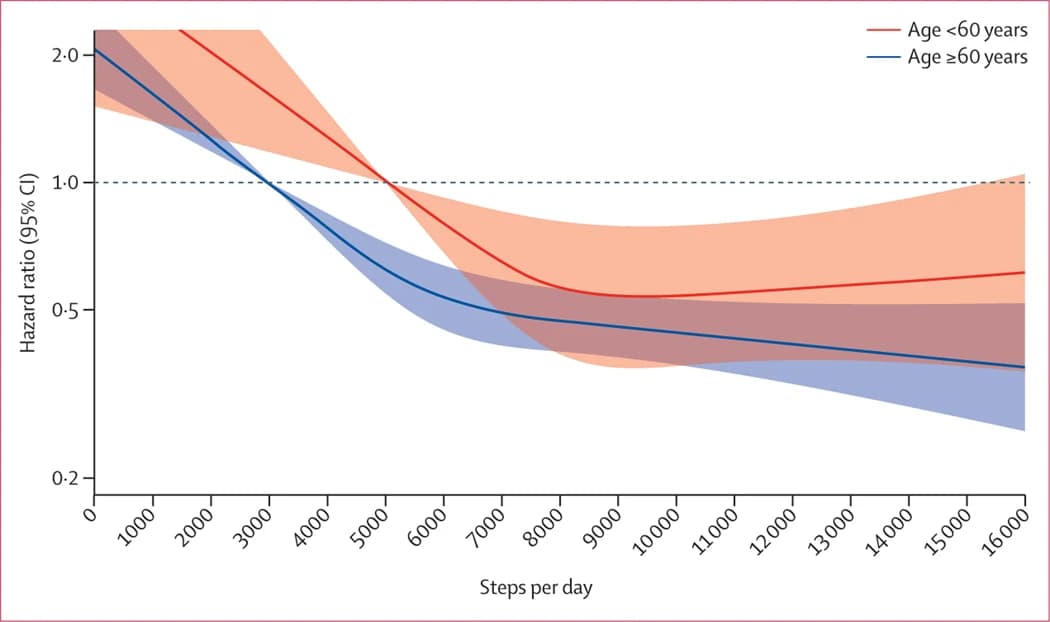
Pooling 15 cohorts (47,471 adults, 3,013 deaths, median follow-up 7.1 years), the second, third and fourth quartiles of daily steps (medians 5,801, 7,842 and 10,901) had hazard ratios for death of 0.60, 0.55 and 0.47 against the lowest quartile (median 3,553). The curve flattened at about 6,000 to 8,000 steps a day for adults aged 60 and over and 8,000 to 10,000 for younger adults. The data are observational, from a single week of step counting, mostly with waist-worn research devices.
Study design
Observational meta-analysis
Reading basis
Full text
Reading focus
Design & applicability
The research question
The goal of 10,000 steps a day is widely promoted, but the authors say it is not based on evidence and instead originates from a marketing campaign in Japan. Phones and fitness trackers now make daily steps easy to monitor, and the WHO 2020 and US 2018 physical activity guidelines both identified a gap in knowledge about how the amount and intensity of activity relate to health outcomes. Earlier studies pointed to different plateaus (about 7,500 steps a day in women aged 62 and over, and about 8,000 to 12,000 in US and Norwegian adults aged 40 and over), and a previous meta-analysis of seven studies found a linear relationship with large heterogeneity and no breakdown by age, sex or stepping rate. This analysis set out to pool more studies to test how steps per day relate to all-cause mortality, whether the relationship differs by age and sex, and, as a secondary question, how stepping rate relates to mortality.
Who and how
This was a meta-analysis carried out with The Steps for Health Collaborative, an international consortium. Studies were found in two ways: a previously published systematic review (MEDLINE, Embase, CINAHL and Cochrane Library searched to 1 August 2019), which found five eligible studies, too few for a meta-analysis, and additional published and unpublished studies known to members of the collaborative. Fifteen studies were included, seven published and eight unpublished, with start dates between 1999 and 2018: eight in the USA, four in Europe, one each in Japan and Australia, and one with data from 40 countries. In total there were 47,471 adults aged 18 or older (mean age 65.0 years, SD 12.4; 32,226 women [68%]; more than 70% White). In each study, participants wore a step-counting device for one week, mostly at the waist, and were then followed for death; investigators processed their own participant-level data under a standardised protocol. Seven studies also reported stepping rate: the peak 30-minute and 60-minute rates (the highest number of steps accumulated in any 30 or 60 minutes of a day, not necessarily consecutive) and the minutes a day spent at 40 steps per minute or faster (intentional walking) or 100 steps per minute or faster (moderate pace).
The outcome was all-cause mortality from death certificates and country registries: 3,013 deaths (10.1 per 1000 participant-years) over a median follow-up of 7.1 years (IQR 4.3 to 9.9; 297,837 person-years). Each study ran Cox models using study-specific quartiles of steps per day with the lowest quartile as reference. The primary model 2 adjusted for age, sex, race and ethnicity, education or income, body-mass index, study-specific chronic disease covariates, self-rated health or function, device wear time and lifestyle factors such as smoking and alcohol; model 1 adjusted only for age and sex. Hazard ratios were pooled with inverse-variance weighted random-effects models, with analyses by age (under 60 versus 60 and over) and sex planned in advance. Restricted cubic splines (knots at the 25th, 50th and 75th percentiles) described the dose-response curve, excluding one study whose data processing inflated step counts. For stepping rate, model 3 added adjustment for steps per day. Sensitivity analyses excluded deaths in the first 2 years, split studies by follow-up length (under 6 years versus 6 years or longer) and by publication status, left out each study and each device in turn, and used fixed-effects models.
What it found
- 1Taking more steps was associated with lower mortality, with the steepest drop at the low end. Compared with the lowest quartile (median 3,553 steps a day), the adjusted hazard ratio was 0.60 (95% CI 0.51 to 0.71) for quartile 2 (median 5,801), 0.55 (0.49 to 0.62) for quartile 3 (7,842) and 0.47 (0.39 to 0.57) for quartile 4 (10,901). The curve was non-linear (P for non-linearity <0.0001), with the lowest hazard ratio at about 7,000 to 9,000 steps a day in the overall sample.
- 2Where the benefit levels off depended on age. Risk stopped falling at about 6,000 to 8,000 steps a day for adults aged 60 and over and about 8,000 to 10,000 for adults younger than 60 (interaction P=0.012). The older group also walked less to begin with: a median of 5,649 steps a day (IQR 3,686 to 8,092) against 7,803 (5,377 to 10,352) in under-60s (P=0.033).
- 3Women and men looked alike. Hazard ratios were similar, the sex interaction was not significant (P=0.11), and the lowest hazard ratio fell at about 7,000 to 9,000 steps a day in both.
- 4Pace mattered in some forms but not others once steps were accounted for. Comparing the lowest and highest quartiles after adjusting for steps per day, the peak 30-minute rate (HR 0.67, 95% CI 0.56 to 0.83) and peak 60-minute rate (0.67, 0.50 to 0.90) stayed linked to lower mortality, but time at 40 steps per minute or faster (1.12, 0.96 to 1.32) and at 100 steps per minute or faster (0.86, 0.58 to 1.28) did not. The median peak 30-minute rate was 64.1 steps per minute (IQR 52.9 to 80.5), and the authors call the evidence for extra benefit of intensity inconclusive.
- 5The association was stronger in studies with shorter follow-up and in published studies. Comparing the lowest and highest quartiles, the hazard ratio was 0.32 (0.25 to 0.41) in the six studies with under 6 years of follow-up and 0.57 (0.49 to 0.66) in the nine with 6 years or more. Comparing the first and second quartiles, it was 0.54 (0.42 to 0.68) in published and 0.73 (0.63 to 0.85) in unpublished studies. Excluding early deaths weakened but did not remove the association, and dropping any one study or device made no appreciable difference.
- 6The authors did not find that high step volumes were associated with higher mortality risk. Funnel plots showed minor asymmetry for the second and third quartile comparisons, Egger's test suggested no study selection bias, and heterogeneity (I2) across quartiles was low to moderate, 0 to 57%.
Limits & uncertainty
- 1The authors note that the data are observational, so causation cannot be inferred, and that residual confounding and reverse causality might remain despite adjustment. Steps were measured once, over a single week, so changes in walking over time are not captured.
- 2The authors note that they used study-level data, so differences between studies in participants, devices and covariates may not be fully accounted for. The pre-specified spline knots risk model misspecification, and only all-cause mortality was examined.
- 3The authors note that all studies were in high-income countries and the participants were volunteers, mainly White, which limits generalisability.
- 4The authors note that step counts from research and consumer devices can differ by 20% or more, that most studies used waist-worn devices whereas many consumer devices are worn on the wrist, and that devices may undercount steps at very slow speeds, particularly in frail older adults. Stepping rate was measured per minute, which may miss short walks.
- 5In our reading, the age-specific plateaus are ranges read from curves, and the size of the association varied with follow-up length and publication status, so the exact thresholds and the strength of the association are uncertain. The stronger link in short follow-up could also reflect people who walked little because they were already ill.
What to take from it
The steepest part of the curve was at the low end: moving from the lowest quartile (median 3,553 steps a day) to the second (median 5,801) went with a hazard ratio of 0.60. The benefit did not require 10,000 steps: for adults aged 60 and over the curve flattened at about 6,000 to 8,000 steps a day, and for younger adults at about 8,000 to 10,000. Whatever your current count, a step up from a low base is where the largest difference appeared, and the authors found no sign of harm at higher counts.
The results do not show that more steps will cut your own risk by the proportions shown, which are group-level, observational comparisons from one week of counting. They are also not an official target: the authors state there are currently no evidence-based public health guidelines recommending a number of steps per day. The evidence on pace beyond total steps is inconclusive. Confidence is reasonable because the pattern held across 15 studies and when any one was removed, but the cohorts were volunteers, mostly White and from high-income countries.
Reading your own data
Use the weekly average of daily steps from one device and compare your own multi-week trend, as the studies averaged all days of one week. Step counts from research and consumer devices can differ by 20% or more, and wrist-worn devices may differ from the waist-worn devices most studies used, so treat thresholds as ranges rather than exact cut-offs. If your app shows pace, the peak 30-minute rate (the fastest stretch of walking in a day) was the measure that stayed linked to mortality after adjusting for steps; the study median was 64.1 steps per minute. Weeks with illness, travel or charging gaps will pull the average down and are not comparable.
How to read this evidence
Pooling observational studies does not remove their confounding. Check overlapping cohorts and whether relative effects are being confused with absolute benefits.
Authors’ structured abstract English
The attributed English abstract is reproduced under the recorded open licence. It is source material, not a MoveVitals interpretation. The prepared analysis above separates the authors’ findings from our interpretation.
Background
Although 10 000 steps per day is widely promoted to have health benefits, there is little evidence to support this recommendation. We aimed to determine the association between number of steps per day and stepping rate with all-cause mortality.
Methods
In this meta-analysis, we identified studies investigating the effect of daily step count on all-cause mortality in adults (aged ≥18 years), via a previously published systematic review and expert knowledge of the field. We asked participating study investigators to process their participant-level data following a standardised protocol. The primary outcome was all-cause mortality collected from death certificates and country registries. We analysed the dose-response association of steps per day and stepping rate with all-cause mortality. We did Cox proportional hazards regression analyses using study-specific quartiles of steps per day and calculated hazard ratios (HRs) with inverse-variance weighted random effects models.
Findings
We identified 15 studies, of which seven were published and eight were unpublished, with study start dates between 1999 and 2018. The total sample included 47 471 adults, among whom there were 3013 deaths (10·1 per 1000 participant-years) over a median follow-up of 7·1 years ([IQR 4·3-9·9]; total sum of follow-up across studies was 297 837 person-years). Quartile median steps per day were 3553 for quartile 1, 5801 for quartile 2, 7842 for quartile 3, and 10 901 for quartile 4. Compared with the lowest quartile, the adjusted HR for all-cause mortality was 0·60 (95% CI 0·51-0·71) for quartile 2, 0·55 (0·49-0·62) for quartile 3, and 0·47 (0·39-0·57) for quartile 4. Restricted cubic splines showed progressively decreasing risk of mortality among adults aged 60 years and older with increasing number of steps per day until 6000-8000 steps per day and among adults younger than 60 years until 8000-10 000 steps per day. Adjusting for number of steps per day, comparing quartile 1 with quartile 4, the association between higher stepping rates and mortality was attenuated but remained significant for a peak of 30 min (HR 0·67 [95% CI 0·56-0·83]) and a peak of 60 min (0·67 [0·50-0·90]), but not significant for time (min per day) spent walking at 40 steps per min or faster (1·12 [0·96-1·32]) and 100 steps per min or faster (0·86 [0·58-1·28]).
Interpretation
Taking more steps per day was associated with a progressively lower risk of all-cause mortality, up to a level that varied by age. The findings from this meta-analysis can be used to inform step guidelines for public health promotion of physical activity.
Funding
US Centers for Disease Control and Prevention.
Sources & attribution
Daily steps and all-cause mortality: a meta-analysis of 15 international cohorts
Paluch AE, Bajpai S, Bassett DR, Carnethon MR, Ekelund U, Evenson KR, Galuska DA, Jefferis BJ, Kraus WE, Lee IM, Matthews CE, Omura JD, Patel AV, Pieper CF, Rees-Punia E, Dallmeier D, Klenk J, Whincup PH, Dooley EE, Pettee Gabriel K, Palta P, Pompeii LA, Chernofsky A, Larson MG, Vasan RS, Spartano N, Ballin M, Nordström P, Nordström A, Anderssen SA, Hansen BH, Cochrane JA, Dwyer T, Wang J, Ferrucci L, Liu F, Schrack J, Urbanek J, Saint-Maurice PF, Yamamoto N, Yoshitake Y, Newton RL, Yang S, Shiroma EJ, Fulton JE, Steps for Health Collaborative.
The Lancet Public Health · 2022-03
DOI: 10.1016/S2468-2667(21)00302-9 ↗PubMed · 35247352 ↗Europe PMC · Recorded licence: cc by ↗Abstract © the original authors, reproduced under the recorded open licence. Translations support reading; use the English record to check terminology and numerical results. Our methodological interpretation is separate from the authors’ conclusions.
MoveVitals editorial interpretation · educational content · no individual clinical review recorded
Sources checked 2026-11-01
Practical guides
Read in context
7,000 steps a day linked to lower risk of death, heart disease and dementia than 2,000
Compared with 2000 steps a day, 7000 steps was associated with a hazard ratio of 0.53 (95% CI 0.46 to 0.60) for all-cause mortality across 14 studies, 0.75 (0.67 to 0.85) for cardiovascular disease and 0.62 (0.53 to 0.73) for dementia; cancer incidence was not significantly different (0.94, 0.87 to 1.01). Several outcomes rest on only two to four studies, and the certainty of evidence ranged from moderate to very low.
The Lancet Public Health
Brief bursts of vigorous effort in daily life linked to lower mortality in non-exercisers
Among 25,241 UK Biobank adults who reported no leisure-time exercise, a median of 3 vigorous bouts of 1 or 2 minutes a day, picked up by a wrist accelerometer, was associated with a 38% to 40% lower risk of all-cause and cancer death and a 48% to 49% lower risk of cardiovascular death than no such bouts, over an average of 6.9 years and 852 deaths. This is an observational study using one week of wrist data and an algorithm to define vigorous effort, so it cannot show that adding such bursts causes the lower risk.
Nature Medicine
Accelerometers on 36,383 adults: any activity, even light, linked to lower mortality
In eight pooled cohorts (36,383 adults, mean age 62.6 years, 2,149 deaths over a median 5.8 years), the most active quarter by accelerometer-measured total activity had a mortality hazard ratio of 0.27 (95% CI 0.23 to 0.32) against the least active, and the most sedentary quarter had 2.63 (1.94 to 3.56). Light activity alone showed the same pattern, with 0.38 (0.28 to 0.51) in the top quarter. These are observational associations in adults aged 40 and over from the US and western Europe, so illness-driven inactivity and confounding cannot be excluded.
BMJ
Older women who took more steps died less often, with gains levelling near 7,500 a day
Among 16,741 US women with a mean age of 72.0 years, mortality was lower in every higher step quartile than in the lowest (median 2,718 steps a day): hazard ratios were 0.59, 0.54 and 0.42 for medians of 4,363, 5,905 and 8,442. Mortality stopped falling at about 7,500 steps a day, and once total steps were accounted for, stepping intensity showed no significant link in the main comparisons. This is an observational study with a mean follow-up of 4.3 years, so it shows an association, not that walking more extends life.
JAMA Internal Medicine