

Key takeaway
Pooling 33 observational studies of 96,173 adults, higher daily step counts went with fewer depressive symptoms, and in the two prospective cohorts that could be pooled, 7000 or more steps a day went with a lower risk of depression than fewer (RR 0.69, 95% CI 0.62-0.77). Most studies were cross-sectional, so low mood may be reducing steps as much as steps affect mood, and the authors say the prediction intervals call for caution.
Study design
Observational meta-analysis
Reading basis
Full text
Reading focus
Design & applicability
The research question
Depressive disorders affect over 330 million people worldwide, and even symptoms below the clinical threshold are tied to lower quality of life and a considerable likelihood of progressing to clinical depression. Earlier research suggested that physical activity protects against depression and that light activity such as walking may be enough.
Step counts are a simple, objective measure that wearable trackers now make easy to follow, and earlier meta-analyses had linked more steps to lower risk of cardiovascular disease and death from any cause. Expert committees (the 2018 US Department of Health and Human Services and the 2020 World Health Organization) had asked for evidence on other health outcomes, and no meta-analysis had yet looked at tracker-measured steps and depression. The authors set out to pool the observational evidence on objectively measured daily steps and depression in the general adult population.
Who and how
This is a systematic review and meta-analysis of observational studies, published in JAMA Network Open in 2024, reported under the PRISMA and MOOSE guidelines and registered in PROSPERO. The authors searched PsycINFO, PubMed, Scopus, SPORTDiscus and Web of Science from inception to July 14, 2023, updated the search to May 18, 2024, and also used Google Scholar and citation searching, with no language or date limits. Eligible studies enrolled general adults aged 18 or older, measured daily steps objectively with accelerometers, pedometers or smartphones, assessed depression as a diagnosis or as symptoms, and were cross-sectional, case-control or longitudinal. Of 10,296 studies screened, 33 were included: 27 cross-sectional and 6 longitudinal (3 panel studies and 3 prospective cohorts), published between 2004 and 2023. They covered 96,173 adults (54.5% female) in 13 countries across Asia, Europe, North America, Oceania and South America, with mean ages from 18.6 to 91.2 years. Mean daily steps ranged from 2931 to 10,378. Most studies measured steps over 7 days (range 3 to 365), panel studies followed people for a mean of 2 to 5 years and prospective cohorts for 1.8 to 7.4 years, and cohort studies excluded people who had depression at baseline.
Depression was recorded as a diagnosis or as self-reported symptoms. Two reviewers independently selected studies, extracted data and rated quality with the National Heart, Lung, and Blood Institute tool. Steps were analysed continuously (more steps per day) and in categories harmonized with the Tudor-Locke classification, using fewer than 5000 steps a day as the reference. Results were pooled by study design with random-effects (Sidik-Jonkman) models and expressed as correlation coefficients (r), standardized mean differences (SMD, where negative values mean fewer symptoms), and risk ratios (RR) and odds ratios (OR) where depression was a yes-or-no outcome. Heterogeneity was measured with I² and 95% prediction intervals. The authors also ran subgroup analyses (age group, sex, device type and position, acceleration axis, study quality), meta-regression on mean age, sex and BMI, leave-one-out and COVID-19-lockdown sensitivity analyses, and Egger tests with funnel plots for publication bias.
What it found
- 1Adults who took more steps reported fewer depressive symptoms. The correlation was r −0.12 (95% CI −0.20 to −0.04) across 19 cross-sectional studies and −0.17 (95% CI −0.28 to −0.04) across 3 panel studies, which follow the same people over time. These are small correlations.
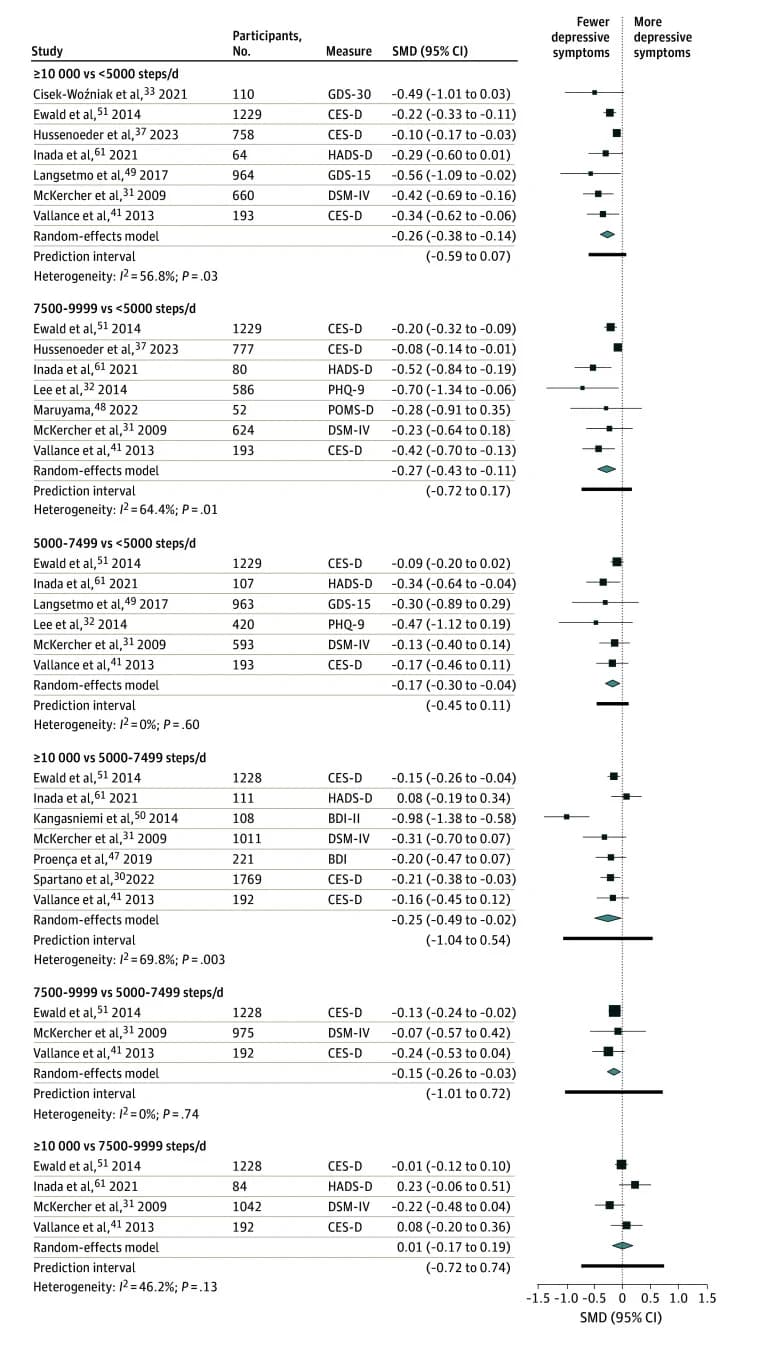
- 2Even moderate step counts went with fewer symptoms than fewer than 5000 steps a day, and the benefit leveled off at the higher end. In cross-sectional studies the SMD was −0.17 (95% CI −0.30 to −0.04; 6 studies) for 5000 to 7499 steps, −0.27 (95% CI −0.43 to −0.11; 7 studies) for 7500 to 9999 and −0.26 (95% CI −0.38 to −0.14; 7 studies) for 10,000 or more. The two highest groups look alike, and the authors say adding steps beyond about 10,000 may not bring further significant reductions, though they cannot establish a ceiling.
- 3Splitting the studies at 7500 steps a day gave a similar answer: 7500 or more versus fewer than 7500 went with fewer symptoms (SMD −0.30, 95% CI −0.44 to −0.16; 12 studies). When depression was treated as a yes-or-no outcome, 7500 or more steps went with lower odds of depression (OR 0.58, 95% CI 0.39 to 0.86; 4 studies), which the authors describe as a 42% lower prevalence.
- 4In prospective cohorts, which follow adults who did not have depression at the start, 7000 or more steps a day versus fewer than 7000 went with a lower risk of developing depression (RR 0.69, 95% CI 0.62 to 0.77; 2 studies). Each additional 1000 steps a day went with a lower risk (RR 0.91, 95% CI 0.87 to 0.94; 2 studies). The authors express these as 31% and 9% lower risk, but each rests on only two studies.
- 5The pattern held in most subgroups examined. It appeared in all age groups, in women and men, in good- and fair-quality studies and with waist-worn accelerometers and pedometers. No significant differences were found between subgroups, and age, sex and BMI did not significantly change the association in cross-sectional studies. Leave-one-out analyses and excluding studies done during COVID-19 lockdowns left the main results unchanged.
Limits & uncertainty
- 1The authors note that reverse associations are possible and that causal conclusions cannot be drawn. Depression itself lowers energy and motivation, so people with more symptoms may walk less, which would produce the same pattern.
- 2The authors note substantial heterogeneity between studies in some pooled estimates (for example I² of 65.4% for both the continuous cross-sectional correlation and the 7500-step split), partly attributed to differences in participants and step-counting devices. They also say their 95% prediction intervals mean the conclusions should be treated with caution.
- 3The authors note that residual confounding cannot be ruled out, for example from forms of activity that do not register as steps, or chronic stress, and that most studies lacked robust methods. They add that the high-quality-only subgroup showed a smaller pooled estimate and less heterogeneity than the fair-quality studies (not significant), and that the cross-sectional 7500-step comparison may be affected by publication bias.
- 4Our observation: the evidence is mostly cross-sectional (27 of 33 studies), only 3 were prospective cohorts, and only 2 fed each pooled longitudinal estimate. Of the cross-sectional studies, 6 were rated good quality, 19 fair and 2 poor. Depression was mostly self-reported symptoms and steps were usually measured over about 7 days, so one short window stands in for long-term habits.
- 5Our observation: the SMDs between −0.17 and −0.30 are modest and the paper does not translate them into points on a depression scale or say what difference would matter to an individual. Step categories were harmonized across studies that used different devices, wear positions and thresholds.
What to take from it
People who walk more tend to report fewer depressive symptoms, and the link appeared at fairly modest levels: even 5000 to 7499 steps a day went with fewer symptoms than fewer than 5000. That makes a gradual, achievable increase a sensible goal, and you do not need to reach 10,000 steps to be on the favorable side of this pattern.
The analysis does not show that adding steps prevents or treats depression, and the thresholds of 7000 or 7500 steps are not targets proven to work for any individual. A persistent drop in mood, interest or energy deserves a conversation with a clinician, whatever your step count. Overall certainty is limited: the direction is consistent, but most data are cross-sectional and the prospective evidence comes from two studies.
Reading your own data
Use the weekly average of your daily steps from one device worn the same way, since most studies in the review measured steps over about 7 days, and compare it with a regular mood check-in rather than reading single days. Trackers differ by wear position (wrist, waist, phone in a pocket) and counting algorithm, so a new device will change your baseline. A sustained fall in steps can be a consequence of low mood, illness or travel, not only a cause, so treat it as a prompt to check in with yourself. Daily step counts say nothing on their own about whether someone has depression.
How to read this evidence
Pooling observational studies does not remove their confounding. Check overlapping cohorts and whether relative effects are being confused with absolute benefits.
Sources & attribution
Daily Step Count and Depression in Adults: A Systematic Review and Meta-Analysis
JAMA Network Open · 2024-12-02
DOI: 10.1001/jamanetworkopen.2024.51208 ↗PubMed · 39680407 ↗MoveVitals editorial interpretation · educational content · no individual clinical review recorded
Sources checked 2026-11-01
Practical guides
Read in context
Exercise gave small-to-moderate cognitive gains across 133 reviews of trials
An umbrella review of 133 systematic reviews (2724 trials, 258,279 participants) found that exercise improved general cognition (SMD 0.42, 95% CI 0.37 to 0.47), memory (0.26) and executive function (0.24), with the largest memory gains in children and adolescents and the largest executive function gains in people with ADHD. Most of the reviews (94) were rated critically low in quality and the effects were smaller in the best-rated ones (0.23 for general cognition), and the outcomes were test scores, not dementia.
British Journal of Sports Medicine
Exercise eased depression in 218 trials, but confidence in the evidence is low
In a network meta-analysis of 218 trials with 14,170 people who met criteria for major depression, walking or jogging, yoga, strength training, mixed aerobic exercise and tai chi or qigong each gave moderate reductions in depression compared with active controls (walking or jogging: Hedges' g −0.62, 95% credible interval −0.80 to −0.45). Confidence in the evidence was low for walking or jogging and very low for the other treatments, mainly because only one study met the low-risk-of-bias criteria.
BMJ
Physical activity eased depression and anxiety across 97 reviews of trials
Across 97 systematic reviews that pooled 1039 randomized trials with 128,119 participants, physical activity had medium effects on depression (median effect size −0.43) and anxiety (−0.42) compared with usual care, and higher-intensity activity went with larger gains. Most of those reviews (77) were rated critically low in quality, and the evidence mainly concerns mild-to-moderate symptoms.
British Journal of Sports Medicine
Strength training eased depressive symptoms in 33 trials, but blinded trials found less
Pooling 33 randomized trials with 1877 participants, resistance exercise training was followed by a moderate reduction in depressive symptoms compared with non-active control conditions (mean effect size 0.66, 95% CI 0.48 to 0.83; P < .001). Trials that blinded allocation and/or assessment found smaller reductions, and results differed a great deal between trials (I² 76.0%), so the true effect is likely smaller and less certain than the headline number.
JAMA Psychiatry