

Idea principal
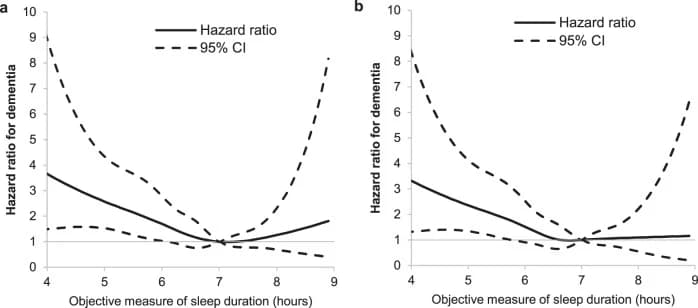
In 7959 British civil servants followed for about 25 years, sleeping six hours or less at age 50 (HR 1.22, 95% CI 1.01–1.48) or age 60 (HR 1.37, 1.10–1.72) was linked to a higher dementia rate than sleeping seven hours, and persistent short sleep gave an HR of 1.30 (1.00–1.69). Sleep was mostly self-reported and the study is observational, so early brain disease or other factors may explain part of the link.
Study design
Estudio de cohorte
Reading basis
Full text
Reading focus
Association & confounding
Esta explicación editorial está disponible en inglés, chino simplificado y chino tradicional. Esta interfaz muestra la lectura en inglés.
Pregunta de investigación
Sleep changes are common in people with dementia and are believed to come from the disease process itself, so the harder question is whether sleep earlier in life relates to dementia later. Much of the existing evidence follows people for under 10 years or starts at 65 and older, yet most dementias develop over 20 years or more, so early disease can already be changing sleep before anyone is diagnosed. Earlier studies also often had too few short or long sleepers for precise estimates, and mental health, which affects both sleep and cognition, needed a closer look. The authors set out to test whether sleep duration at ages 50, 60 and 70, and the pattern of change between 50 and 70, was associated with later dementia, whether mental disorders explained the link, and whether a wrist-accelerometer measure of sleep would agree with self-report.
Población y método
This was a prospective cohort study within Whitehall II, which recruited 10,308 British civil servants (33.1% women, aged 35–55) in 1985–1988 and followed them with clinical visits every 4–5 years until 2015–2016, plus linkage to National Health Service (NHS) electronic health records through 31 March 2019. Sleep duration came from one questionnaire item, ‘how many hours of sleep do you have on an average weeknight?’, asked at six waves between 1985–1988 and 2015–2016 (answers: 5 h or less, 6, 7, 8, 9 h or more). The authors took each person’s answer at age 50, 60 and 70 (allowing a ±5-year margin) and grouped it as short (6 h or less), normal (7 h, the comparison group) or long (8 h or more). The main analysis included 7959 people with sleep and covariate data at age 50 (mean age 50.6, SD 2.6), 7164 at age 60 and 6516 at age 70. Sleep trajectories between 50 and 70 were built for 6875 people who were alive and dementia-free at 70 with at least two of three measures, using group-based trajectory modelling, which gave six groups. A sub-study of 3888 participants aged 60–83 wore a GENEActiv wrist accelerometer for nine consecutive days in 2012–2013; sleep was estimated over 7 nights with a validated algorithm guided by a sleep log and split into thirds (tertiles).
Dementia was identified by linkage to three national registers (hospital episode statistics, the Mental Health Services Data Set and the mortality register) using ICD-10 codes F00-F03, F05.1, G30 and G31, and the first record gave the date. In the hospital data the sensitivity and specificity for dementia are reported as 78.0% and 92.0%. Of the 7959 people at age 50, 521 developed dementia over a mean follow-up of 24.6 years (SD 7.0), at a mean age of 77.1 at diagnosis. Analyses used Cox regression with age as the timescale, censoring at dementia, death or 31 March 2019, and adjusted in steps: sociodemographic factors, then health behaviours (smoking, alcohol, physical activity, fruit and vegetables), then health factors (BMI, hypertension, diabetes, cardiovascular disease, depressive symptoms and central nervous system medication). Sensitivity analyses excluded people with a mental disorder before 65, used inverse-probability weighting for missing data, added APOE ε4 genotype and tried a proxy for Alzheimer’s dementia; the last two were exploratory. A two-sided P value of 0.05 or less counted as significant.
Resultados
- 1Short sleep at 50 and 60 went with a higher dementia rate than seven hours of sleep. Fully adjusted, the hazard ratio for 6 h or less was 1.22 (95% CI 1.01–1.48, P = 0.04) at age 50, with 211 cases among 3149 short sleepers versus 219 among 3624 normal sleepers, and 1.37 (1.10–1.72, P = 0.005) at age 60, with 192 of 2759 versus 142 of 2988.
- 2At age 70 the estimate was similar but imprecise (HR 1.24, 95% CI 0.98–1.57, P = 0.10), so the interval includes no effect. Dementia rates per 1000 person-years were 2.8 versus 2.4 at age 50, 4.7 versus 3.2 at 60 and 9.3 versus 6.8 at 70 for short versus normal sleepers; follow-up length differs by age (24.6, 14.8 and 7.5 years), so the three ages should not be compared with each other.
- 3Being a short sleeper at every check-in carried the clearest signal across time. Persistent short sleep at 50, 60 and 70 compared with persistent normal sleep gave an HR of 1.30 (95% CI 1.00–1.69, P = 0.048), with 103 cases among 1358 people versus 141 among 2520, and rates of 10.5 versus 7.3 per 1000 person-years. The other patterns were not significantly different: persistent long sleep 1.28 (0.88–1.85), short to normal 1.20 (0.89–1.63), normal to short 1.13 (0.79–1.62) and normal to long 1.02 (0.73–1.42).
- 4Wrist-accelerometer data pointed the same way. Among 3888 people with 111 dementia cases over a mean 6.4 years, the shortest third of sleepers (1 h 16 min to 6 h 13 min) had an HR of 1.63 (95% CI 1.04–2.57) against the middle third (6 h 14 min to 7 h 0 min), while the longest third (7 h 1 min to 10 h 6 min) had 0.78 (0.46–1.32). Questionnaire and accelerometer sleep durations correlated at 0.41 (P < 0.001).
- 5Long sleep (8 h or more) showed no clear link. The HRs were 1.25 (0.98–1.60, P = 0.07) at age 50, 1.15 (0.87–1.52) at 60 and 1.15 (0.88–1.51) at 70, and the accelerometer analysis also showed no raised risk for sleep over 8 h.
- 6Mental health did not explain the association, but the numbers moved with the method. Adjustment for behaviours and health factors shrank estimates (age 60: from 1.48, 95% CI 1.19–1.84, to 1.37). Excluding people with mental disorders before 65 gave 1.25 (1.03–1.53) at 50 and 1.28 (1.02–1.62) at 60, while persistent short sleep became 1.29 (0.98–1.69, P = 0.06). With inverse-probability weighting for missing data, the age 50 HR was 1.21 (0.99–1.48, P = 0.06) and persistent short sleep 1.24 (0.94–1.64), the same direction but no longer clearly significant. Adding APOE ε4 changed nothing.
Límites e incertidumbre
- 1The authors note that dementia was found through electronic health records, which can miss milder cases (sensitivity 78.0% and specificity 92.0% in the hospital data), that dementia subtype was incomplete in the records, and that their Alzheimer’s proxy (dementia without stroke or heart attack) may not be precise. The APOE and Alzheimer’s analyses were exploratory.
- 2The authors note that the observational design cannot rule out residual confounding despite many adjustments, and that Whitehall II participants were all employed at recruitment and are healthier than the general population. They also say there were too few long sleepers to judge long sleep.
- 3Our observation: sleep was a single self-reported weeknight answer in whole hours, with 5 h or less lumped in with 6 h as ‘short’, and it says nothing about sleep quality, apnoea or weekends. The wrist-accelerometer check covers only 111 cases and 6.4 years of follow-up in people aged 60–83, a window in which early dementia could itself alter sleep.
- 4Our observation: several findings sit near the line. Persistent short sleep has a lower confidence limit of 1.00 and P = 0.048, the age 50 estimate loses significance with inverse-probability weighting (P = 0.06), and the age 70 estimate is not significant after full adjustment (P = 0.10). The 1987 people left out for missing data were older and more likely to develop dementia (6.6% versus 4.0%).
- 5Our observation: people who moved from short to normal sleep did not clearly have lower risk (HR 1.20, 0.89–1.63), so the data do not show that fixing sleep reduces risk.
Relevancia práctica
Seven hours a night had the lowest dementia rate at every age measured, and regularly sleeping six hours or less in your 50s and 60s went with a higher relative rate, and persistent short sleep with a 30% higher one. That is a modest relative difference, and the rates were small in absolute terms at 50 (2.8 versus 2.4 per 1000 person-years). If you are habitually short of sleep and not by choice, or are tired in the day, it is a sound reason to raise it with a clinician; decisions about sleep problems or treatment belong with them.
The study does not show that adding an hour of sleep prevents dementia. Brain changes begin decades before diagnosis and may themselves disturb sleep, and nobody was assigned to sleep more or less. It also does not show that long sleep is safe or harmful, and one short night is not a sign of brain damage. Certainty is moderate for the association and low for any causal story.
Tus datos
A wearable gives a nightly estimate, so look at your average over several weeks, including weekends, rather than single nights, since this study classified people by usual sleep and by whether it persisted across decades. The accelerometer and questionnaire agreed only moderately (0.41), so do not expect a watch total to match how you would answer a survey; compare yourself with yourself on the same device. Illness, travel and new medication will all pull a few weeks of data off your normal. A sleep average is not a dementia risk score.
Cómo interpretar la evidencia
Exposure precedes follow-up outcomes, but confounding and reverse causation can remain. A hazard ratio is not an individual absolute risk or a demonstrated intervention effect.
Fuentes y atribución
Association of sleep duration in middle and old age with incidence of dementia
Nature Communications · 2021-04-20
DOI: 10.1038/s41467-021-22354-2 ↗PubMed · 33879784 ↗Interpretación editorial de MoveVitals · contenido educativo · sin revisión clínica individual registrada
Fuentes verificadas 2026-11-01
Guías prácticas
Leer en contexto
Exercise improved sleep-quality scores in adults 45 and older with sleep disorders
Pooling 23 randomized trials with 1,478 adults aged 45 to 77 who had sleep disorders, exercise improved Pittsburgh Sleep Quality Index scores (SMD 0.62, 95% CI 0.40–0.83), and aerobic exercise showed the largest effect in the network analysis (SMD 1.34, 95% CrI 0.86–1.82). Certainty was low to moderate, the outcomes were questionnaires, and the best weekly dose of about 539 MET-min/week is a model estimate, not a prescription.
Journal of Exercise Science & Fitness
Sleep regularity tracked mortality more closely than sleep duration in 60,977 UK adults
Among 60,977 UK Biobank adults who wore a wrist accelerometer for a week, the most regular fifth of sleepers had a fully adjusted all-cause mortality HR of 0.70 (95% CI 0.59–0.83) against the least regular fifth, over about 6.3 years and 1859 deaths. Regularity fitted the data better than sleep duration, but the study is observational and rests on one week of sleep data.
Sleep
Sleep extension cut daily energy intake by about 270 kcal in adults with overweight
In 80 adults with overweight who usually slept under 6.5 hours, two weeks of sleep-extension counselling added about 1.2 hours of sleep and lowered measured energy intake by 270.4 kcal/d versus control (95% CI −393.4 to −147.4). The trial was short, single-centre and in a narrow group, so it does not show lasting weight loss or any benefit for people who already sleep enough.
JAMA Internal Medicine
Students with irregular sleep had later melatonin timing and lower grades
Among 61 Harvard undergraduates tracked for about 30 days, the most irregular sleepers had melatonin onset at 00:08 versus 21:32 in the most regular sleepers (p < 0.003), and sleep regularity correlated with grade point average (r = 0.37, p < 0.004). The sample was small and the design observational, so the data cannot show that irregular sleep lowers grades or shifts the body clock.
Scientific Reports