

Idea principal
In 80 adults with overweight who usually slept under 6.5 hours, two weeks of sleep-extension counselling added about 1.2 hours of sleep and lowered measured energy intake by 270.4 kcal/d versus control (95% CI −393.4 to −147.4). The trial was short, single-centre and in a narrow group, so it does not show lasting weight loss or any benefit for people who already sleep enough.
Study design
Ensayo aleatorizado
Reading basis
Full text
Reading focus
Comparator & uncertainty
Esta explicación editorial está disponible en inglés, chino simplificado y chino tradicional. Esta interfaz muestra la lectura en inglés.
Pregunta de investigación
Short sleep is a recognised risk factor for obesity and prospective studies link it to weight gain, but it was unknown whether lengthening sleep can prevent or reverse obesity. Laboratory studies of sleep restriction find that people eat about 250 to 350 kcal/d more with little change in energy expenditure, yet those studies used extreme restriction and measured intake at one or a few meals, which is not real life. Small daily differences matter: according to dynamic prediction models, a sustained 100 kcal/d rise in intake would add about 4.5 kg over 3 years. The trial tested whether a sleep-extension intervention at home changes objectively assessed energy intake, energy expenditure and body weight in adults with overweight who habitually curtail their sleep.
Población y método
This was a single-centre, parallel-group randomised clinical trial at the University of Chicago, run from November 2014 to October 2020 and registered on ClinicalTrials.gov (NCT02253368). Eligible adults were aged 21 to 40 years, had a BMI between 25.0 and 29.9, stable sleep habits for 6 months and habitual sleep under 6.5 hours per night, confirmed by a week of wrist actigraphy; people with obstructive sleep apnoea (apnoea-hypopnoea index above 5), insomnia, other sleep disorders or shift work were excluded. Of 210 adults assessed, 81 were randomised and 1 was later found ineligible, leaving 80 (40 per group; mean age 29.8, SD 5.1; 41 men and 39 women). After a 2-week baseline of habitual sleep, block randomisation stratified by sex assigned people to a 2-week sleep-extension group or a control group. The extension group had one individualised sleep-hygiene counselling session aimed at extending time in bed to 8.5 hours, plus a check-in on day 22; controls kept their habitual sleep and attended the same visits without advice. Everyone continued normal routines at home with no prescribed diet or exercise, and participants were told only that the study concerned sleep habits and metabolism.
The primary outcome was change in energy intake from baseline, calculated by the energy-balance principle as total energy expenditure plus change in body energy stores. Total energy expenditure was measured with doubly labeled water; change in energy stores came from the slope of daily home weights on a cellular scale (hidden from participants) plus fat mass and fat-free mass changes from dual-energy x-ray absorptiometry. Sleep was tracked throughout the 4 weeks with an Actiwatch Spectrum Plus actigraph. Analysis followed the intention-to-treat principle with linear mixed-effects models for the group-by-period interaction (the difference in change from baseline), plus analysis of covariance as a robustness check and models adjusted for sex or menstrual cycle. No multiplicity adjustment or imputation was used. The planned 80 participants gave 80% power to detect a 207 kcal/d difference in intake.
Resultados
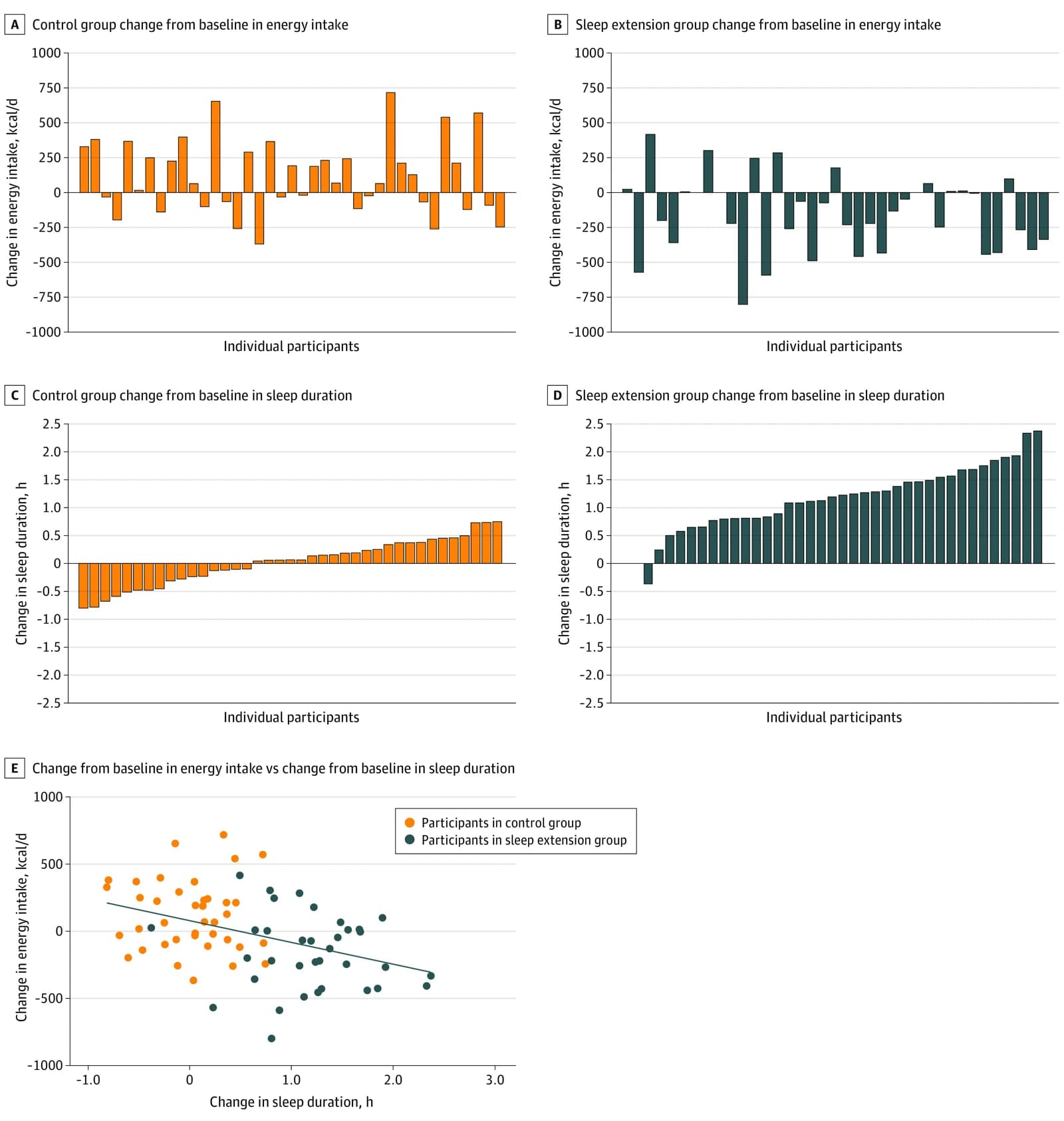
- 1The counselling worked: the extension group slept about 1.2 hours longer per night than controls (95% CI 1.0 to 1.4, P < 0.001), 1.3 hours longer on workdays (1.0 to 1.5) and 1.1 hours longer on free days (0.7 to 1.5). Sleep efficiency, the share of time in bed spent asleep, did not differ between groups (P = 0.48).
- 2Energy intake fell by 270.4 kcal/d more in the extension group than in controls (95% CI −393.4 to −147.4, P < 0.001). Within groups, intake rose by 114.9 kcal/d in controls (29.6 to 200.2) and fell by 155.5 kcal/d in the extension group (−244.1 to −66.9), so part of the between-group gap came from controls eating more.
- 3More extra sleep went with a bigger drop in intake. Across all participants the change in sleep duration was inversely correlated with the change in energy intake (r = −0.41, 95% CI −0.59 to −0.20, P < 0.001), and each additional hour of sleep went with 162.3 kcal/d less intake (95% CI −246.8 to −77.7, P < 0.001).
- 4Energy expenditure did not change significantly, so the balance tipped negative. Total energy expenditure differed by −53.9 kcal/d between groups (95% CI −134.9 to 27.1, P = 0.19), and activity energy expenditure by −17.9 kcal/d (−112.1 to 76.3, P = 0.71). Energy balance was −211.1 kcal/d lower in the extension group (−335.4 to −86.8, P = 0.001).
- 5Weight was lower with sleep extension at two weeks: −0.87 kg versus control (95% CI −1.39 to −0.35, P = 0.001), from a gain of 0.39 kg in controls and a loss of 0.48 kg in the extension group. Fat mass differed by −0.25 kg (−0.39 to −0.10, P = 0.001) and fat-free mass by −0.62 kg (−1.02 to −0.23, P = 0.002), so most of the weight difference was not fat.
- 6Results were similar after adjusting for sex or menstrual cycle. Fasting resting metabolic rate differed slightly (−32.5 kcal/d, 95% CI −64.5 to −0.5, P = 0.047), while the postprandial rate (P = 0.41) and thermic effect of the meal (P = 0.54) did not. The extension group also reported more daytime energy, more alertness and better mood (supplementary table).
Límites e incertidumbre
- 1The authors note that they enrolled adults with overweight under selective eligibility criteria, which may limit generalisability, and that the trial gives no information on how long healthy sleep habits could be kept up. The rise in intake and weight in the control group may have contributed to the treatment effect.
- 2The authors note that the doubly labeled water method has a precision of 5%, which adds uncertainty to the calculated energy intake. They did not systematically assess what changed sleep behaviour, though cutting back on electronic devices seemed key, and did not assess food frequency, the circadian timing of eating or the biological mechanisms.
- 3Our observation: the intervention lasted two weeks, and the weight difference was mostly fat-free mass rather than fat, a pattern the authors call consistent with short-term changes in body composition. The trial cannot say whether the effect on intake lasts, and the authors’ projection of about 12 kg lost over 3 years rests on a model that assumes a sustained effect.
- 4Our observation: intake is derived from expenditure and weight change, not recorded as food, so the trial cannot say what or when people ate. Participants in the extension group knew after counselling that sleep was the focus, so changes in eating through other routes cannot be excluded. Complete intake data were available for 75 of 80 people (90.0% in the extension group versus 97.5% in controls) and no correction was made for multiple outcomes.
Relevancia práctica
In people who regularly slept under 6.5 hours, getting about an hour more sleep over two weeks went with a measured drop in energy intake of roughly 270 kcal a day and a lower weight than the control group. That makes sleep a reasonable habit to protect when you are working on weight, particularly if you are a habitual short sleeper. It looks like one useful part of a weight plan, not a replacement for one.
It does not show that sleeping more will make you lose weight over months or years. The weight difference was small, mostly not fat, and measured at two weeks, and the 12 kg projection is a modelling extrapolation, not a result. The trial does not apply to people who already sleep 7 to 9 hours, to other age groups or to people with sleep disorders. Anyone managing obesity or a sleep problem should take decisions on treatment to a clinician. Certainty is moderate for the two-week effect on intake and low for the long-term outcome.
Tus datos
Compare like with like: record your usual sleep from a wearable for about two weeks, then a second two-week stretch while you deliberately extend time in bed, as the trial did with a 2-week baseline. Wearable sleep totals come from motion-based estimates, so judge change within the same device and compare weekly averages rather than single nights. Morning weight under the same conditions is the useful companion number; menstrual cycle and illness shift weight over days. Calorie burn and food-log numbers from apps cannot reproduce the doubly labeled water and body-scan measurements used here, so do not read a calorie deficit off your device.
Cómo interpretar la evidencia
Randomisation can support causal inference, but check allocation, blinding, missing outcomes, follow-up and the actual comparator. A trial label alone does not establish high certainty.
Resumen estructurado de los autores English
El resumen original en inglés se reproduce con atribución bajo la licencia indicada. Es una fuente, no una interpretación de MoveVitals. El análisis preparado figura arriba; verifica los resultados importantes en la fuente.
Importance
Short sleep duration has been recognized as a risk factor for obesity. Whether extending sleep duration may mitigate this risk remains unknown.
Objective
To determine the effects of a sleep extension intervention on objectively assessed energy intake, energy expenditure, and body weight in real-life settings among adults with overweight who habitually curtailed their sleep duration.
Design, setting, and participants
This single-center, randomized clinical trial was conducted from November 1, 2014, to October 30, 2020. Participants were adults aged 21 to 40 years with a body mass index (calculated as weight in kilograms divided by height in meters squared) between 25.0 and 29.9 and had habitual sleep duration of less than 6.5 hours per night. Data were analyzed according to the intention-to-treat principle.
Interventions
After a 2-week habitual sleep period at baseline, participants were randomized to either an individualized sleep hygiene counseling session that was intended to extend their bedtime to 8.5 hours (sleep extension group) or to continue their habitual sleep (control group). All participants were instructed to continue daily routine activities at home without any prescribed diet or physical activity.
Main outcomes and measures
The primary outcome was change in energy intake from baseline, which was objectively assessed as the sum of total energy expenditure and change in body energy stores. Total energy expenditure was measured by the doubly labeled water method. Change in body energy stores was computed using regression of daily home weights and body composition changes from dual-energy x-ray absorptiometry. Sleep duration was monitored by actigraphy. Changes from baseline were compared between the 2 groups using intention-to-treat analysis.
Results
Data from 80 randomized participants (mean [SD] age, 29.8 [5.1] years; 41 men [51.3%]) were analyzed. Sleep duration was increased by approximately 1.2 hours per night (95% CI, 1.0 to 1.4 hours; P < .001) in the sleep extension group vs the control group. The sleep extension group had a significant decrease in energy intake compared with the control group (-270 kcal/d; 95% CI, -393 to -147 kcal/d; P < .001). The change in sleep duration was inversely correlated with the change in energy intake (r = -0.41; 95% CI, -0.59 to -0.20; P < .001). No significant treatment effect in total energy expenditure was found, resulting in weight reduction in the sleep extension group vs the control group.
Conclusions and relevance
This trial found that sleep extension reduced energy intake and resulted in a negative energy balance in real-life settings among adults with overweight who habitually curtailed their sleep duration. Improving and maintaining healthy sleep duration over longer periods could be part of obesity prevention and weight loss programs.
Trial registration
ClinicalTrials.gov Identifier: NCT02253368.
Fuentes y atribución
Effect of Sleep Extension on Objectively Assessed Energy Intake Among Adults With Overweight in Real-life Settings: A Randomized Clinical Trial
Tasali E, Wroblewski K, Kahn E, Kilkus J, Schoeller DA.
JAMA Internal Medicine · 2022-04-01
DOI: 10.1001/jamainternmed.2021.8098 ↗PubMed · 35129580 ↗Europe PMC · Licencia registrada: cc by ↗Abstract © the original authors, reproduced under the recorded open licence. Translations support reading; use the English record to check terminology and numerical results. Our methodological interpretation is separate from the authors’ conclusions.
Interpretación editorial de MoveVitals · contenido educativo · sin revisión clínica individual registrada
Fuentes verificadas 2026-11-01
Guías prácticas
Leer en contexto
Exercise improved sleep-quality scores in adults 45 and older with sleep disorders
Pooling 23 randomized trials with 1,478 adults aged 45 to 77 who had sleep disorders, exercise improved Pittsburgh Sleep Quality Index scores (SMD 0.62, 95% CI 0.40–0.83), and aerobic exercise showed the largest effect in the network analysis (SMD 1.34, 95% CrI 0.86–1.82). Certainty was low to moderate, the outcomes were questionnaires, and the best weekly dose of about 539 MET-min/week is a model estimate, not a prescription.
Journal of Exercise Science & Fitness
Sleep regularity tracked mortality more closely than sleep duration in 60,977 UK adults
Among 60,977 UK Biobank adults who wore a wrist accelerometer for a week, the most regular fifth of sleepers had a fully adjusted all-cause mortality HR of 0.70 (95% CI 0.59–0.83) against the least regular fifth, over about 6.3 years and 1859 deaths. Regularity fitted the data better than sleep duration, but the study is observational and rests on one week of sleep data.
Sleep
Six hours or less of sleep at 50 and 60 linked to higher dementia risk
In 7959 British civil servants followed for about 25 years, sleeping six hours or less at age 50 (HR 1.22, 95% CI 1.01–1.48) or age 60 (HR 1.37, 1.10–1.72) was linked to a higher dementia rate than sleeping seven hours, and persistent short sleep gave an HR of 1.30 (1.00–1.69). Sleep was mostly self-reported and the study is observational, so early brain disease or other factors may explain part of the link.
Nature Communications
Students with irregular sleep had later melatonin timing and lower grades
Among 61 Harvard undergraduates tracked for about 30 days, the most irregular sleepers had melatonin onset at 00:08 versus 21:32 in the most regular sleepers (p < 0.003), and sleep regularity correlated with grade point average (r = 0.37, p < 0.004). The sample was small and the design observational, so the data cannot show that irregular sleep lowers grades or shifts the body clock.
Scientific Reports